Comprehensive Guide to System of Equations Solver with Work
📋 In this guide
A system of equations solver with work is a powerful tool that helps students tackle the challenge of solving multiple equations simultaneously. This method is especially crucial when dealing with algebraic problems that require finding the values of variables that satisfy all given equations. Students often struggle with systems of equations because they involve multiple steps and require a solid understanding of algebraic principles. In this article, you will learn how to effectively use a system of equations solver with work, walking through the process step-by-step to ensure clarity and understanding.
The concept of solving systems of equations is foundational in algebra, and it’s often a stumbling block for students. Many find it difficult to keep track of the multiple variables and equations, leading to mistakes and frustration. However, by mastering the use of a system of equations solver with work, students can gain confidence and competence in handling these problems. This method not only helps in solving equations but also illustrates each step taken to reach the solution, providing valuable insights into the problem-solving process.
In this comprehensive guide, we will explore the essential steps to solve a system of equations, provide detailed examples, and discuss common mistakes to avoid. Additionally, we'll highlight real-world applications of these techniques and answer frequently asked questions to deepen your understanding. Whether you are preparing for an exam or tackling homework problems, understanding how to use a system of equations solver with work will undoubtedly enhance your mathematical skills.
Step-by-Step: How to Solve System Of Equations Solver With Work
Step 1: Identify the System of Equations
The first step in using a system of equations solver with work is to clearly identify the equations involved. This requires listing each equation and ensuring they are in a standard form, such as Ax + By = C. For instance, if you are given two equations like 2x + 3y = 12 and x - y = 1, you should note down these equations clearly. Understanding this initial setup is crucial as it forms the basis for applying any solving method.
Step 2: Choose a Solving Method
Once the system of equations is identified, the next step is to choose an appropriate solving method. The most common methods include substitution and elimination. Substitution involves solving one equation for one variable and then substituting this expression into the other equation. Elimination, on the other hand, involves adding or subtracting equations to eliminate one variable, making it easier to solve for the remaining variable. Each method has its advantages, and the choice often depends on the specific equations you are dealing with.
Step 3: Solve for One Variable
After selecting a method, proceed to solve for one variable. If using substitution, rewrite one of the equations to express one variable in terms of the other. If using elimination, manipulate the equations to cancel out one of the variables. For example, with the system 2x + 3y = 12 and x - y = 1, you might solve the second equation for x, giving x = y + 1, and substitute this into the first equation. This step is critical as it simplifies the system, making it manageable.
Step 4: Solve for the Remaining Variable and Verify
With one variable isolated, solve for its value and then substitute back to find the value of the other variable. After calculating both variables, it's essential to verify your solution by substituting these values back into the original equations to ensure they satisfy all conditions. This verification step is a crucial part of using a system of equations solver with work, as it confirms the accuracy of your solution.
🤖 Stuck on a math problem?
Take a screenshot and let our AI solve it step-by-step in seconds
⚡ Try MathSolver Free →Worked Examples
Example 1
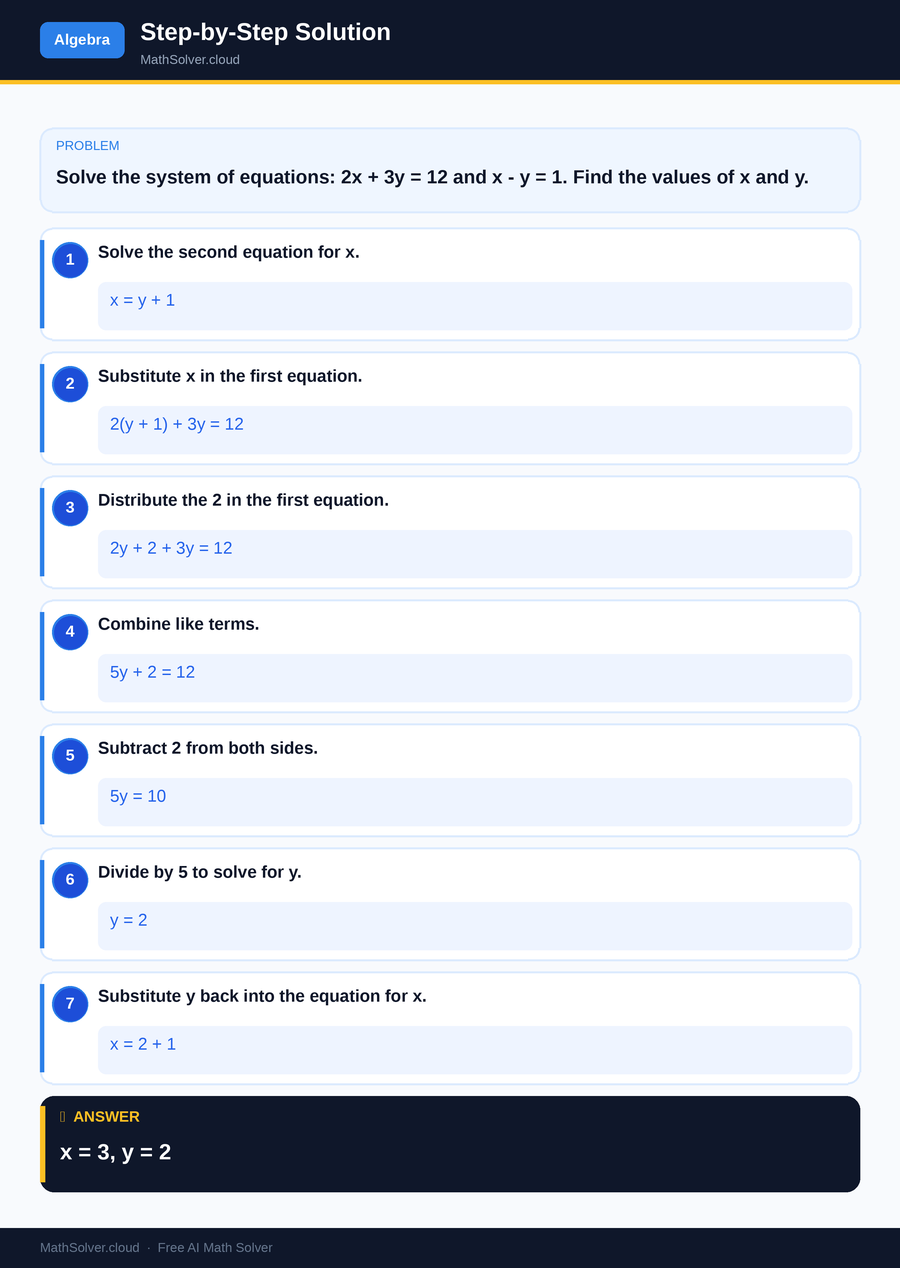
MathSolver Chrome extension solving this problem step-by-step
Example 2
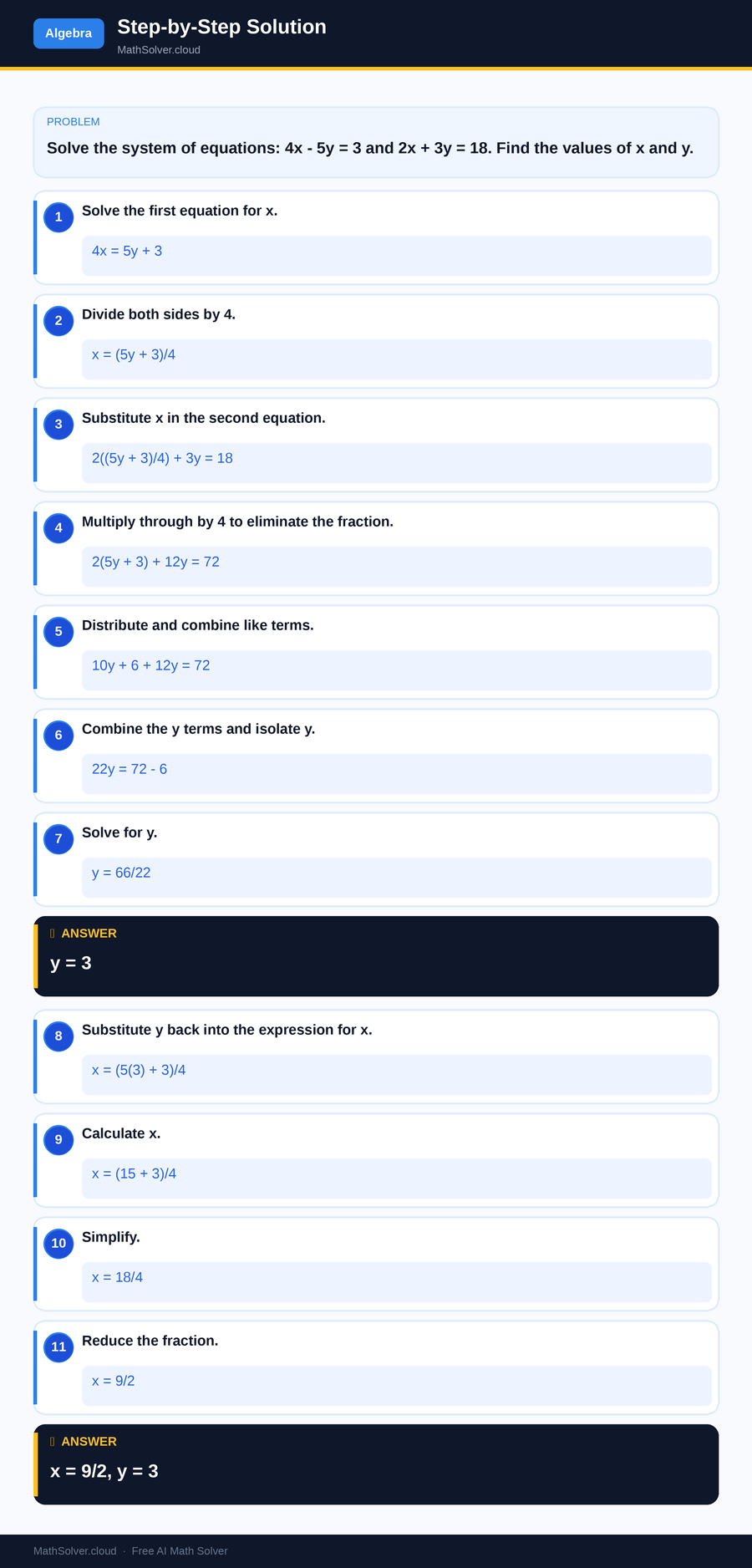
MathSolver Chrome extension solving this problem step-by-step
Common Mistakes to Avoid
One common mistake students make is not aligning the equations properly, which can lead to incorrect results. Always ensure that terms are correctly aligned and that you are consistent with the operations applied to each equation. Another frequent error is neglecting to verify the solution by substituting the values back into the original equations. Verification is crucial to confirm that the solution is correct.
Additionally, students sometimes confuse the methods of substitution and elimination, leading to unnecessary complexity. It’s important to clearly understand each method and decide which one is more efficient for the given problem. Practice and familiarity with these methods can help avoid such mistakes.
Real-World Applications
The system of equations solver with work is not just an academic exercise; it has real-world applications. For instance, in economics, systems of equations are used to model supply and demand scenarios, helping businesses determine optimal pricing and production levels. Similarly, engineers use these systems to solve kinematic equations, which describe the motion of objects.
In the field of computer science, systems of equations can be used in algorithms for data analysis and machine learning, where multiple variables and constraints need to be considered simultaneously. Understanding how to solve these systems effectively can provide valuable skills applicable in various professional fields.
Frequently Asked Questions
❓ What is a system of equations solver with work?
❓ Why do students find systems of equations challenging?
❓ How can AI help with system of equations solver with work?
❓ What are the benefits of using a system of equations solver with work in exams?
❓ Can system of equations solvers assist with advanced topics like algebra 2.0?
🚀 Solve any math problem instantly
2,000+ students use MathSolver every day — join them for free
📥 Add to Chrome — It's Free