Comprehensive Guide to Quadratic Equations
📋 In this guide
A quadratic equation is a type of polynomial equation of the second degree, characterized by the presence of a squared term as its highest power. Students often find quadratic equations challenging due to their complexity and the various methods required for solving them. However, understanding this fundamental algebraic concept is crucial for success in higher-level math courses and standardized tests. In this article, you will learn the essential aspects of quadratic equations, including their key formula, a step-by-step guide to solving them, and practical applications in real life.
Quadratic equations are an integral part of the algebra curriculum and are often encountered in courses like Algebra 1 and Algebra 2.0. They are also a significant component of various exams, including the Algebra 1 Regents and the Edmentum Mastery Test Answers Algebra 1. By mastering quadratic equations, students can enhance their problem-solving skills and build a solid foundation for more advanced mathematical concepts.
Throughout this guide, we will explore the core principles of quadratic equations, provide detailed examples of solving them, and address common pitfalls. Additionally, we will discuss how modern tools, such as the MathSolver Chrome extension, can assist students in tackling these equations efficiently. Whether you're a student looking to improve your algebra skills or a math enthusiast seeking deeper understanding, this comprehensive article will serve as an invaluable resource.
Step-by-Step: How to Solve Quadratic Equation
Step 1: Understanding the Structure of a Quadratic Equation
Before solving a quadratic equation, it's essential to identify the values of "a," "b," and "c" in the equation ax^2 + bx + c = 0. Recognizing these coefficients allows you to apply the quadratic formula correctly. For instance, in the equation 2x^2 - 8x + 6 = 0, we identify "a" as 2, "b" as -8, and "c" as 6. This step sets the groundwork for correctly applying the quadratic formula or other solving techniques.
Step 2: Calculating the Discriminant
The discriminant, represented by the expression b^2 - 4ac, is a crucial element in determining the nature and number of solutions for a quadratic equation. By calculating the discriminant, you can ascertain whether the equation has two distinct real solutions, one real solution, or complex solutions. A positive discriminant indicates two real solutions, zero indicates one real solution, and a negative value suggests two complex solutions.
Step 3: Applying the Quadratic Formula
Once you have the coefficients and the discriminant, you can apply the quadratic formula: x = (-b ± sqrt(b^2 - 4ac)) / (2a). This formula provides the solutions to the quadratic equation by incorporating the values of "a," "b," and "c" into the formula. Solving the quadratic equation using this method requires careful arithmetic to ensure accuracy, especially when dealing with negative numbers and square roots.
Step 4: Verifying the Solutions
After calculating the solutions using the quadratic formula, it's crucial to verify your results by substituting the solutions back into the original equation. This step ensures that no arithmetic errors were made and that the solutions satisfy the equation. Verification provides confidence in your answer and reinforces your understanding of quadratic equations.
🤖 Stuck on a math problem?
Take a screenshot and let our AI solve it step-by-step in seconds
⚡ Try MathSolver Free →Worked Examples
Example 1
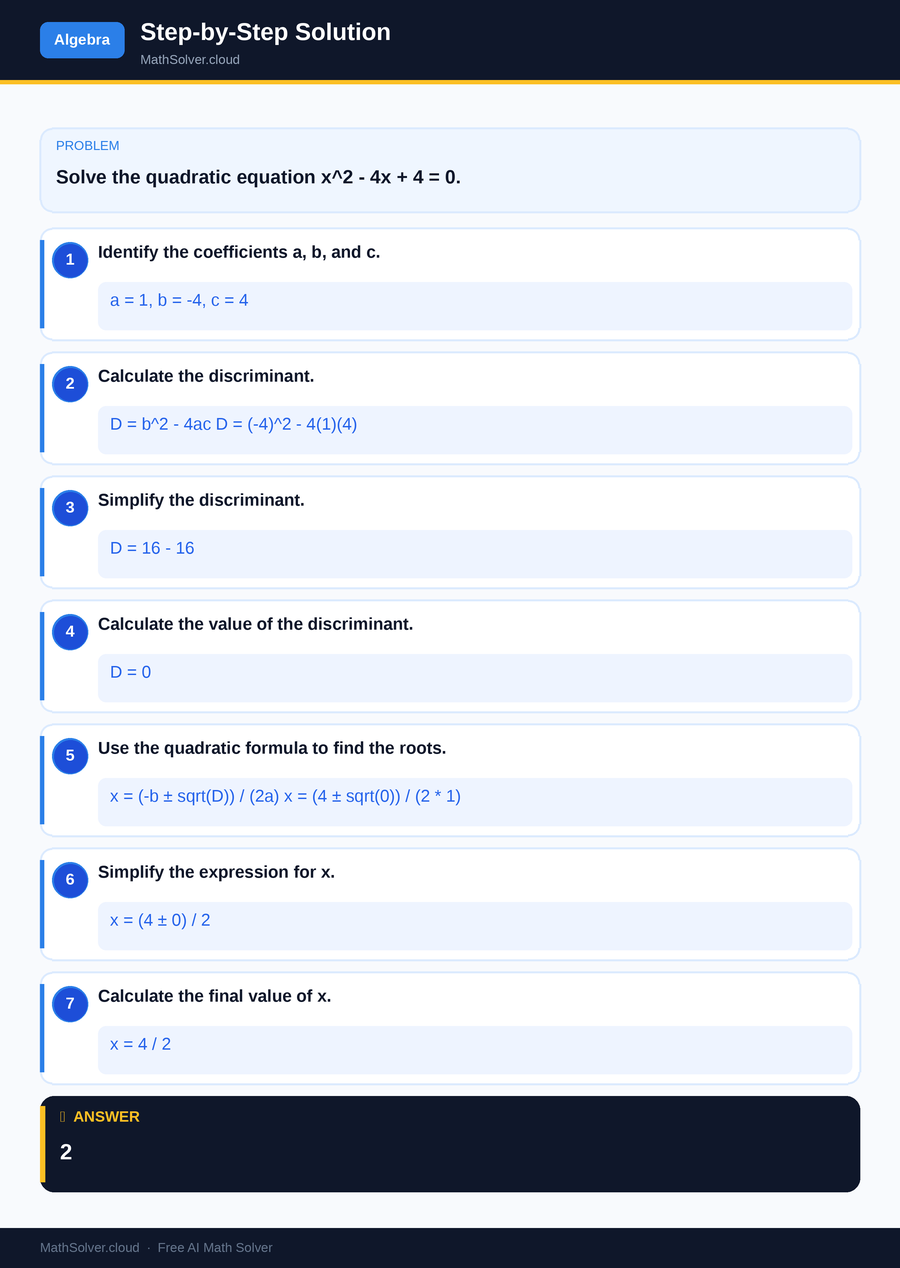
MathSolver Chrome extension solving this problem step-by-step
Example 2
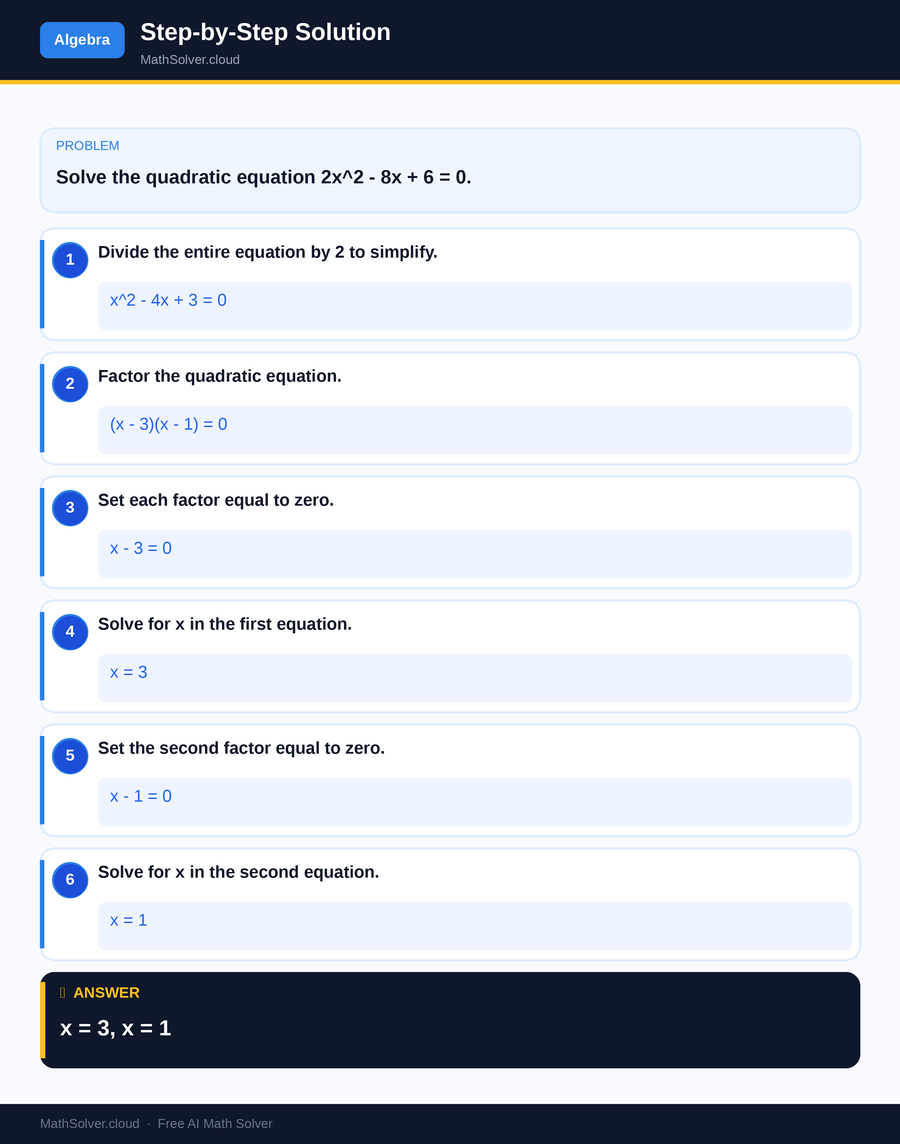
MathSolver Chrome extension solving this problem step-by-step
Common Mistakes to Avoid
One common mistake students make with quadratic equations is misidentifying the coefficients "a," "b," and "c." This error can lead to incorrect calculations in the quadratic formula, resulting in wrong solutions. To avoid this, carefully examine the equation and ensure each coefficient is correctly identified before proceeding with calculations.
Another frequent error is incorrect arithmetic, particularly when dealing with negative signs and square roots. When applying the quadratic formula, pay close attention to the signs and ensure calculations are accurate. Double-checking work and practicing with a quadratic equation calculator can help minimize errors and build confidence in solving these equations.
Real-World Applications
Quadratic equations have numerous real-world applications, making them essential for various fields. For instance, they are used in physics to model projectile motion, allowing scientists and engineers to predict the trajectory of objects. By understanding the principles of quadratic equations, professionals can design and analyze systems involving motion and forces.
In the field of economics, quadratic equations help model cost functions and optimize financial strategies. Businesses and economists use these equations to determine the most efficient use of resources, maximizing profits while minimizing costs. Mastery of quadratic equations empowers individuals to apply mathematical concepts to solve practical problems in diverse industries.
Frequently Asked Questions
❓ What is a quadratic equation, and why is it important?
❓ Why do students struggle with quadratic equations?
❓ How can AI help with quadratic equations?
❓ What are the different methods for solving quadratic equations?
❓ How can I verify my solutions to a quadratic equation?
🚀 Solve any math problem instantly
2,000+ students use MathSolver every day — join them for free
📥 Add to Chrome — It's Free