Understanding Algebra 2.0: A Comprehensive Guide
📋 In this guide
Algebra 2.0 is an advanced study of algebra that builds upon foundational concepts learned in Algebra 1, pushing students to explore more complex equations, functions, and systems. Students often find algebra 2.0 challenging due to its introduction of more abstract concepts and the integration of various mathematical branches. This course typically covers topics like quadratic functions, polynomials, rational expressions, logarithms, and sequences, among others. Mastery of algebra 2.0 is crucial for students aiming to pursue STEM fields, as it lays the groundwork for higher-level mathematics courses.
The struggle with algebra 2.0 often stems from its abstract nature and the need for a strong understanding of algebraic principles. Students must be comfortable with manipulating equations, understanding functions, and applying their knowledge to solve complex problems. The fear of making errors can also hinder their progress, but with practice and guidance, they can gain confidence. This article aims to demystify algebra 2.0 by offering clear explanations, step-by-step guides, and practical examples to aid understanding.
By the end of this exploration, students will have a better grasp of key algebra 2.0 concepts and will be equipped with strategies to tackle challenging problems. They will also learn about the real-world applications of algebra 2.0, discover common pitfalls to avoid, and gain insight into how digital tools, like the MathSolver Chrome extension, can support their learning journey.
Step-by-Step: How to Solve Algebra 2.0
Understanding Quadratic Equations
To effectively use the quadratic formula, it's essential to understand what a quadratic equation is. A quadratic equation is a polynomial equation of the second degree, typically written in the form ax^2 + bx + c = 0. The coefficients a, b, and c are constants, with 'a' not equal to zero. Quadratic equations can have two solutions, one solution, or no real solution, depending on the discriminant (b^2 - 4ac).
Identifying the Coefficients
Before applying the quadratic formula, identify the coefficients from your quadratic equation. For example, in the equation 2x^2 + 4x - 6 = 0, the coefficients are a = 2, b = 4, and c = -6. Correctly identifying these values is crucial, as they are directly substituted into the quadratic formula to find the solutions.
Applying the Quadratic Formula
Once you have identified the coefficients, substitute them into the quadratic formula: x = (-b ± sqrt(b^2 - 4ac)) / (2a). Calculate the discriminant (b^2 - 4ac) first to determine the nature of the roots. If the discriminant is positive, there are two distinct real roots. If it's zero, there is one real root. If negative, there are no real roots.
Solving and Verifying
After calculating the values of x using the quadratic formula, verify your solutions by substituting them back into the original equation. This ensures that your solutions satisfy the equation. Verification helps reinforce your understanding and increases confidence in tackling similar problems.
🤖 Stuck on a math problem?
Take a screenshot and let our AI solve it step-by-step in seconds
⚡ Try MathSolver Free →Worked Examples
Example 1
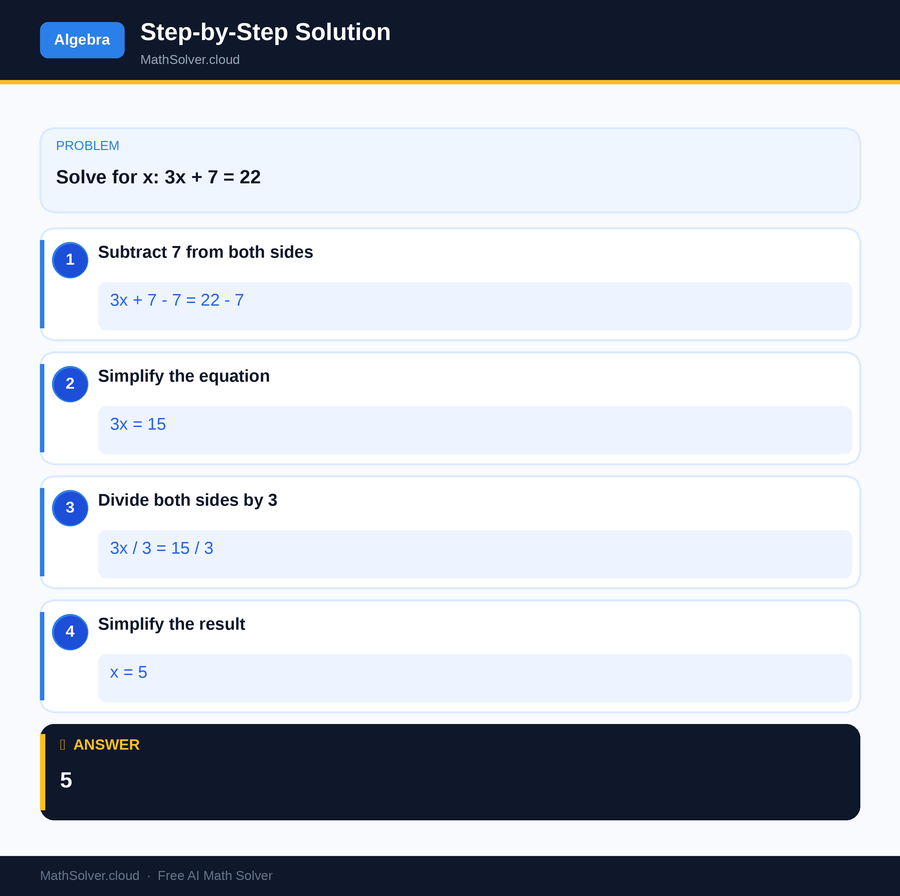
MathSolver Chrome extension solving this problem step-by-step
Example 2
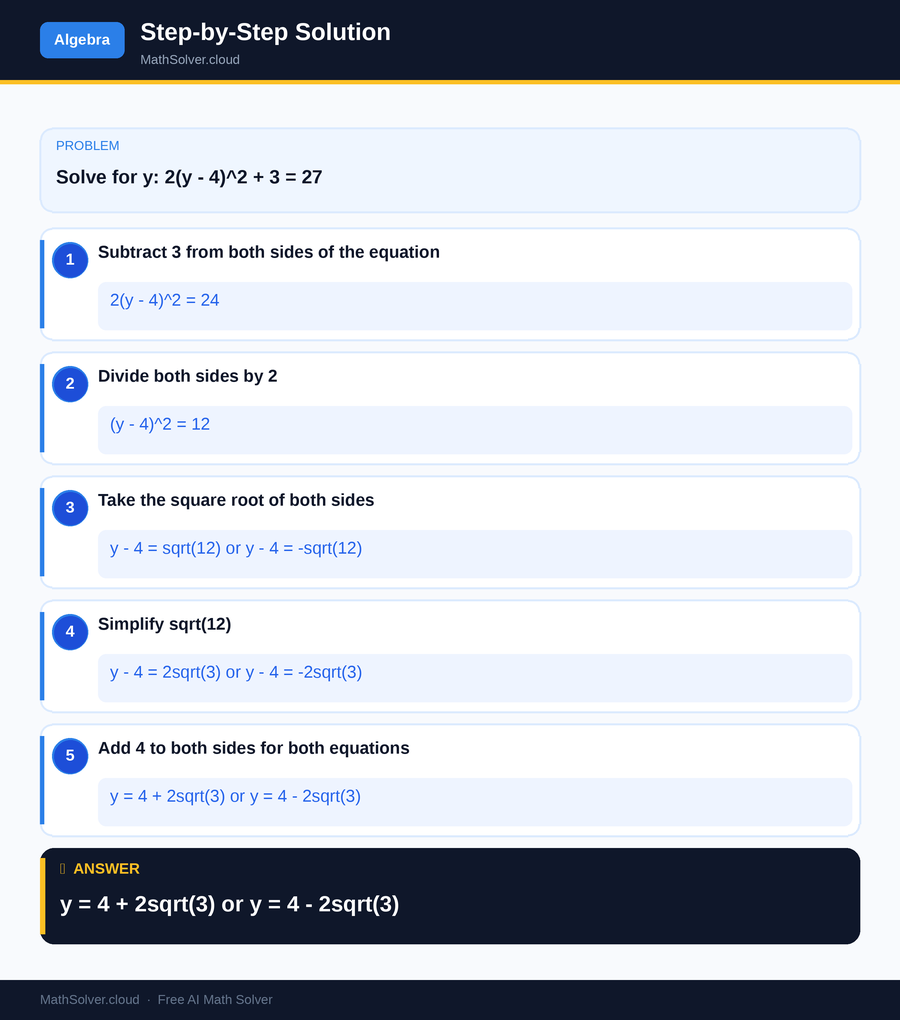
MathSolver Chrome extension solving this problem step-by-step
Common Mistakes to Avoid
A frequent mistake in algebra 2.0 is incorrectly identifying the coefficients in a quadratic equation, especially when the equation is not in standard form. Students should ensure the equation is in the form ax^2 + bx + c = 0 before determining the values of a, b, and c. Another common error is miscalculating the discriminant, leading to incorrect conclusions about the number of solutions. Carefully performing arithmetic operations can help avoid these errors.
Additionally, students may forget to verify their solutions by substituting the values back into the original equation. Verification is crucial as it confirms the accuracy of the solution and helps identify any arithmetic mistakes made during the process. Practicing these steps consistently can significantly reduce errors and improve problem-solving skills in algebra 2.0.
Real-World Applications
Algebra 2.0 is not just an academic exercise; it has numerous real-world applications. For instance, quadratic equations are used in physics to model the trajectory of projectiles, making them essential in fields like engineering and sports science. Understanding these equations allows professionals to predict the behavior of objects in motion accurately.
In economics, algebra 2.0 concepts like exponential functions and logarithms are used to model growth rates and compound interest. These mathematical tools help economists and financial analysts make informed predictions about market trends and investment outcomes. By mastering algebra 2.0, students can apply these concepts to solve practical problems in various industries.
Frequently Asked Questions
❓ What is algebra 2.0, and why is it important?
❓ Why do students find algebra 2.0 challenging?
❓ How can AI help with algebra 2.0?
❓ What are the key differences between algebra 1 and algebra 2.0?
❓ How can I improve my algebra 2.0 skills?
🚀 Solve any math problem instantly
2,000+ students use MathSolver every day — join them for free
📥 Add to Chrome — It's Free