Comprehensive Guide to the Algebra 1 Regents Exam
📋 In this guide
The algebra 1 regents exam is a standardized test that measures a student's understanding of algebraic concepts in New York State. It's a pivotal moment for students as it often determines their readiness for more advanced math courses. Many students find the algebra 1 regents challenging because it requires not only memorizing formulas but also understanding how to apply them to solve complex problems. Throughout the exam, students encounter questions that test their ability to manipulate equations, understand functions, and work with graphs.
In preparing for the algebra 1 regents, students will learn several key concepts such as solving linear equations, factoring polynomials, and understanding quadratic functions. Mastery of these topics is crucial as they form the foundation for higher-level mathematics. Additionally, students will develop critical thinking skills and problem-solving strategies that are applicable beyond the classroom.
Despite the challenges, succeeding in the algebra 1 regents is achievable with the right preparation and mindset. By familiarizing themselves with the types of questions and practicing consistently, students can gain confidence and improve their performance. This comprehensive guide will help you navigate through essential concepts, provide step-by-step solutions, and offer tips to avoid common pitfalls, setting you on the path to success.
Step-by-Step: How to Solve Algebra 1 Regents
Step 1: Understanding Linear Equations
To excel in the algebra 1 regents, start by mastering linear equations. A linear equation is any equation that can be written in the form ax + b = c. Begin by identifying the variable, coefficients, and constants. The goal is to isolate the variable on one side of the equation. This means you'll need to perform operations such as addition, subtraction, multiplication, or division to simplify the equation. Pay attention to maintaining balance by performing the same operation on both sides of the equation.
Step 2: Solving Systems of Equations
Systems of equations are a key component of the algebra 1 regents. These involve finding the point of intersection between two lines, which represents the solution that satisfies both equations. You can solve systems of equations using substitution, elimination, or graphing. Practice each method to determine which you find most efficient. Start by expressing one variable in terms of the other, if using substitution, or add and subtract equations to eliminate a variable if using elimination.
Step 3: Factoring Polynomials
Factoring polynomials is another important skill for the algebra 1 regents. This involves expressing a polynomial as a product of its factors. Begin by identifying the greatest common factor (GCF) of all terms. Then, use methods such as factoring by grouping or applying the difference of squares formula. Practice with a variety of polynomials, as this will help you recognize patterns and become more proficient in factoring.
Step 4: Working with Quadratic Equations
Quadratic equations, typically written in the form ax^2 + bx + c = 0, are a staple of the algebra 1 regents. To solve these, you can use factoring, completing the square, or the quadratic formula, which is x = (-b ± sqrt(b^2 - 4ac)) / 2a. Understanding when to apply each method is crucial. For example, if a quadratic is easily factorable, factoring may be the quickest method. However, for more complex equations, the quadratic formula is often preferred.
🤖 Stuck on a math problem?
Take a screenshot and let our AI solve it step-by-step in seconds
⚡ Try MathSolver Free →Worked Examples
Example 1
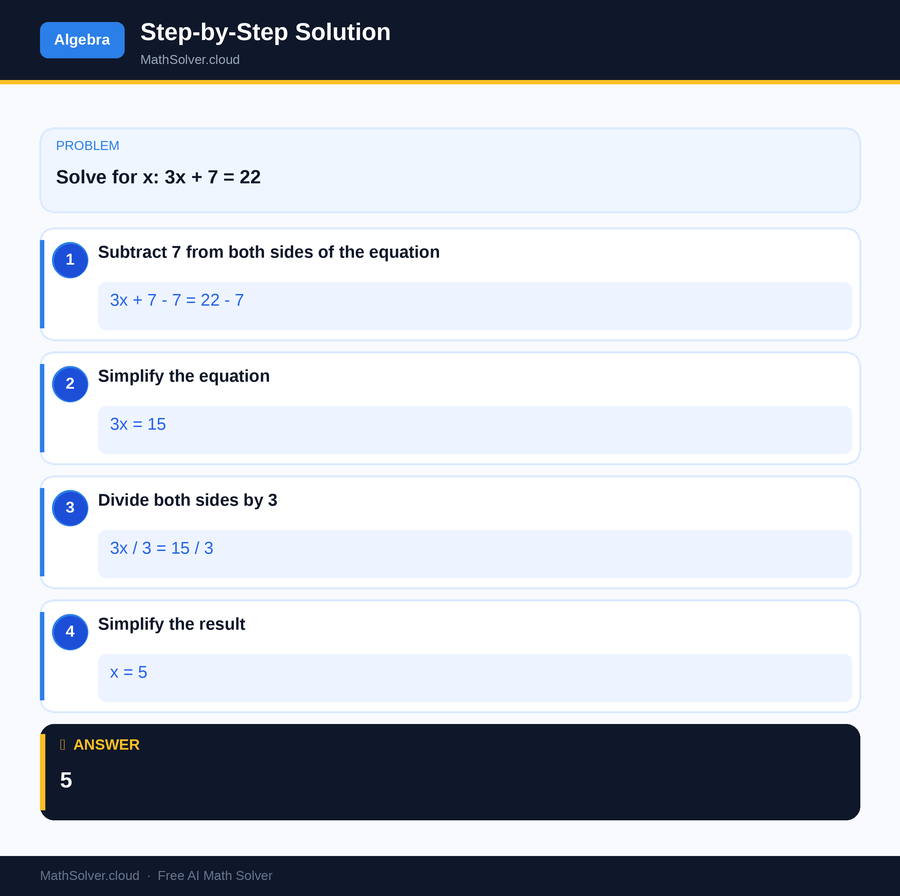
MathSolver Chrome extension solving this problem step-by-step
Example 2
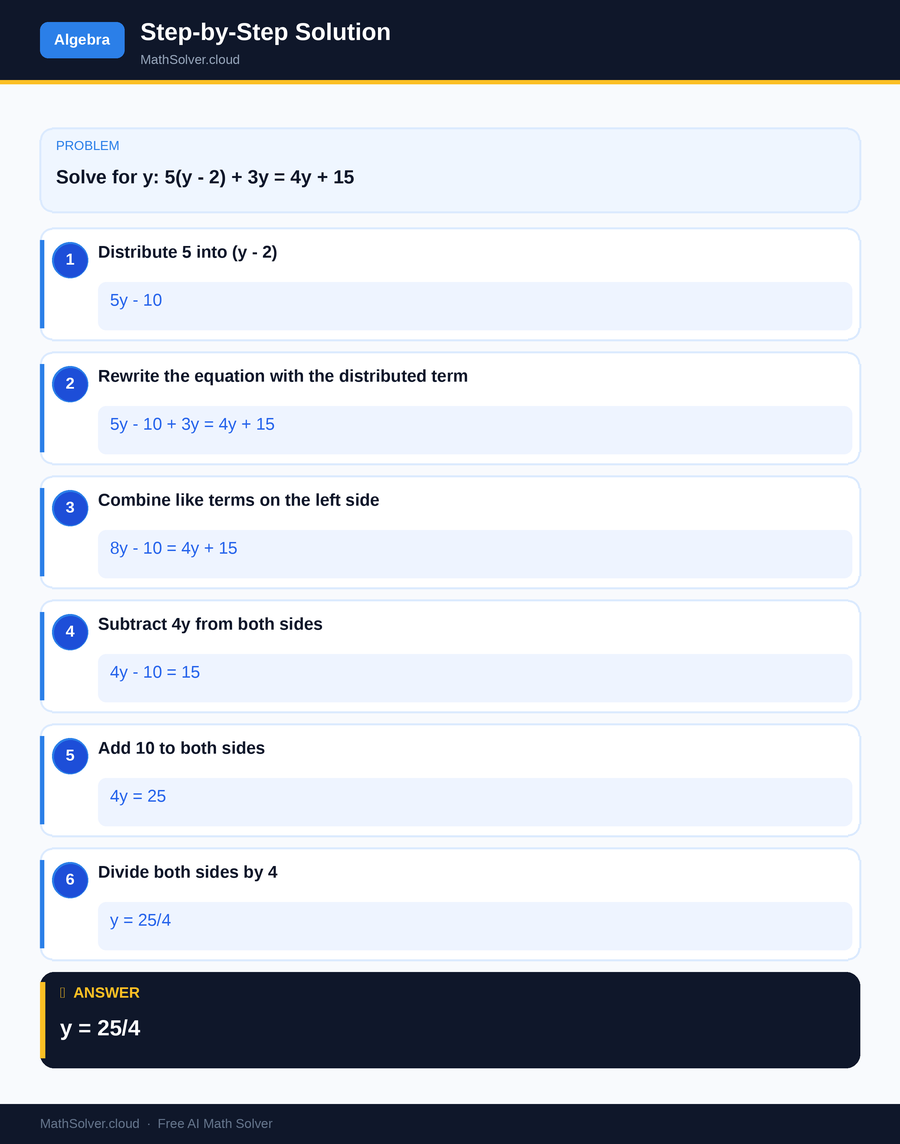
MathSolver Chrome extension solving this problem step-by-step
Common Mistakes to Avoid
One common mistake students make on the algebra 1 regents is neglecting the order of operations, also known as PEMDAS (Parentheses, Exponents, Multiplication and Division, Addition and Subtraction). Always follow this order to avoid errors in calculations. Another frequent error is forgetting to apply operations to both sides of an equation. This is crucial for maintaining the balance of the equation and arriving at the correct solution.
Another pitfall is not checking your solutions. After solving an equation, substitute your answer back into the original equation to verify its accuracy. This step helps catch mistakes and ensures that your solution is correct. Additionally, misreading the question or failing to understand what is being asked can lead to incorrect answers, so always read each problem carefully.
Real-World Applications
Algebra 1 regents concepts are not just for tests; they have real-world applications. For example, linear equations can be used to calculate distances and costs, making them vital in fields like engineering and economics. Understanding how to manipulate formulas allows professionals in these areas to solve practical problems efficiently.
Quadratic equations are used in physics to model the motion of objects under the influence of gravity, such as calculating the trajectory of a projectile. Factoring polynomials is essential in computer science algorithms and cryptography, where breaking down complex expressions into simpler parts can lead to more efficient code and secure communications.
Frequently Asked Questions
❓ What is the algebra 1 regents exam?
❓ Why do students struggle with algebra 1 regents?
❓ How can AI help with algebra 1 regents?
❓ What is the best way to prepare for the algebra 1 regents?
❓ How is the algebra 1 regents different from the edmentum mastery test?
🚀 Solve any math problem instantly
2,000+ students use MathSolver every day — join them for free
📥 Add to Chrome — It's Free