Mastering the System of Equations
📋 In this guide
A system of equations is a collection of two or more equations with a common set of unknowns. Understanding how to solve a system of equations is fundamental in algebra and is a skill that students often find challenging. The complexity arises from the need to find a solution that satisfies all the equations simultaneously, which can be particularly daunting when dealing with multiple variables or complex coefficients.
Students often struggle with systems of equations because the methods for solving them, such as substitution, elimination, and graphical analysis, can be intricate and require a solid understanding of algebraic fundamentals. As you learn how to solve these systems, you'll discover the importance of precision and strategy in algebra. This article will guide you through the key definitions, formulas, and techniques needed to become proficient in solving systems of equations.
In this guide, you will learn not only the basic concepts but also practical strategies for tackling systems of equations. We will explore step-by-step methods, work through examples, and discuss common pitfalls to avoid. Additionally, we'll highlight real-world applications of systems of equations, showing their relevance beyond the classroom. By the end, you'll be equipped with the knowledge and skills to approach these problems confidently.
Step-by-Step: How to Solve System Of Equations
Step 1: Identify the Type of System
The first step in solving a system of equations is to identify what type of system you are dealing with. Determine if the system is linear or non-linear. A linear system consists of equations of the first degree, meaning each term is either a constant or the product of a constant and a single variable. On the other hand, a non-linear system may involve quadratic terms, higher powers, or products of variables. Recognizing the type of system helps you choose the most effective method for solving it.
Step 2: Choose a Solution Method
Once you've identified the type of system, decide on the most suitable solution method. For linear systems, the substitution method involves solving one equation for one variable and substituting this expression into the other equation(s). The elimination method involves adding or subtracting equations to eliminate one of the variables, making it easier to solve for the remaining variables. Graphical methods can also be used, where you plot the equations on a graph and find the point(s) of intersection. Each method has its advantages, depending on the complexity and coefficients of the equations.
Step 3: Solve the System
After selecting a method, proceed to solve the system. If using substitution, isolate one variable in one of the equations and substitute it into the other equation(s). This will allow you to solve for one variable at a time. In the elimination method, modify the equations by multiplication if necessary so that adding or subtracting them will eliminate one variable. Solve the resulting equation for one variable and back-substitute to find the others. If using a graph, identify the intersection point(s), which represent the solution(s) to the system.
Step 4: Verify Your Solution
Once you have a solution, it is crucial to verify its accuracy. Substitute your solution back into the original equations to ensure that it satisfies all the equations in the system. This step is important to confirm that you have found the correct solution and that there were no errors in your calculations. Verification also helps in identifying any potential mistakes made during the solving process, allowing you to correct them and gain a deeper understanding of the problem.
🤖 Stuck on a math problem?
Take a screenshot and let our AI solve it step-by-step in seconds
⚡ Try MathSolver Free →Worked Examples
Example 1
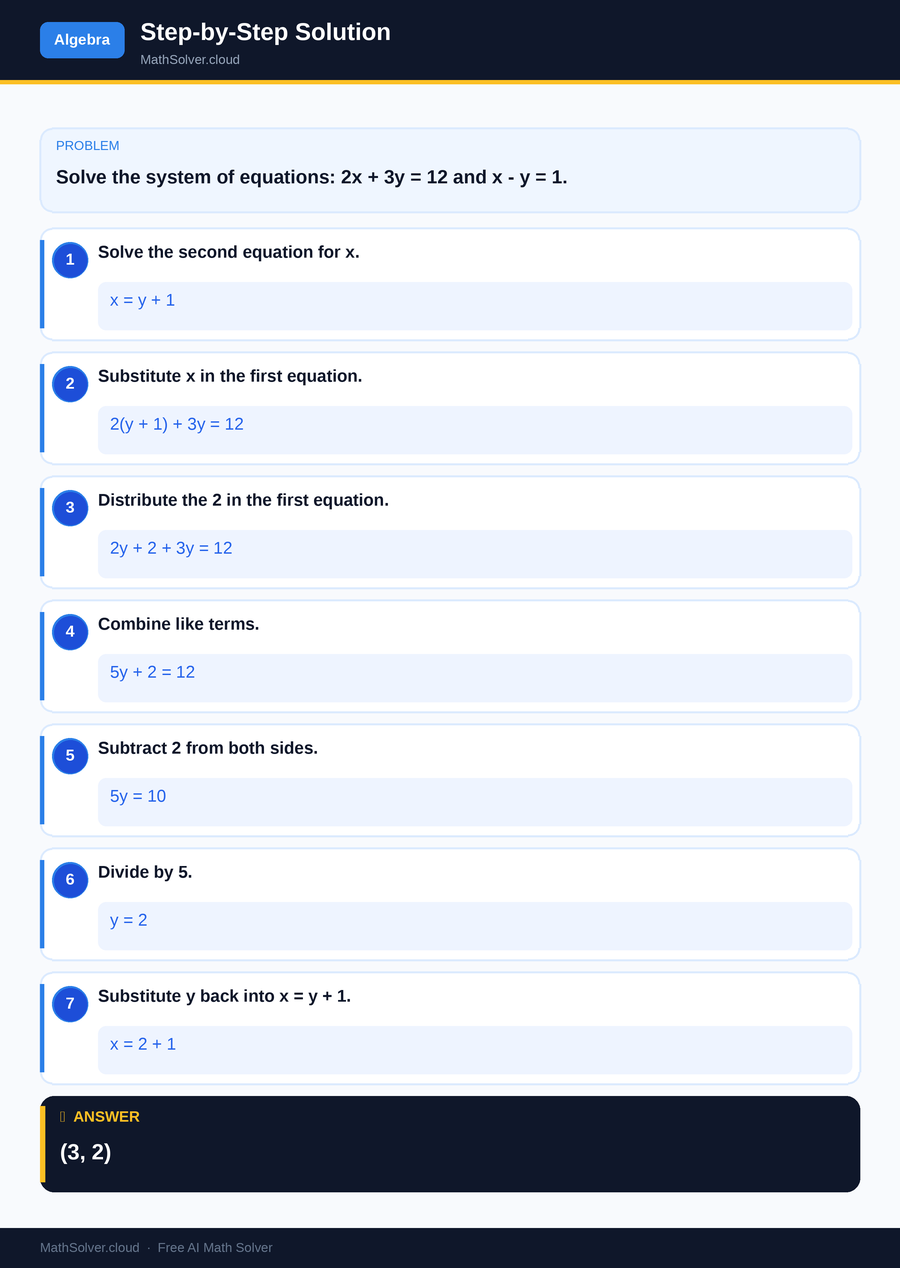
MathSolver Chrome extension solving this problem step-by-step
Example 2
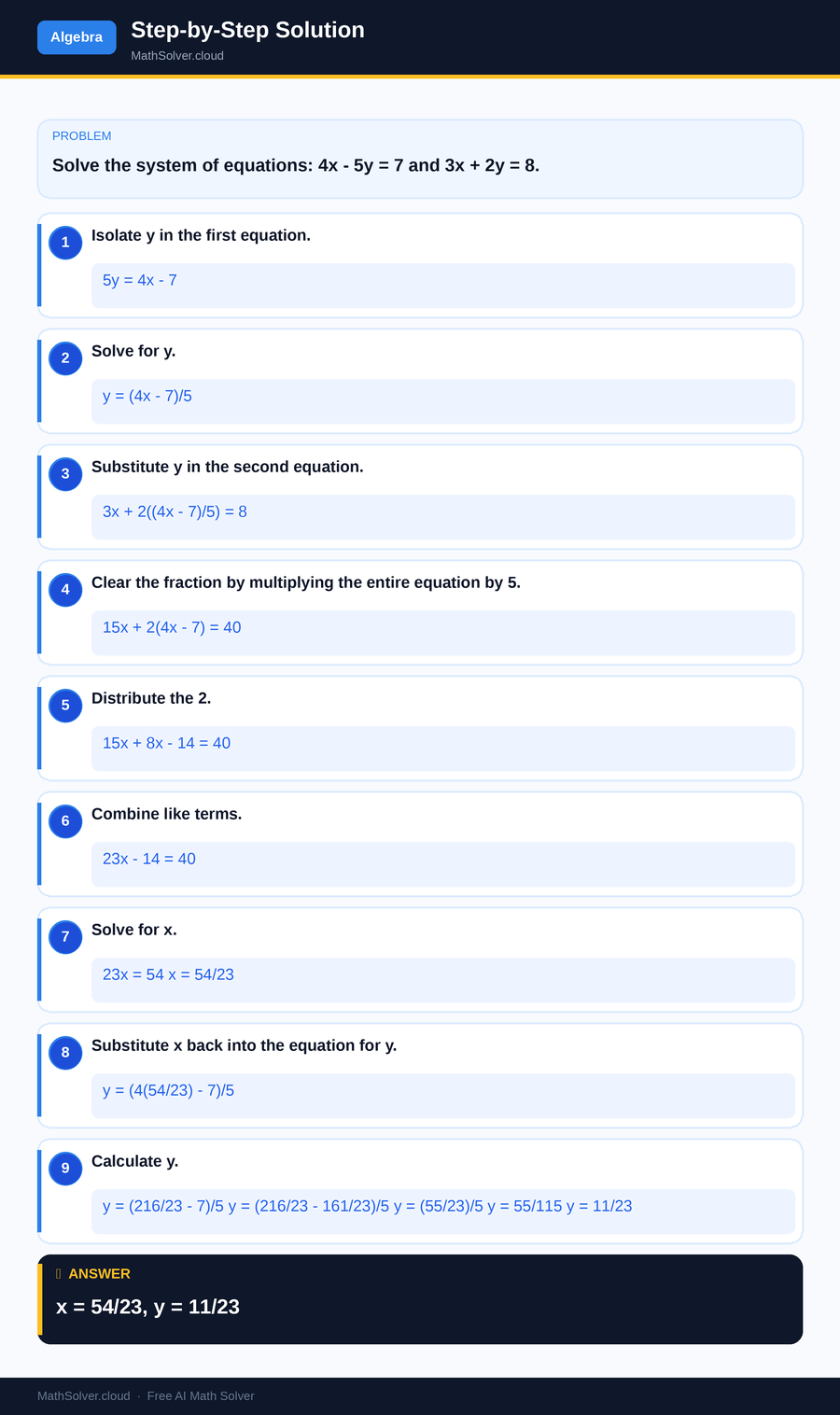
MathSolver Chrome extension solving this problem step-by-step
Common Mistakes to Avoid
One common mistake when solving systems of equations is failing to align the equations properly for elimination. This often leads to incorrect cancellation of variables, resulting in erroneous solutions. To avoid this, ensure that the coefficients of the variable you wish to eliminate are equal and opposite before adding or subtracting the equations.
Another frequent error is neglecting to verify the solution. Students might solve for the variables but forget to substitute back into the original equations to ensure the solution is correct. Always check your solution by plugging the values back into the original equations to confirm that they work for all equations in the system.
Real-World Applications
Systems of equations are not just academic exercises; they have practical applications in various fields. In finance, systems of equations can model and solve problems involving budgets, investments, and pricing strategies. For example, businesses use systems of equations to determine the optimal mix of products to maximize profit while adhering to constraints like production capacity and cost.
In engineering, systems of equations can model the behavior of electrical circuits, structural forces, and chemical reactions. For instance, engineers use systems of equations to balance forces in a bridge design, ensuring stability and safety. Understanding how to solve systems of equations is thus essential for professionals in these fields to make informed, accurate decisions.
Frequently Asked Questions
❓ What is a system of equations?
❓ Why do students find systems of equations challenging?
❓ How can AI help with systems of equations?
❓ What are some methods for solving systems of equations?
❓ Where can I find more resources on algebra topics?
🚀 Solve any math problem instantly
2,000+ students use MathSolver every day — join them for free
📥 Add to Chrome — It's Free