A Comprehensive Guide to Solving Trigonometric Equations
📋 In this guide
Solving trigonometric equations is a critical skill in mathematics, often challenging for students due to its abstract nature and complexity. Trigonometric equations involve trigonometric functions like sine, cosine, and tangent, and require finding all possible angle solutions that satisfy the equation within a given interval. Many students struggle with solving trigonometric equations because they involve multiple steps, transformations, and the application of various identities. The topic demands a solid understanding of trigonometric identities, unit circle concepts, and algebraic manipulation.
In this article, you will learn how to approach solving trigonometric equations systematically. By breaking down the process into manageable steps, we aim to make it more approachable and less intimidating. You'll also find worked examples to illustrate the method, common mistakes to avoid, and real-world applications to understand its importance. Additionally, we'll explore how resources like a solving trigonometric equations calculator and worksheets can aid your learning.
Whether you are preparing for an exam or just seeking to improve your understanding, this article will be a valuable resource. We’ll provide you with strategies and insights to boost your confidence and proficiency in solving trigonometric equations. Let’s dive into the fascinating world of trigonometry!
Step-by-Step: How to Solve Solving Trigonometric Equations
Step 1: Simplify the Equation
The first step in solving trigonometric equations is to simplify the equation as much as possible. This often involves using trigonometric identities to rewrite the equation in a simpler form. For instance, if you have an equation like 2sin^2(x) + sin(x) - 1 = 0, you might try expressing it in terms of a single trigonometric function or convert it into a quadratic form. Simplification may also involve factoring or using algebraic techniques to isolate the trigonometric function.
Step 2: Solve for the Trigonometric Function
Once the equation is simplified, the next step is to solve for the trigonometric function itself. This means isolating the sine, cosine, or tangent term on one side of the equation. For example, if your equation is sin(x) = 0.5, you have successfully isolated the trigonometric function. At this stage, you should also consider the domain of the function and the given interval for the solution.
Step 3: Find All Possible Solutions
With the trigonometric function isolated, the next step is to determine all possible solutions within the specified interval. This involves using the unit circle or trigonometric tables to find the angles that satisfy the equation. For example, if cos(x) = 0.5, you would look for angles on the unit circle where the cosine value is 0.5. Remember that trigonometric functions are periodic, so there might be multiple solutions within one cycle.
Step 4: Verify and Interpret Solutions
The final step is to verify that all obtained solutions satisfy the original equation. This involves substituting the solutions back into the original equation and checking for correctness. Additionally, it’s crucial to interpret the solutions in the context of the problem. If any extraneous solutions arise, they should be excluded. Verifying solutions ensures accuracy and builds confidence in your problem-solving skills.
🤖 Stuck on a math problem?
Take a screenshot and let our AI solve it step-by-step in seconds
⚡ Try MathSolver Free →Worked Examples
Example 1
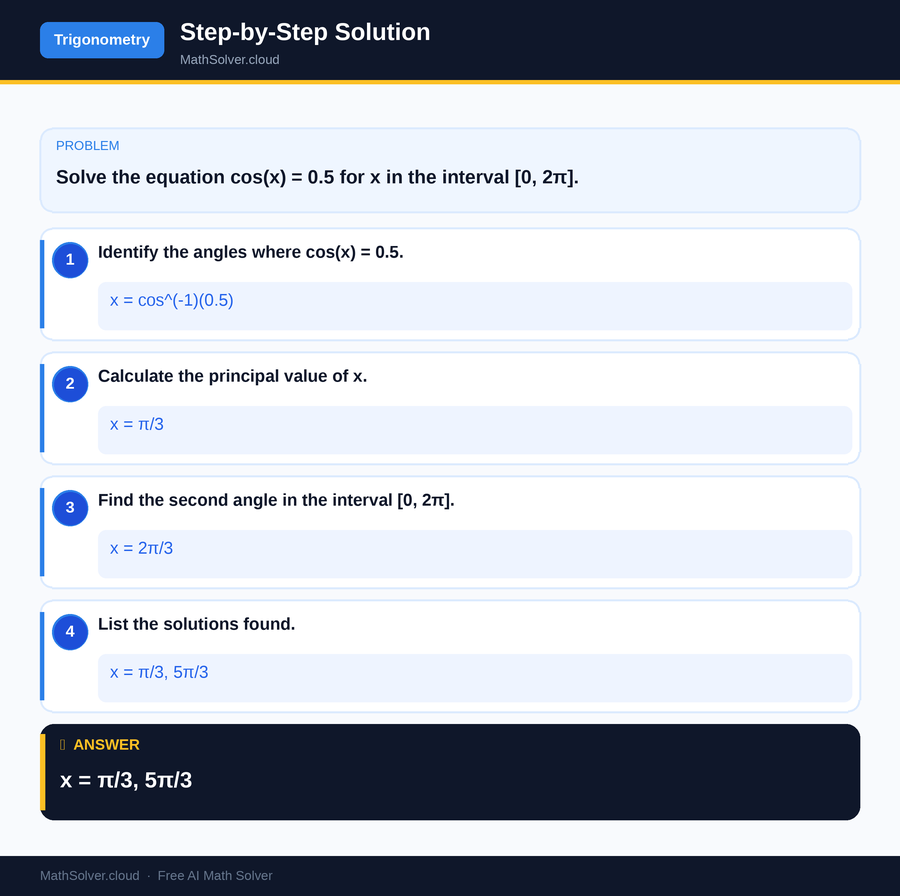
MathSolver Chrome extension solving this problem step-by-step
Example 2
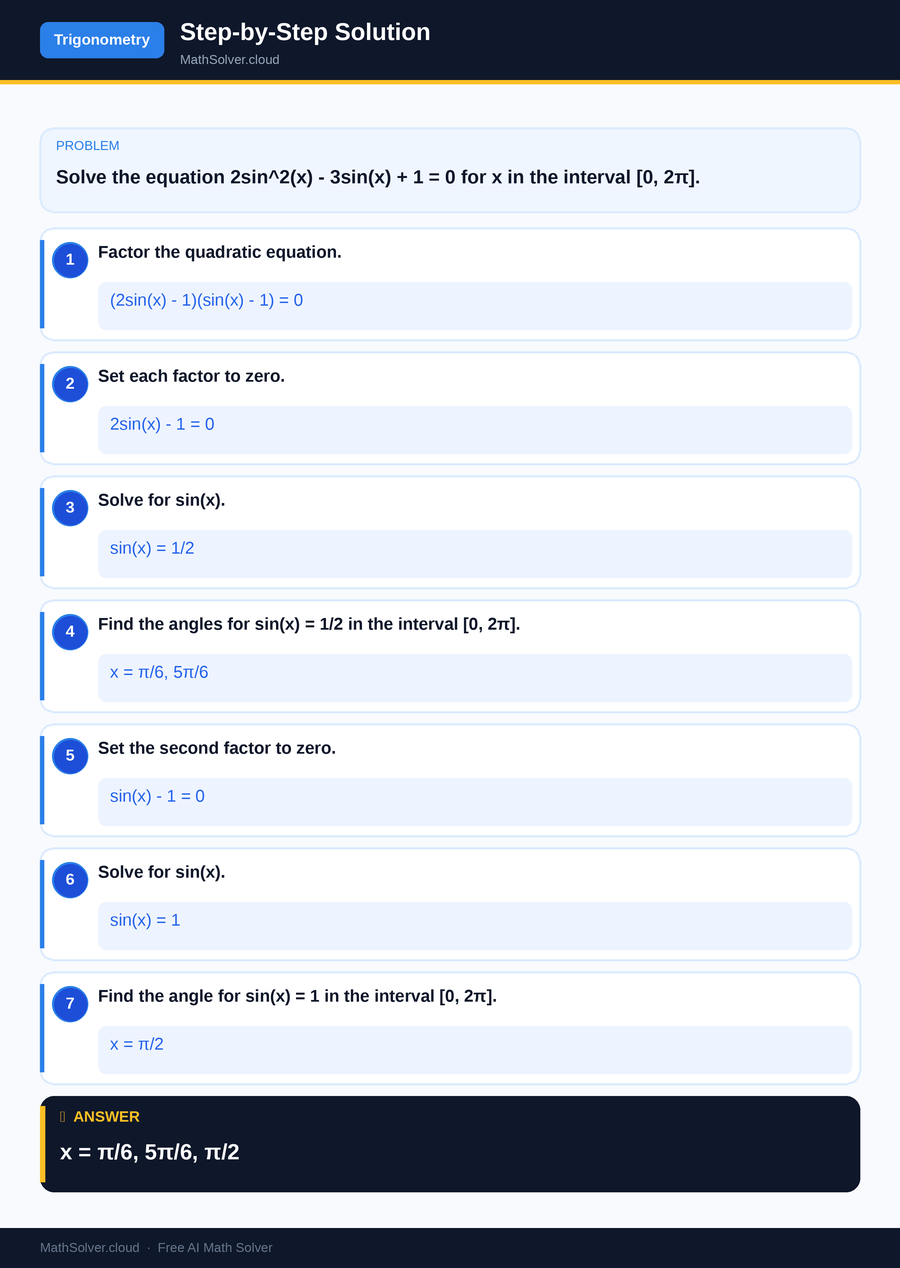
MathSolver Chrome extension solving this problem step-by-step
Common Mistakes to Avoid
A common mistake in solving trigonometric equations is failing to consider all possible solutions within the given interval. Trigonometric functions are periodic, meaning they repeat values at specific intervals. Students often find the primary solution but forget to account for additional solutions within the same period. To avoid this, always remember to use the unit circle or periodic properties of the trigonometric functions to find all possible solutions.
Another mistake is neglecting to verify solutions. After solving the equation, it’s essential to substitute your answers back into the original equation to ensure they are correct. This step helps eliminate extraneous solutions that may arise from algebraic manipulations, especially when squaring both sides of an equation. Always verify solutions to confirm their validity.
Real-World Applications
Solving trigonometric equations has numerous real-world applications, particularly in fields that involve wave patterns and oscillations. In physics, trigonometric equations are used to model wave functions, such as sound waves or electromagnetic waves, where understanding the amplitude, frequency, and phase shift is crucial.
In engineering, trigonometric equations are applied in signal processing, where engineers analyze and manipulate signals for communication systems. Additionally, architects and designers use trigonometry in constructing structures, ensuring stability and aesthetic appeal by calculating angles and dimensions accurately. Understanding how to solve these equations is fundamental in these fields, illustrating the practical importance of mastering this mathematical skill.
Frequently Asked Questions
❓ What is the main goal when solving trigonometric equations?
❓ Why do students often struggle with solving trigonometric equations?
❓ How can AI help with solving trigonometric equations?
❓ What resources can help me practice solving trigonometric equations?
❓ How are trigonometric equations related to other mathematical concepts?
🚀 Solve any math problem instantly
2,000+ students use MathSolver every day — join them for free
📥 Add to Chrome — It's Free