Comprehensive Guide to Solving Trig Equations
📋 In this guide
Solving trig equations is an essential skill in mathematics, particularly in the study of trigonometry. These equations involve trigonometric functions like sine, cosine, and tangent, and require you to find the angle values that satisfy the equation. Many students find solving trig equations challenging due to the abstract nature of trigonometric concepts and the variety of techniques needed to solve different types of equations. In this comprehensive guide, you'll learn how to tackle these equations with confidence through clear explanations, step-by-step processes, and practical examples.
One reason students struggle with solving trig equations is the need to understand and apply various trigonometric identities and algebraic techniques. These equations often require you to manipulate expressions and understand the unit circle to find the correct solutions. As you work through this article, you'll gain a deeper understanding of these concepts, which will help you solve trig equations more efficiently.
By the end of this article, you'll be equipped with the tools and knowledge to solve a wide range of trig equations. You'll also gain insights into common mistakes to avoid and real-world applications of these mathematical concepts. Whether you're preparing for an exam or simply looking to improve your math skills, this guide will provide you with the resources you need, including the use of tools like a solving trig equations calculator or solving trig equations worksheet.
Step-by-Step: How to Solve Solving Trig Equations
Step 1: Identify the Trigonometric Function(s)
The first step in solving trig equations is to identify the trigonometric function(s) involved. Determine whether the equation involves sine, cosine, tangent, or a combination of these. Also, keep an eye out for other functions like secant, cosecant, and cotangent, which are the reciprocals of cosine, sine, and tangent, respectively.
Step 2: Isolate the Trigonometric Function
Once you've identified the key trigonometric function, the next step is to isolate it on one side of the equation. This often involves algebraic manipulation, such as adding or subtracting terms, multiplying or dividing both sides of the equation, or factoring. Isolating the function makes it easier to apply trigonometric identities or inverse functions later.
Step 3: Solve for the Angle
With the trigonometric function isolated, use inverse trigonometric functions or identities to solve for the angle variable (commonly denoted as x or theta). Depending on the equation, you may need to apply the inverse sine, cosine, or tangent function to find the primary solution. Be mindful of the equation's domain and the periodic nature of trigonometric functions, which may yield multiple solutions.
Step 4: Verify and Generalize Solutions
After finding the primary solution(s), verify them by substituting back into the original equation. Also, consider the periodicity of the trigonometric functions to find any additional solutions within the given interval. For example, since sine and cosine have a period of 2π, additional solutions can be found by adding multiples of 2π to the primary solution.
🤖 Stuck on a math problem?
Take a screenshot and let our AI solve it step-by-step in seconds
⚡ Try MathSolver Free →Worked Examples
Example 1
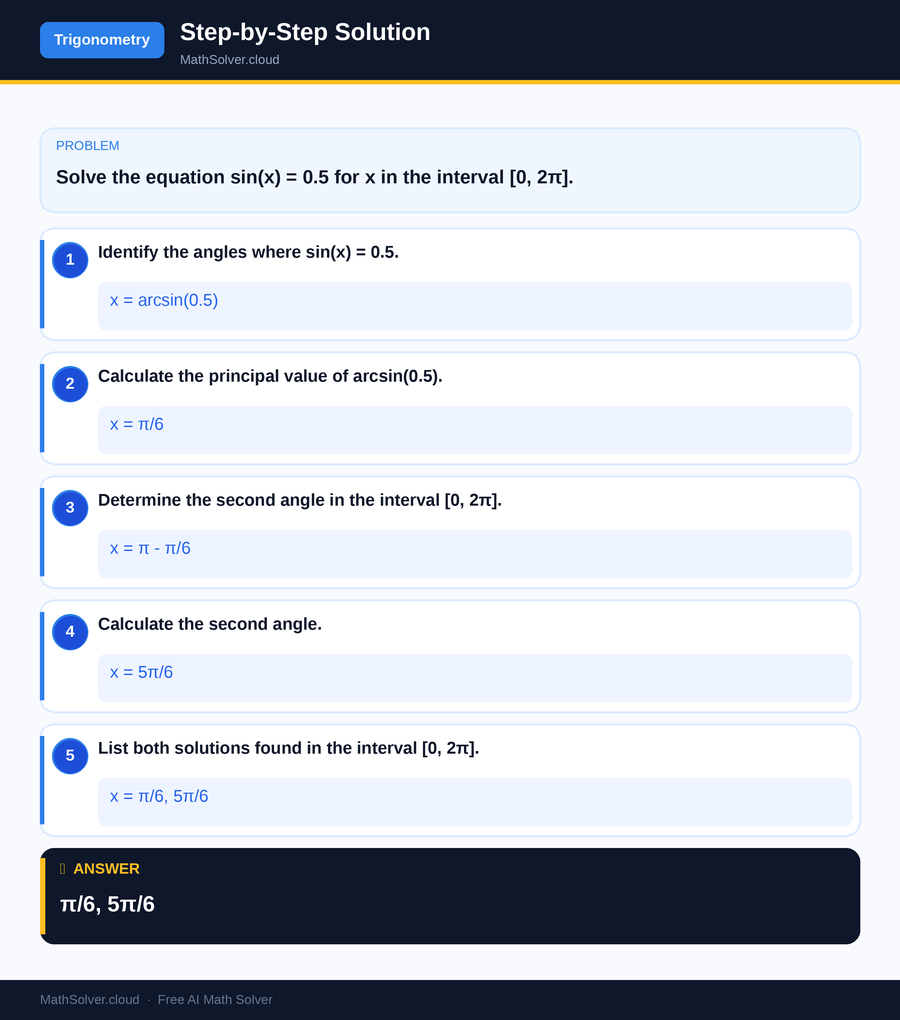
MathSolver Chrome extension solving this problem step-by-step
Example 2
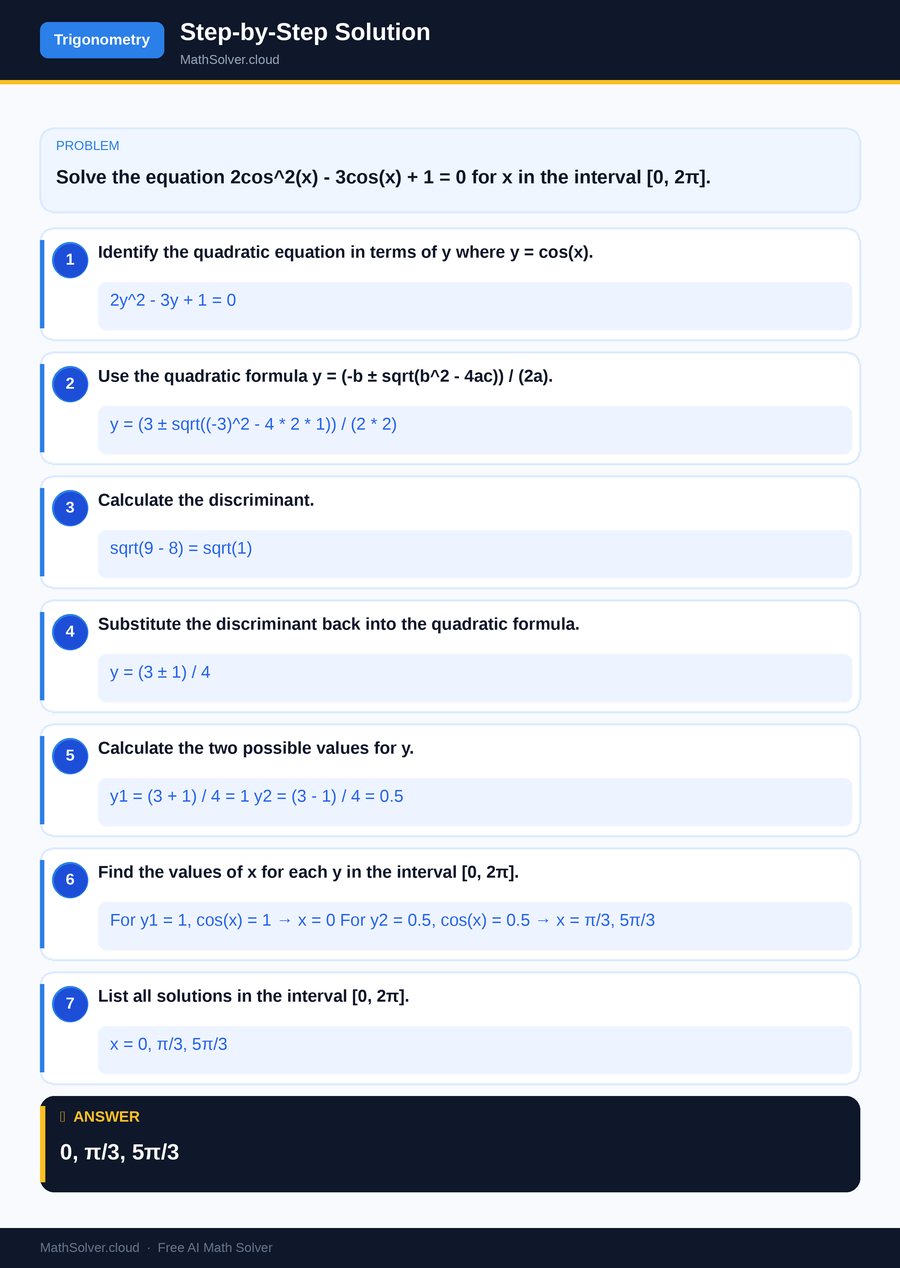
MathSolver Chrome extension solving this problem step-by-step
Common Mistakes to Avoid
One common mistake when solving trig equations is not considering all possible solutions. Trigonometric functions are periodic, meaning they repeat their values over specific intervals. Students often find the primary solution but neglect to account for additional solutions within the given interval. Always remember to consider the function's period and check for multiple solutions by adding or subtracting full cycles (e.g., 2π for sine and cosine).
Another pitfall is misapplying trigonometric identities. It's crucial to use the correct identity for the given function and context. Misapplication can lead to incorrect solutions or overly complicated expressions. Practice using identities correctly by working through a solving trig equations worksheet or consulting our complete Trigonometry guide for additional resources.
Real-World Applications
Solving trig equations is not just an academic exercise—it has practical applications in various fields. For instance, in engineering, trigonometric equations are used to model wave patterns, which are essential in designing structures that withstand vibrations. Trigonometry is also crucial in physics, where it helps describe oscillations, like the movement of pendulums or springs.
In the world of computer graphics, solving trig equations is fundamental for rendering realistic scenes. Trigonometric functions help calculate angles and shapes, allowing for the creation of lifelike animations and simulations. These real-world applications highlight the importance of mastering trig equations for both academic and professional success.
Frequently Asked Questions
❓ What are the steps for solving trig equations?
❓ Why do I get different solutions when solving trig equations?
❓ How can AI help with solving trig equations?
❓ What is the equation for diagonal to the right sine curve?
❓ How can I practice solving trig equations effectively?
🚀 Solve any math problem instantly
2,000+ students use MathSolver every day — join them for free
📥 Add to Chrome — It's Free