Mastering the Sine Wave Equation
📋 In this guide
The sine wave equation is a fundamental concept in trigonometry and is critical for understanding periodic phenomena in various scientific fields. At its core, the sine wave equation represents a smooth, repetitive oscillation that is characterized by its amplitude, frequency, and phase. Many students find the sine wave equation challenging due to its abstract nature and the mathematical complexity involved in manipulating these parameters. However, with a solid grasp of the basics, students can overcome these challenges and gain a deeper understanding of how to model real-world phenomena using sine waves.
In this article, you will learn about the sine wave equation, its key components, and how to work with it effectively. We will break down the equation into manageable parts, providing step-by-step guidance and worked examples to solidify your understanding. Additionally, we will explore common mistakes to avoid, real-world applications, and frequently asked questions, ensuring you leave with a comprehensive understanding of this essential mathematical concept.
By the end of this guide, you'll be equipped with the knowledge needed to tackle problems involving the sine wave equation with confidence. Whether you're a student preparing for exams or a curious learner seeking to expand your mathematical toolkit, this article will provide the clarity and insight you need to master the sine wave equation.
Step-by-Step: How to Solve Sine Wave Equation
Step 1: Understanding Amplitude and Vertical Shift
The amplitude of a sine wave, denoted as A in the equation y = A * sin(B * x + C) + D, is a measure of how far the wave peaks above or below its central axis. It is always a positive value, reflecting the maximum height from the central line. The vertical shift, represented by D, moves the entire wave up or down along the y-axis. Recognizing these components is essential, as they directly impact the visual representation and physical interpretation of the wave. By identifying A and D in the sine wave equation, you can immediately determine the range of y-values that the wave can achieve.
Step 2: Calculating Frequency and Period
The frequency of a sine wave is linked to the coefficient B in the equation y = A * sin(B * x + C) + D. Frequency refers to the number of complete cycles the wave makes in a specific interval, often related to time or space. The period, which is the reciprocal of frequency, indicates the length of one complete cycle. It can be calculated using the formula period = 2 * pi / B. By understanding the relationship between frequency and period, you can accurately determine the behavior of the wave over time or space, which is crucial for applications in physics and engineering.
Step 3: Identifying Phase Shifts
The phase shift of a sine wave is expressed by the term C in the equation y = A * sin(B * x + C) + D. Phase shift refers to the horizontal displacement of the wave along the x-axis. A positive C results in a shift to the left, while a negative C shifts the wave to the right. Understanding phase shifts is vital when comparing multiple waves or synchronizing wave patterns, as it allows you to align or offset waves as needed. By mastering the concept of phase shifts, you can manipulate the timing and alignment of waveforms in various applications.
Step 4: Graphing the Sine Wave
Graphing the sine wave involves plotting the equation y = A * sin(B * x + C) + D on a coordinate plane. Start by marking the central axis, determined by the vertical shift D. Next, plot points for key angles (0, pi/2, pi, 3*pi/2, 2*pi) considering the amplitude A. Adjust these points based on the phase shift C and repeat the pattern for each period, determined by 2 * pi / B. Connect these points smoothly to form the sine wave. By graphing, you can visually interpret the wave's behavior and verify your understanding of its characteristics.
🤖 Stuck on a math problem?
Take a screenshot and let our AI solve it step-by-step in seconds
⚡ Try MathSolver Free →Worked Examples
Example 1
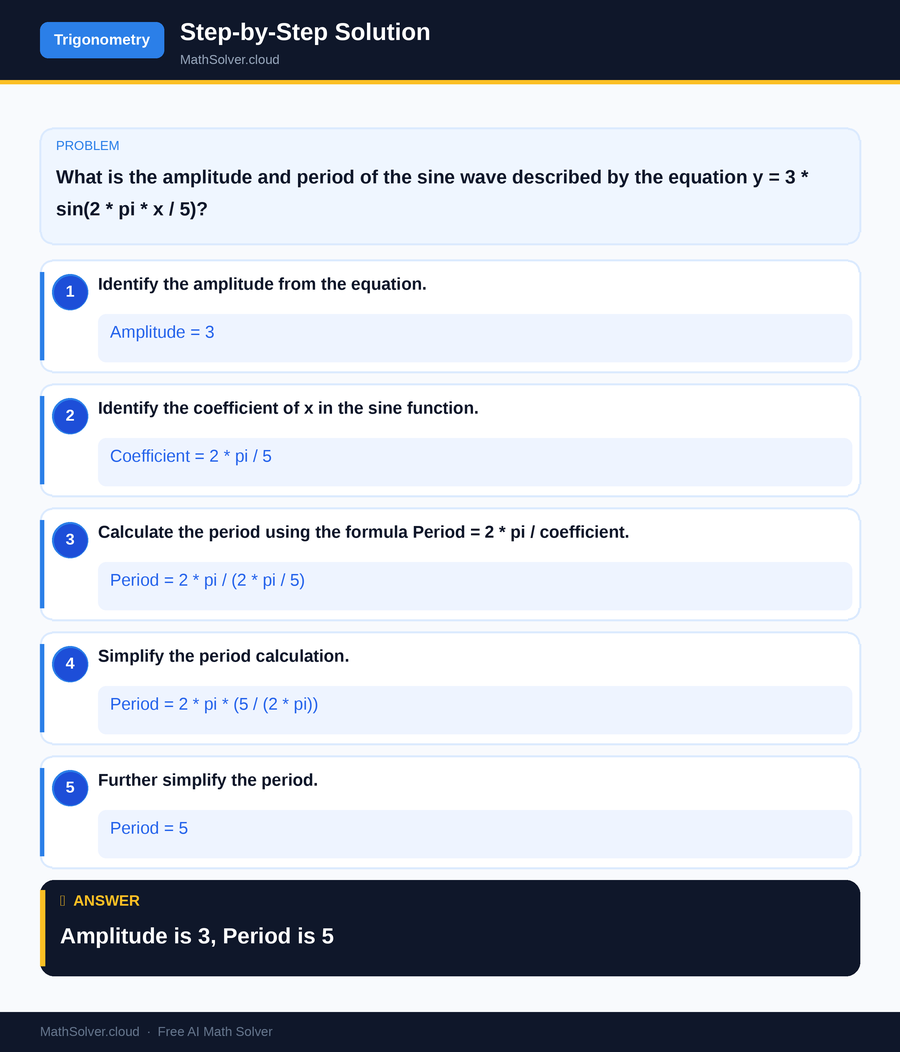
MathSolver Chrome extension solving this problem step-by-step
Example 2
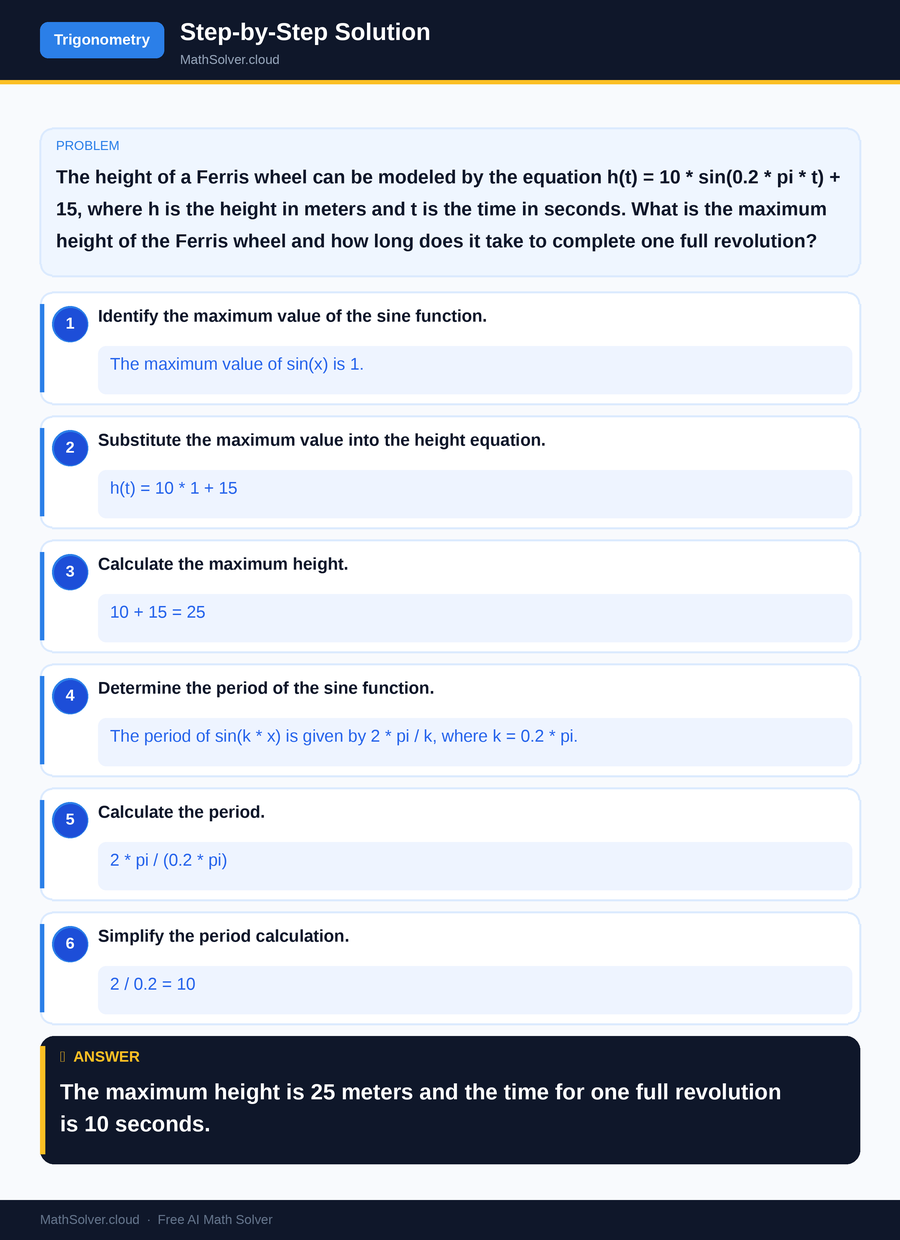
MathSolver Chrome extension solving this problem step-by-step
Common Mistakes to Avoid
One common mistake students make is confusing amplitude with vertical shift. Amplitude should always be a positive value, representing the peak deviation from the central axis, while the vertical shift moves the entire wave up or down without affecting its shape. Another frequent error is miscalculating the period of the wave. Remember, the period is determined by the formula period = 2 * pi / B, not simply the coefficient B. Ensuring you apply the correct formula will help you accurately describe the wave's behavior over time or space.
Additionally, students often overlook the importance of the phase shift, especially when multiple waves are involved. Failing to account for phase shifts can lead to incorrect alignment of waves, affecting the overall analysis of wave patterns. By being mindful of these common pitfalls and reviewing the fundamental concepts, you can avoid errors and confidently work with sine wave equations.
Real-World Applications
The sine wave equation is prevalent in various real-world applications, particularly in fields like physics, engineering, and music. For instance, in electrical engineering, sine waves are used to model and analyze alternating current (AC) circuits, which are essential for powering homes and electronic devices. Understanding the sine wave equation allows engineers to optimize circuit designs and improve energy efficiency.
In the realm of sound engineering, sine waves are fundamental for synthesizing musical tones and understanding acoustics. By manipulating sine wave properties like frequency and amplitude, sound engineers can create complex audio effects and ensure high-quality sound reproduction. These applications highlight the sine wave equation's versatility and importance in both theoretical and practical contexts.
Frequently Asked Questions
❓ What is the sine wave equation?
❓ Why do students struggle with the sine wave equation?
❓ How can AI help with the sine wave equation?
❓ What is the difference between a sine wave and a cosine wave equation?
❓ Where can I learn more about trigonometric equations like the sine wave equation?
🚀 Solve any math problem instantly
2,000+ students use MathSolver every day — join them for free
📥 Add to Chrome — It's Free