Demystifying the Sine Equation
📋 In this guide
The sine equation is a fundamental concept in trigonometry, a branch of mathematics that deals with the relationships between the angles and sides of triangles. Understanding the sine equation can be challenging for many students, as it requires a firm grasp of both algebraic manipulation and trigonometric principles. The sine equation is often used to solve problems involving periodic phenomena, such as waves and oscillations, making it an essential tool in various fields of science and engineering.
Students often struggle with the sine equation due to its abstract nature and the need to visualize and interpret trigonometric graphs. Without a clear understanding of the unit circle and the behavior of the sine function, it can be difficult to accurately solve these equations. This article aims to demystify the sine equation by providing clear explanations, step-by-step guides, and practical examples.
By the end of this article, you will gain a comprehensive understanding of the sine equation, including how to derive and apply its formula, solve it step-by-step, and recognize its real-world applications. Whether you're preparing for an exam or looking to deepen your understanding of trigonometry, this guide will equip you with the knowledge you need to tackle sine equations with confidence.
Step-by-Step: How to Solve Sine Equation
Step 1: Understanding the Unit Circle
The first step in solving a sine equation is to understand the unit circle, a circle with a radius of one centered at the origin of a coordinate plane. The unit circle is essential for visualizing the sine function, as it provides a geometric representation of the angles and their corresponding sine values. Each point on the unit circle corresponds to an angle, with the x-coordinate representing the cosine of the angle and the y-coordinate representing the sine. To solve a sine equation, identify the angles on the unit circle that correspond to the given sine value.
Step 2: Identifying the Principal Angle
Once you have a visual representation of the unit circle, the next step is to identify the principal angle, which is the smallest positive angle that satisfies the sine equation. This angle is typically found within the interval from 0 to 360 degrees. To find the principal angle, determine the inverse sine (also known as arcsin) of the given sine value. Keep in mind that the sine function is periodic and symmetric, meaning that there are multiple angles that can satisfy the equation within one full rotation of the circle.
Step 3: Considering Additional Solutions
The sine equation often has more than one solution due to the periodic nature of the sine curve, which repeats every 360 degrees. After finding the principal angle, consider additional solutions by adding or subtracting 360 degrees (or 2pi radians) to the principal angle. Additionally, because the sine function is symmetric about the y-axis, you can find another solution by subtracting the principal angle from 180 degrees. This process is crucial for identifying all possible solutions within a given interval.
Step 4: Verifying and Simplifying Solutions
Finally, verify the solutions obtained by substituting them back into the original sine equation to ensure they satisfy the equation. This step is crucial to avoid any errors resulting from miscalculation or misunderstanding of the unit circle. Once verified, simplify the solutions if possible, and express them in the required format. If the problem specifies a particular interval, such as 0 to 360 degrees, ensure that all solutions fall within this range.
🤖 Stuck on a math problem?
Take a screenshot and let our AI solve it step-by-step in seconds
⚡ Try MathSolver Free →Worked Examples
Example 1
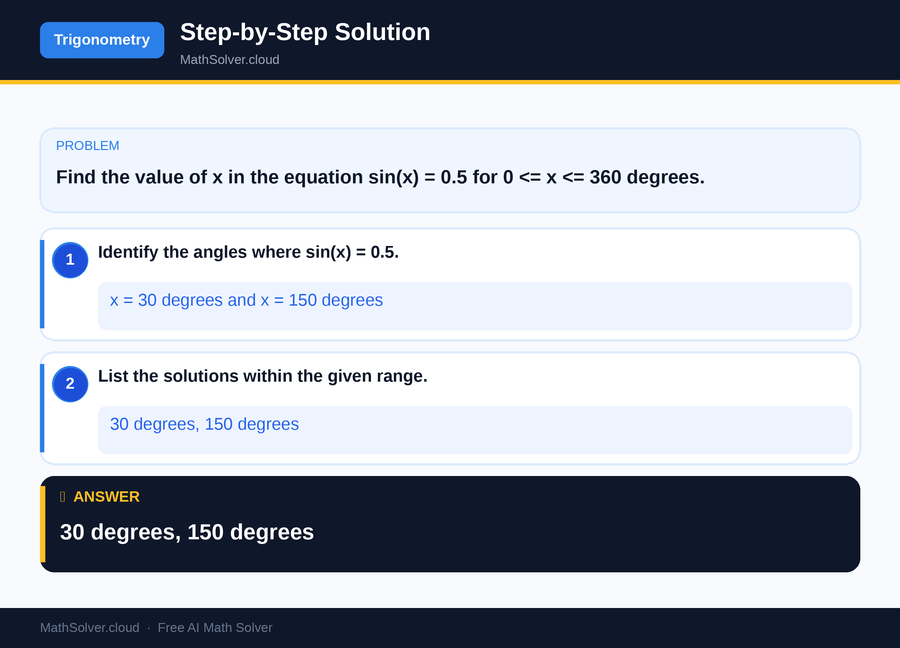
MathSolver Chrome extension solving this problem step-by-step
Example 2
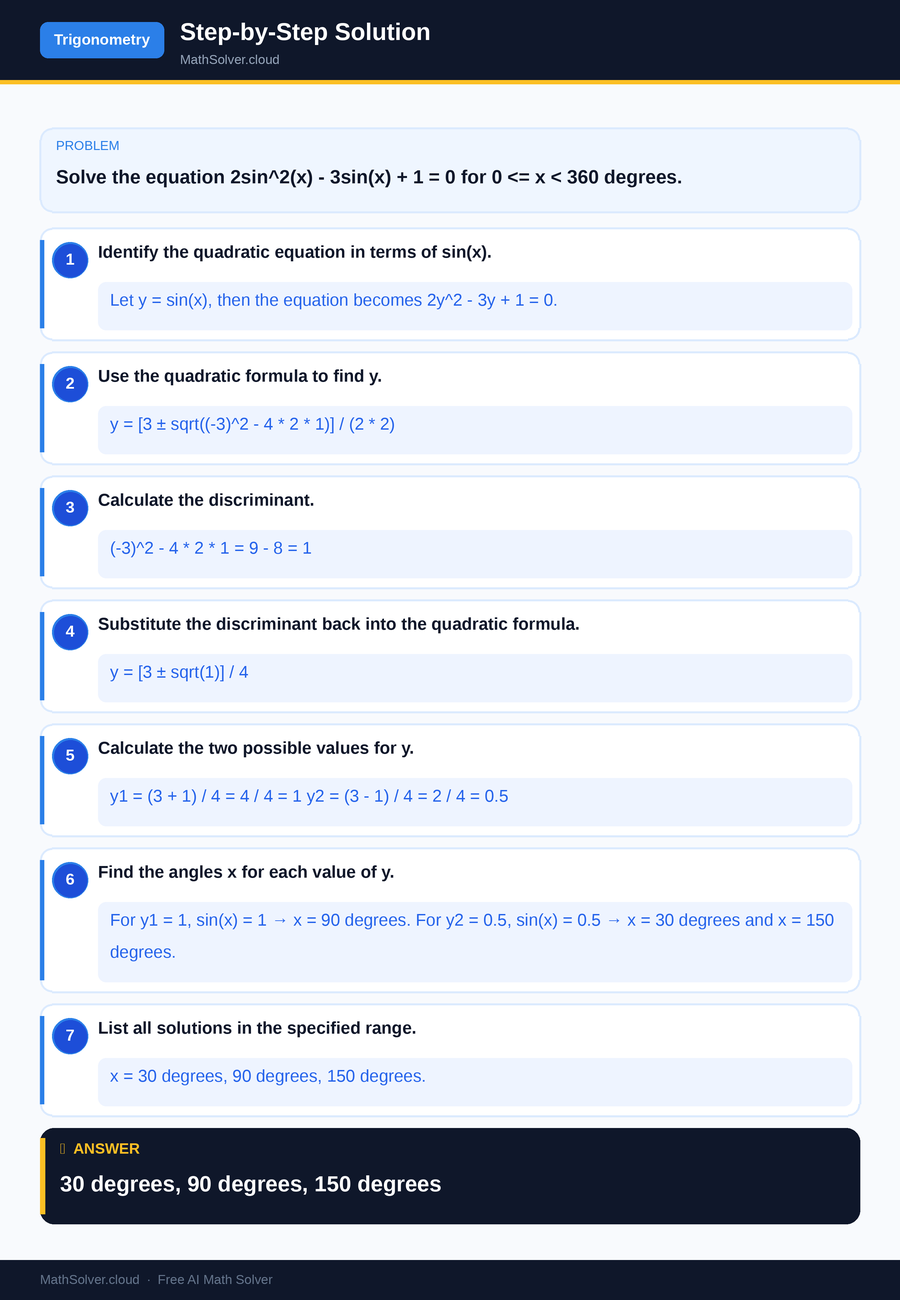
MathSolver Chrome extension solving this problem step-by-step
Common Mistakes to Avoid
One common mistake when solving sine equations is neglecting the periodic nature of the sine function, leading to an incomplete set of solutions. Students often identify the principal angle but forget to account for additional solutions by applying the periodic properties of the sine curve. To avoid this, always consider the full range of possible solutions within the specified interval.
Another frequent error is incorrect use of the unit circle, particularly in identifying the correct angles corresponding to given sine values. Misreading the unit circle can lead to incorrect answers, so it is crucial to practice and become comfortable with interpreting the unit circle. Double-check your answers by substituting them back into the original equation to ensure accuracy.
Real-World Applications
The sine equation is not just an abstract concept; it has numerous real-world applications. In physics, it is used to model oscillatory motion, such as the swinging of a pendulum or the vibrations of a string. Engineers apply the sine equation to design and analyze waveforms in electrical circuits, ensuring proper signal transmission and reception.
In addition to physics and engineering, the sine equation finds applications in fields like music and acoustics, where it helps model sound waves and harmonics. By understanding the properties and applications of the sine equation, you can appreciate its significance in everyday phenomena and technological advancements.
Frequently Asked Questions
❓ What is a sine equation, and how is it used?
❓ Why do students struggle with sine equations?
❓ How can AI help with sine equations?
❓ What is the difference between a sine equation and a cosine equation?
❓ How is the sine equation applied in engineering?
🚀 Solve any math problem instantly
2,000+ students use MathSolver every day — join them for free
📥 Add to Chrome — It's Free