Mastering Quadratic Equations: A Comprehensive Guide
📋 In this guide
Quadratic equations are a fundamental part of algebra that often present a challenge to students. These equations take the form of ax^2 + bx + c = 0, where a, b, and c are constants, and x represents an unknown variable. Students frequently struggle with quadratic equations because they involve more complex operations than linear equations, such as factoring, completing the square, and using the quadratic formula. Understanding quadratic equations is crucial for students as they form the basis for many advanced topics in mathematics.
In learning about quadratic equations, students will gain the skills necessary to solve them using various methods. This article will guide you through these methods, providing step-by-step instructions and examples to enhance your understanding. Whether you are preparing for an Algebra 1 regents exam or brushing up on your algebra skills, mastering quadratic equations is essential.
Through this comprehensive guide, you will learn how to effectively tackle quadratic equations and avoid common mistakes. We will explore the practical applications of quadratic equations in real life, answer frequently asked questions, and provide additional resources for further learning. By the end of this article, you will have a solid grasp of how to solve quadratic equations and apply this knowledge confidently.
Step-by-Step: How to Solve Quadratic Equations
Step 1: Identify the Type of Quadratic Equation
The first step in solving quadratic equations is to identify the type of equation you are dealing with. Quadratic equations can be categorized based on the values of a, b, and c. For instance, if a = 1, the equation is said to be monic. Recognizing the type of equation helps determine the most suitable method for solving it, whether it be factoring, using the quadratic formula, or another technique.
Step 2: Choose the Method of Solution
Once you have identified the type of quadratic equation, the next step is to choose the most appropriate method to solve it. For example, if the equation can be easily factored, then solving quadratic equations by factoring might be the best approach. However, if the equation is more complex, using the quadratic formula could be more efficient. Understanding how to solve quadratic equations by different methods is key to finding the right solution quickly and accurately.
Step 3: Solve the Equation
After selecting the method, proceed to solve the quadratic equation. If you are factoring, express the equation in the form of (px + q)(rx + s) = 0 and solve for x. If using the quadratic formula, substitute the values of a, b, and c into the formula and calculate the roots. Be meticulous with calculations to avoid errors, especially when dealing with square roots and fractions.
Step 4: Verify the Solution
The final step is to verify your solution. Substitute the values of x back into the original quadratic equation to ensure they satisfy the equation. This step is crucial as it confirms the accuracy of your solution and helps identify any calculation mistakes. Additionally, checking your work builds confidence and reinforces your understanding of solving quadratic equations.
🤖 Stuck on a math problem?
Take a screenshot and let our AI solve it step-by-step in seconds
⚡ Try MathSolver Free →Worked Examples
Example 1
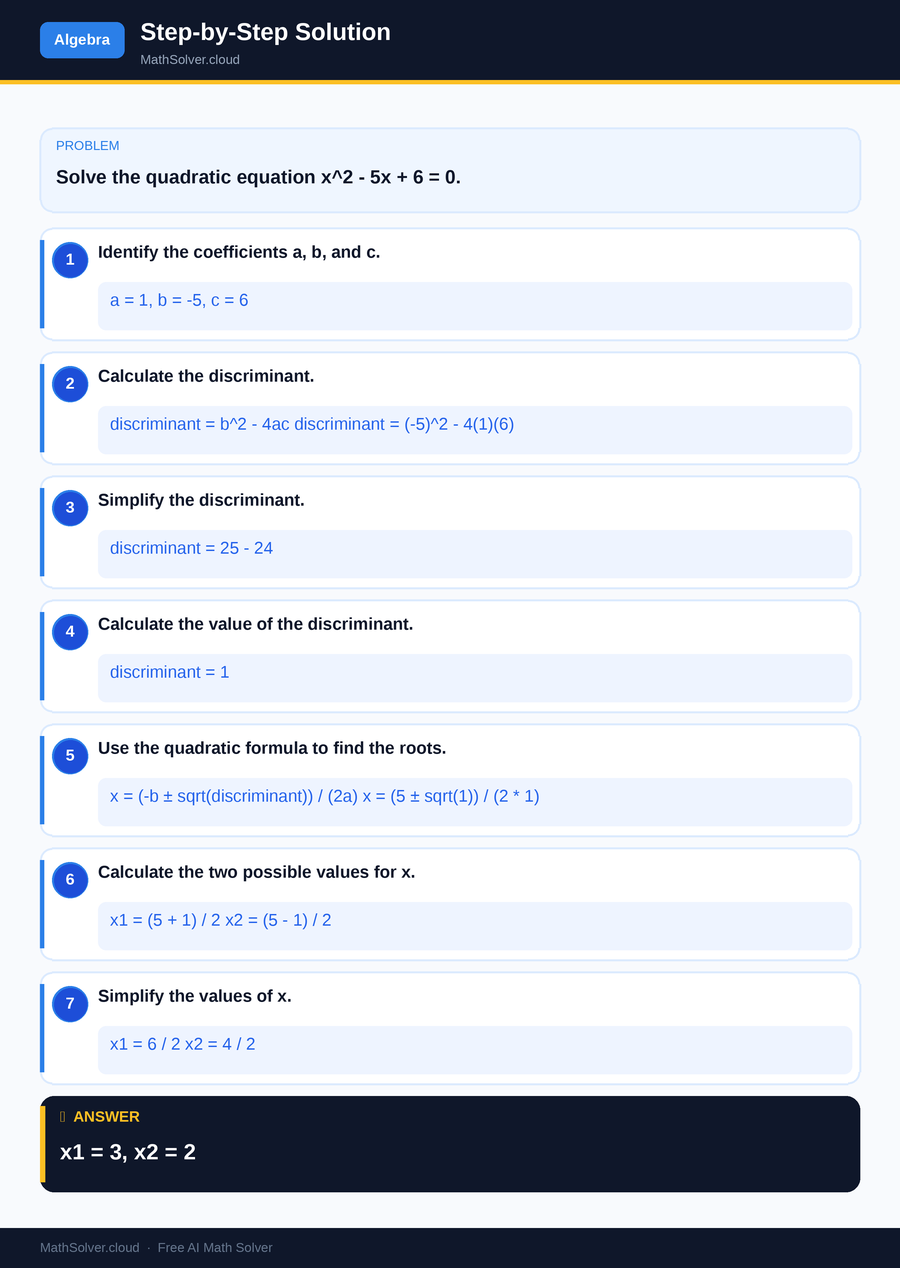
MathSolver Chrome extension solving this problem step-by-step
Example 2
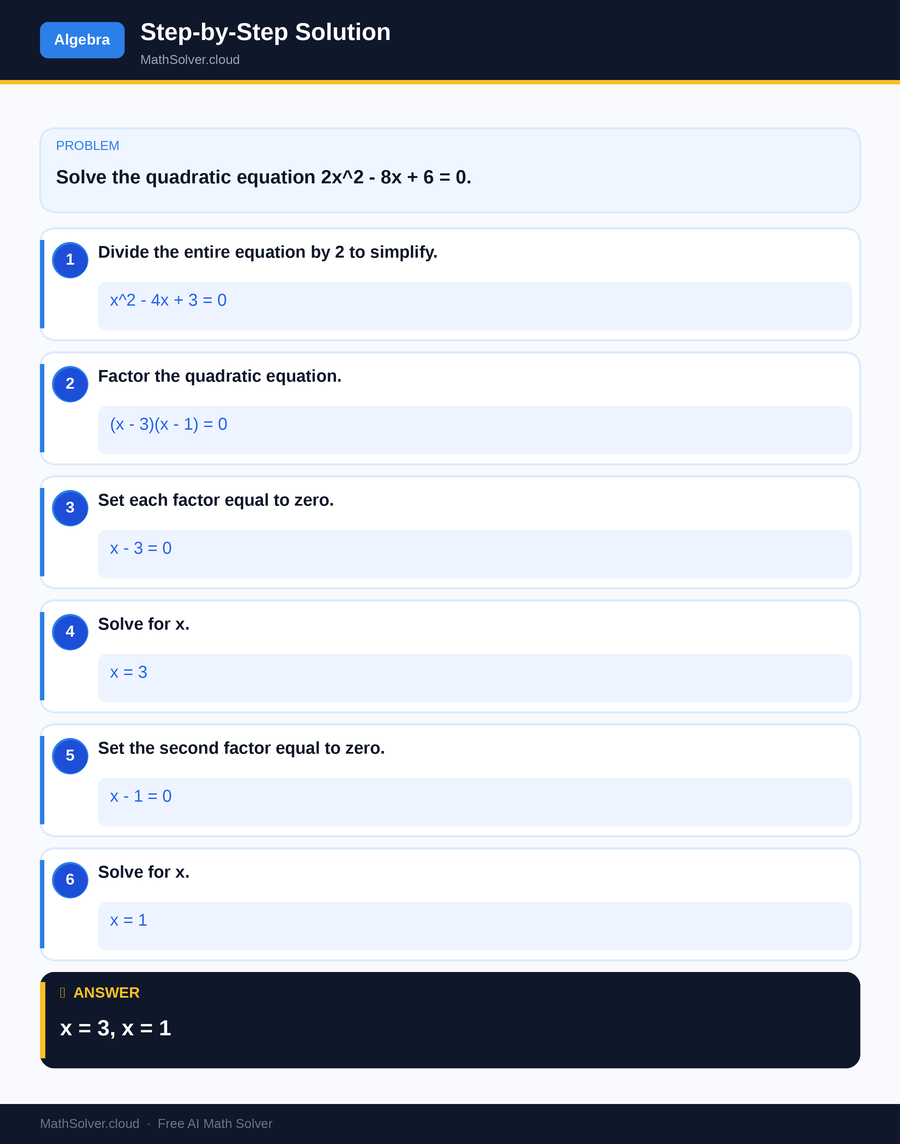
MathSolver Chrome extension solving this problem step-by-step
Common Mistakes to Avoid
One common mistake students make with quadratic equations is incorrect factoring. It's crucial to double-check your factors to ensure they multiply to the original constant term and add up to the linear coefficient. Another error is mishandling the quadratic formula, particularly the negative sign in front of b and the square root operation. Always ensure that calculations are precise, and when in doubt, verify the solutions by plugging them back into the original equation.
Students also frequently overlook the importance of verifying their solutions. Skipping this step can lead to accepting incorrect answers. By taking the time to substitute solutions back into the original equation, you can catch any errors and gain confidence in your problem-solving abilities.
Real-World Applications
Quadratic equations are not just abstract mathematical concepts; they have practical applications in various fields. For example, in physics, they are used to calculate projectile motion. The path of an object thrown into the air follows a parabolic trajectory, which can be modeled using a quadratic equation.
In economics, quadratic equations can model cost functions, helping businesses optimize production and pricing strategies. Additionally, architecture and engineering use quadratic equations in design calculations, such as determining the load-bearing capacity of structures. These real-world applications highlight the importance and versatility of quadratic equations in everyday life.
Frequently Asked Questions
❓ What are quadratic equations used for in mathematics?
❓ Why do students struggle with solving quadratic equations?
❓ How can AI help with quadratic equations?
❓ How do we solve quadratic equations when they can't be factored?
❓ What is the significance of the discriminant in quadratic equations?
🚀 Solve any math problem instantly
2,000+ students use MathSolver every day — join them for free
📥 Add to Chrome — It's Free