Mastering the Quadratic Equation Solver
📋 In this guide
A quadratic equation solver is an essential tool for students tackling algebra, particularly those who find themselves perplexed by quadratic equations. These equations, which can seem daunting at first, are a fundamental part of algebra that students encounter in courses like Algebra 1 and Algebra 2.0. It's common for students to struggle with quadratic equations due to their complexity and the multiple methods available for solving them. In this article, we’ll demystify quadratic equation solvers by exploring their key aspects, providing step-by-step solutions, and delving into real-world applications.
Students often feel overwhelmed by quadratic equations because they involve squaring terms and can produce two solutions. This is in contrast to linear equations, which typically have a single solution. The quadratic equation solver provides a systematic approach to finding these solutions. By the end of this guide, you will have a clear understanding of how to use various methods to solve quadratic equations and how these skills apply to different scenarios.
Throughout this article, we will cover the fundamental formula for solving quadratic equations, detailed steps for solving them, and common pitfalls to avoid. We will also look at worked examples to illustrate the process, and explore the real-world applications of quadratic equations. Whether you're preparing for an edmentum mastery test in Algebra 1 or gearing up for the Algebra 1 Regents, mastering the quadratic equation solver is crucial for your success.
Step-by-Step: How to Solve Quadratic Equation Solver
Step 1: Understanding the Standard Form
To effectively use a quadratic equation solver, it's crucial to first identify the standard form of a quadratic equation, which is ax^2 + bx + c = 0. This involves recognizing each component: 'a' as the coefficient of x^2, 'b' as the coefficient of x, and 'c' as the constant term. For example, in the equation 2x^2 + 4x - 6 = 0, 'a' is 2, 'b' is 4, and 'c' is -6. Make sure your equation is set to zero, as this is necessary for applying the quadratic formula or other solving methods.
Step 2: Applying the Quadratic Formula
Once you have identified 'a', 'b', and 'c', you can apply the quadratic equation solver formula: x = (-b ± sqrt(b^2 - 4ac)) / (2a). Begin by calculating the discriminant, which is b^2 - 4ac. The discriminant helps determine the nature of the roots. If it's positive, you have two real solutions; if zero, one real solution; and if negative, two complex solutions. Plug the values of 'a', 'b', and 'c' into the formula to find the solutions for x.
Step 3: Factoring the Quadratic Equation
Another method for solving quadratic equations is factoring, which involves expressing the equation as a product of binomials. For example, to factor a quadratic equation solver like x^2 + 5x + 6 = 0, you would look for two numbers that multiply to 6 and add to 5. These numbers are 2 and 3, so the equation factors to (x + 2)(x + 3) = 0. Solving for x gives the roots of the equation. This method works best when the equation can be easily factored.
Step 4: Completing the Square
The completing the square method involves rewriting the quadratic equation in the form (x + p)^2 = q, where p and q are constants. This technique is especially useful when the quadratic equation solver with steps is needed to show work. For an equation like x^2 + 6x + 9 = 0, you can rewrite it as (x + 3)^2 = 0, which yields the solution x = -3. This method provides a visual understanding of the roots and is a foundational skill for algebra students.
🤖 Stuck on a math problem?
Take a screenshot and let our AI solve it step-by-step in seconds
⚡ Try MathSolver Free →Worked Examples
Example 1
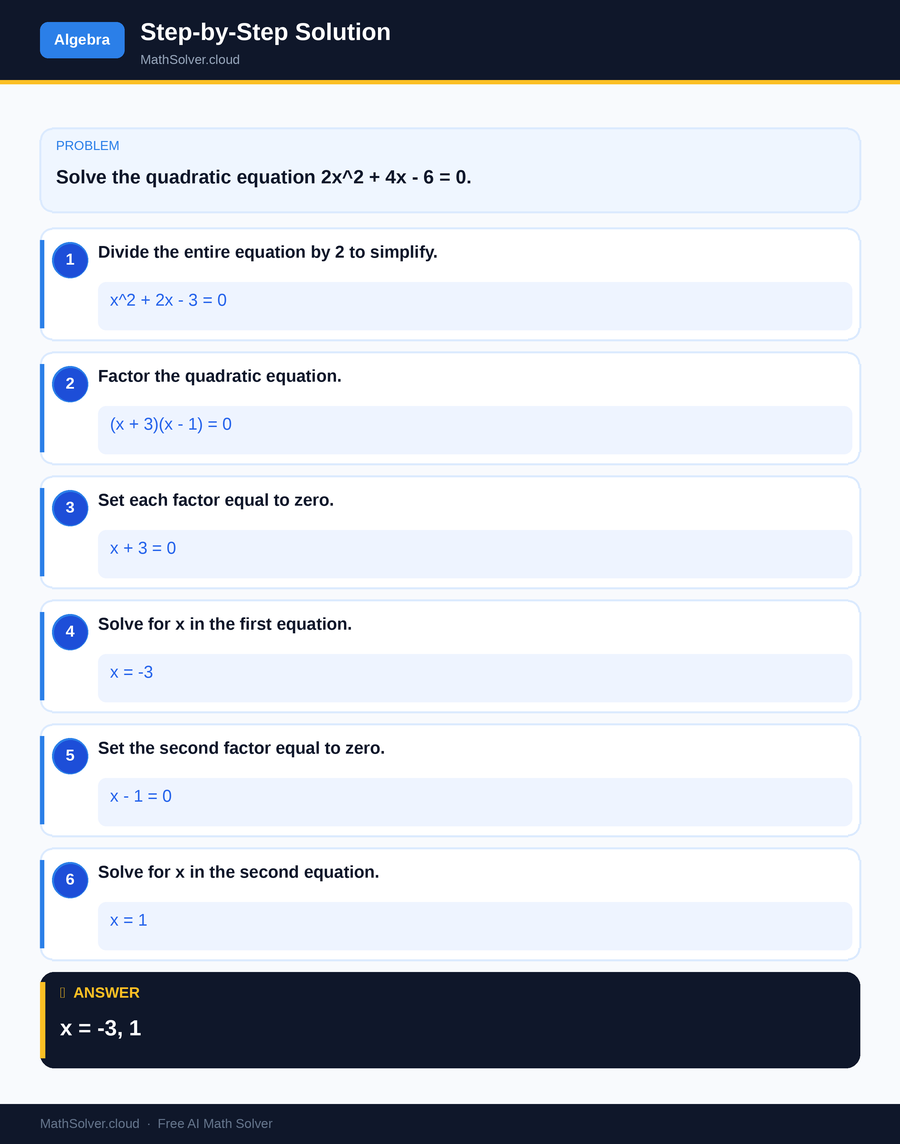
MathSolver Chrome extension solving this problem step-by-step
Example 2
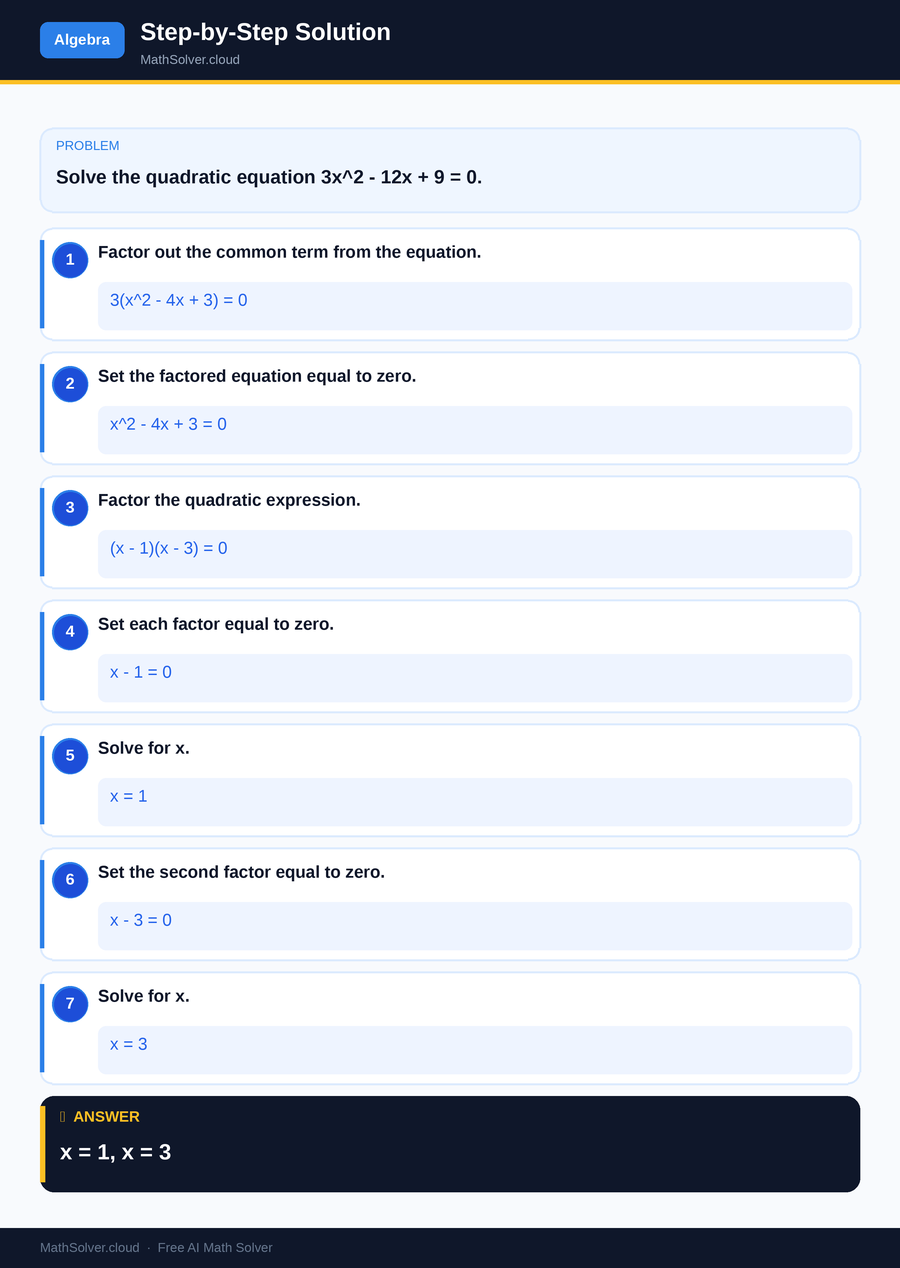
MathSolver Chrome extension solving this problem step-by-step
Common Mistakes to Avoid
One common mistake students make when using a quadratic equation solver is incorrectly calculating the discriminant. This often happens when students rush through the arithmetic or misapply the order of operations. To avoid this, double-check your work and ensure you accurately square the 'b' term and correctly handle the signs in the equation. Another frequent error is neglecting to simplify the radicals in the quadratic formula, leading to incorrect solutions.
Another pitfall is failing to recognize when a quadratic equation can be factored. Students may overlook simple factorable expressions, opting instead for the quadratic formula, which can be more time-consuming. Practice identifying factorable quadratics by considering the relationship between the coefficients and potential factors. This skill will enable you to solve equations more efficiently and accurately.
Real-World Applications
Quadratic equation solvers are not just academic exercises—they have practical applications in various fields. For instance, they are used in physics to calculate projectile trajectories. When a ball is thrown, its path can be described by a quadratic equation, allowing physicists to predict its position at any given time. This application is crucial in sports science and engineering.
In economics, quadratic equations can model cost-profit relationships. Businesses use them to determine the price point at which they can maximize profit or minimize costs. Understanding these equations enables economists and business analysts to make informed decisions about pricing strategies and resource allocation. Quadratic equations thus play a vital role in optimizing business operations.
Frequently Asked Questions
❓ What is a quadratic equation solver, and how does it work?
❓ Why do students struggle with quadratic equations?
❓ How can AI help with quadratic equation solver tasks?
❓ What are some tips for mastering quadratic equation solvers?
❓ How can I factor a quadratic equation solver easily?
🚀 Solve any math problem instantly
2,000+ students use MathSolver every day — join them for free
📥 Add to Chrome — It's Free