Mastering the Quadratic Equation Calculator
📋 In this guide
A quadratic equation calculator is a vital tool that helps students solve quadratic equations efficiently. Quadratic equations, which are polynomial equations of the second degree, often present a challenge for students due to their complexity. These equations typically take the form ax^2 + bx + c = 0, where a, b, and c are constants. Understanding how to solve these can be daunting, especially when dealing with the various methods like factoring, completing the square, or using the quadratic formula.
Students often struggle with quadratic equations because they involve multiple steps and require a good understanding of algebraic manipulation. The quadratic equation calculator simplifies this process by providing quick and accurate solutions. This tool not only saves time but also helps students verify their answers and understand the solution process better. By using a quadratic equation calculator, students can focus on understanding the underlying concepts rather than getting bogged down in complex calculations.
In this article, we will explore how to effectively use a quadratic equation calculator, guiding you through the key formula, a step-by-step process, and providing worked examples. We will also discuss common mistakes to avoid, real-world applications, and answer frequently asked questions. Whether you're preparing for an edmentum mastery test in Algebra 1 or brushing up for the Algebra 1 Regents, understanding how to use a quadratic equation calculator can enhance your problem-solving skills.
Step-by-Step: How to Solve Quadratic Equation Calculator
Step 1: Identify the Coefficients
The first step in using a quadratic equation calculator is to identify the coefficients a, b, and c from the quadratic equation ax^2 + bx + c = 0. These coefficients are crucial as they are the inputs for the quadratic formula. Double-check these values to ensure accuracy, as any mistake here will lead to incorrect solutions.
Step 2: Calculate the Discriminant
Next, calculate the discriminant using the formula b^2 - 4ac. The discriminant is significant because it indicates the nature of the roots. If the discriminant is positive, the equation has two distinct real roots. If it is zero, there is one real root (a repeated root). If negative, the quadratic equation has two complex roots. Understanding the discriminant helps in predicting the type of solutions you'll obtain.
Step 3: Apply the Quadratic Formula
With the discriminant calculated, apply the quadratic formula: x = [-b ± sqrt(b^2 - 4ac)] / (2a). This step involves substituting the values of a, b, and c into the formula, then calculating the possible values of x. The plus-minus symbol (±) indicates that there will be two potential solutions, one for addition and another for subtraction.
Step 4: Interpret the Results
Finally, interpret the results provided by the quadratic equation calculator. If the solutions are real numbers, these are the x-values where the quadratic equation equals zero. If the solutions are complex, they indicate that the quadratic equation does not intersect the x-axis. Understanding the results helps in identifying the nature of the equation's graph and verifying the solutions against the original equation.
🤖 Stuck on a math problem?
Take a screenshot and let our AI solve it step-by-step in seconds
⚡ Try MathSolver Free →Worked Examples
Example 1
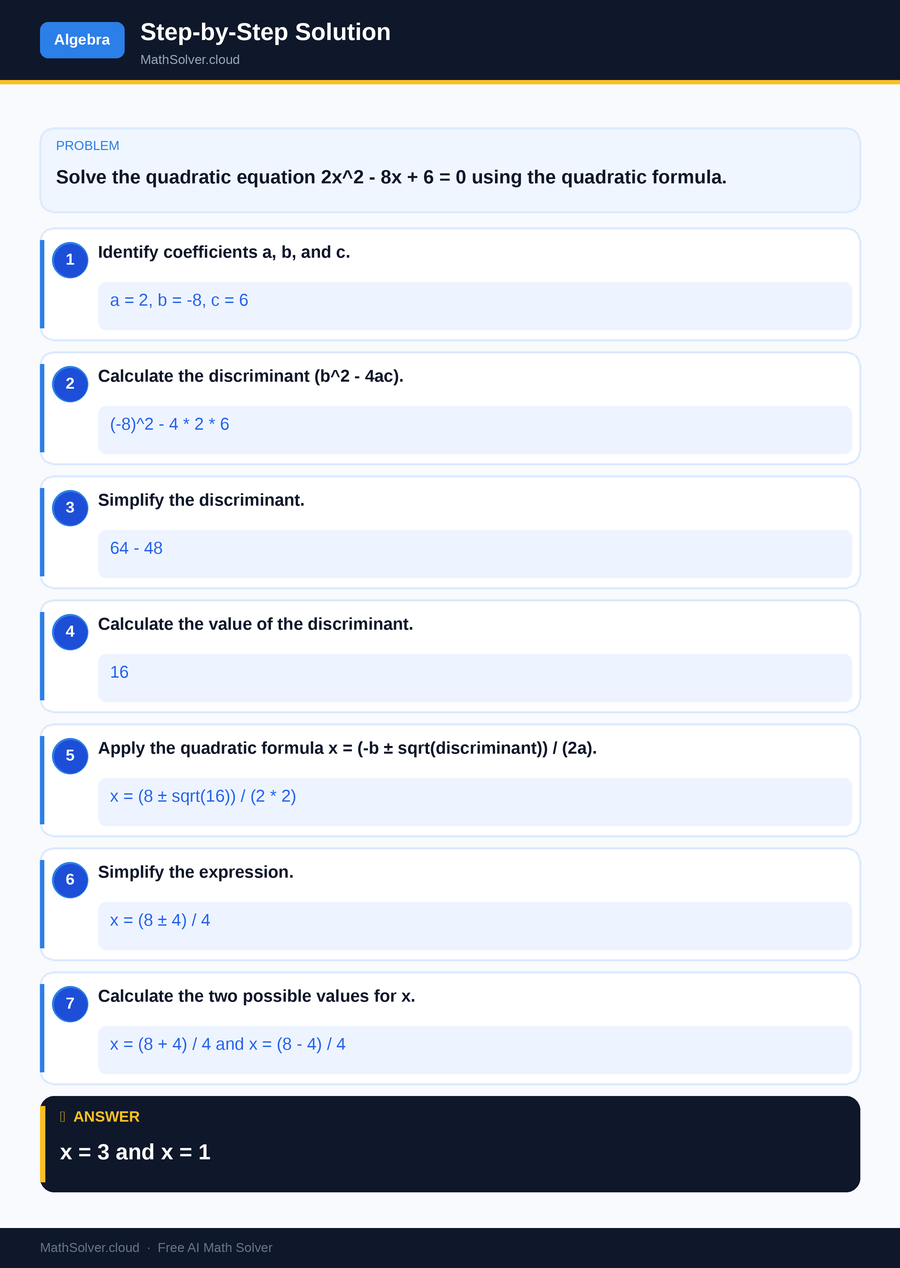
MathSolver Chrome extension solving this problem step-by-step
Example 2
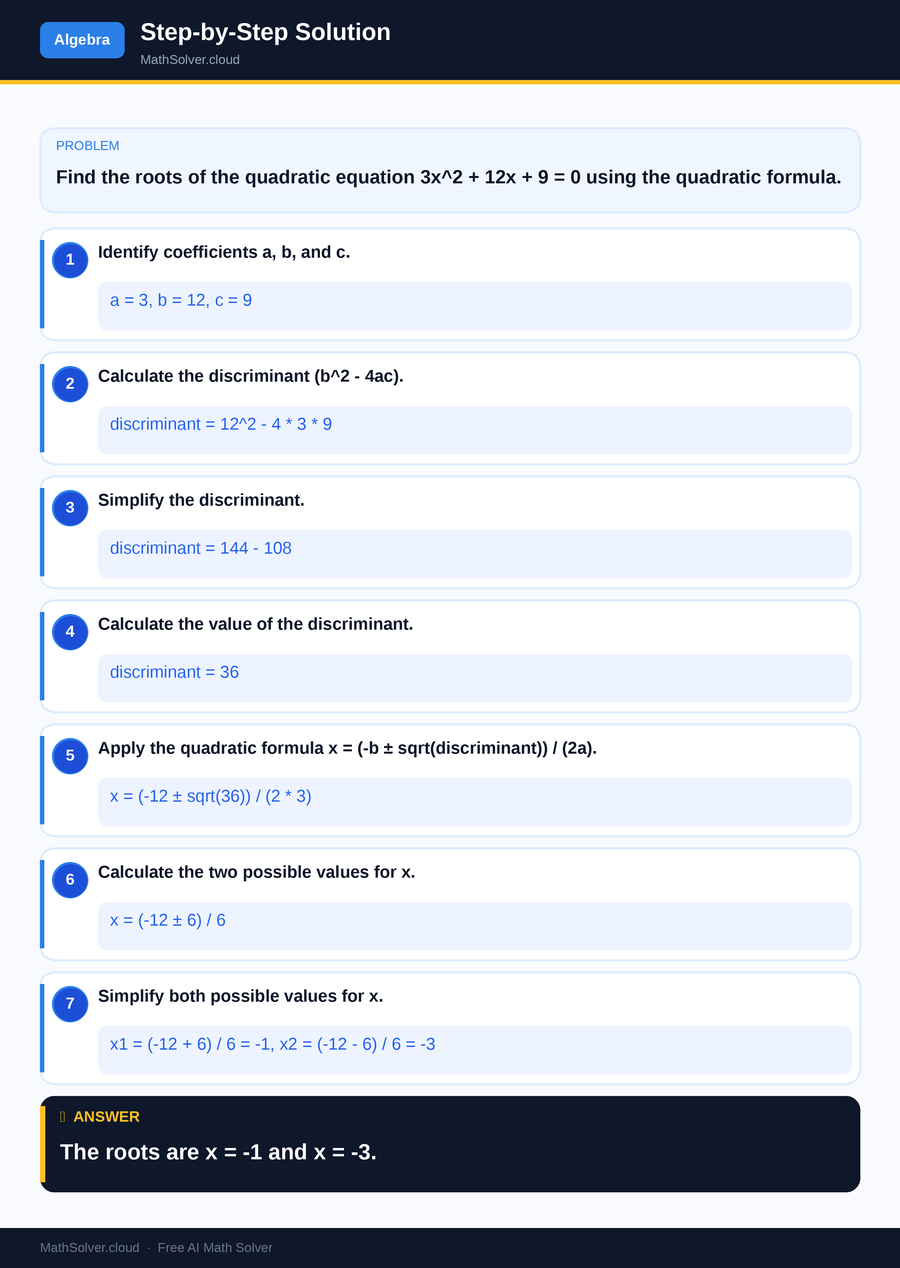
MathSolver Chrome extension solving this problem step-by-step
Common Mistakes to Avoid
A common mistake students make is incorrectly identifying the coefficients a, b, and c from the quadratic equation. It's essential to ensure these values are extracted accurately from the equation format. Another frequent error is miscalculating the discriminant, which can lead to incorrect solutions. Ensuring precise arithmetic at this stage is crucial.
Additionally, while using the quadratic formula, students might neglect the plus-minus (±) symbol, which results in missing one of the roots. It's vital to remember that this symbol indicates two possible solutions, representing the two potential intersections with the x-axis.
Real-World Applications
Quadratic equations and the use of a quadratic equation calculator have numerous real-world applications. For instance, they are extensively used in physics to model the trajectory of projectiles under gravity, helping engineers design efficient paths and predict landing points. In finance, quadratic equations are used to model and solve problems related to profit maximization and cost minimization.
Another practical application is in architecture, where quadratic equations help in designing parabolic arches and structures. These equations ensure that the structures can withstand certain weights and forces, ensuring safety and stability.
Frequently Asked Questions
❓ How does a quadratic equation calculator work?
❓ What is the best way to solve a quadratic equation manually?
❓ How can AI help with quadratic equation calculators?
❓ Why is the discriminant important in solving quadratic equations?
❓ Can quadratic equations model real-world phenomena?
🚀 Solve any math problem instantly
2,000+ students use MathSolver every day — join them for free
📥 Add to Chrome — It's Free