Mastering Probability Equations: A Comprehensive Guide
📋 In this guide
Probability equations are a fascinating branch of mathematics that deals with the likelihood of certain events occurring. These equations help us quantify uncertainty and make informed predictions about various outcomes. Despite their importance, many students struggle with probability equations due to their abstract nature and the intricate calculations involved. Understanding probability equations is crucial not only for academic success but also for making sense of real-world phenomena.
When students first encounter probability equations, they often find the concepts challenging to grasp. The abstract nature of probability and the need to accurately interpret mathematical expressions can be daunting. This difficulty is compounded when students transition from basic probability equations to more complex ones encountered in courses like probability equations algebra 2 or advanced placement statistics (probability equations ap stats). However, with a solid foundation and practice, mastering probability equations becomes achievable.
In this comprehensive guide, you'll learn the fundamentals of probability equations, including key formulas and step-by-step problem-solving techniques. We'll also explore common pitfalls to avoid, real-world applications, and frequently asked questions to help you navigate this topic with confidence. Whether you're a student trying to understand probability equations for the first time or looking to refine your skills, this article will provide valuable insights and practical advice.
Step-by-Step: How to Solve Probability Equations
Step 1: Understanding the Sample Space
The first step in solving probability equations is to clearly define the sample space, which is the set of all possible outcomes. Understanding the sample space is crucial because it forms the denominator in the probability equation. For example, if you are rolling a six-sided die, the sample space is {1, 2, 3, 4, 5, 6}. Accurately identifying the sample space helps in calculating the total number of possible outcomes and ensures that probability calculations are based on a solid foundation.
Step 2: Identifying Favorable Outcomes
Once the sample space is defined, the next step is to identify the favorable outcomes for the event in question. Favorable outcomes are those that align with the event you are interested in. For instance, if you want to know the probability of rolling an even number on a six-sided die, the favorable outcomes are {2, 4, 6}. Accurately identifying these outcomes is vital for applying probability equations correctly, as they form the numerator in the probability formula.
Step 3: Applying the Probability Formula
With the sample space and favorable outcomes in hand, apply the probability formula: P(E) = n(E) / n(S). Count the number of favorable outcomes (n(E)) and the total number of possible outcomes (n(S)) to calculate the probability. For example, using the die-rolling scenario, n(E) is 3 (the outcomes {2, 4, 6}), and n(S) is 6 (the outcomes {1, 2, 3, 4, 5, 6}), making the probability P(E) = 3/6 = 1/2. This step requires careful counting and division to ensure accuracy.
Step 4: Interpreting the Results
The final step is to interpret the results of the probability calculation. Probability values range from 0 to 1, where 0 indicates impossibility, and 1 indicates certainty. A probability of 1/2, as in the die example, suggests that there is an equal chance of the event occurring or not occurring. Understanding these results helps in making informed decisions and predictions. This step is crucial in translating mathematical results into meaningful real-world insights.
🤖 Stuck on a math problem?
Take a screenshot and let our AI solve it step-by-step in seconds
⚡ Try MathSolver Free →Worked Examples
Example 1
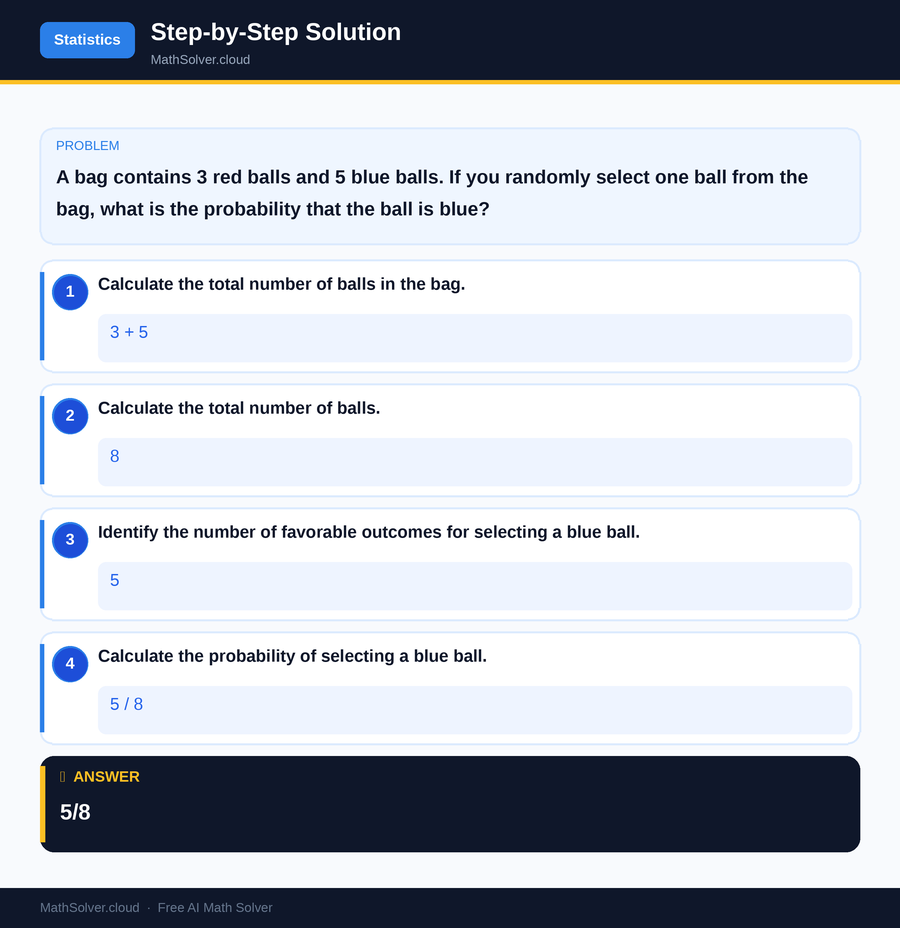
MathSolver Chrome extension solving this problem step-by-step
Example 2
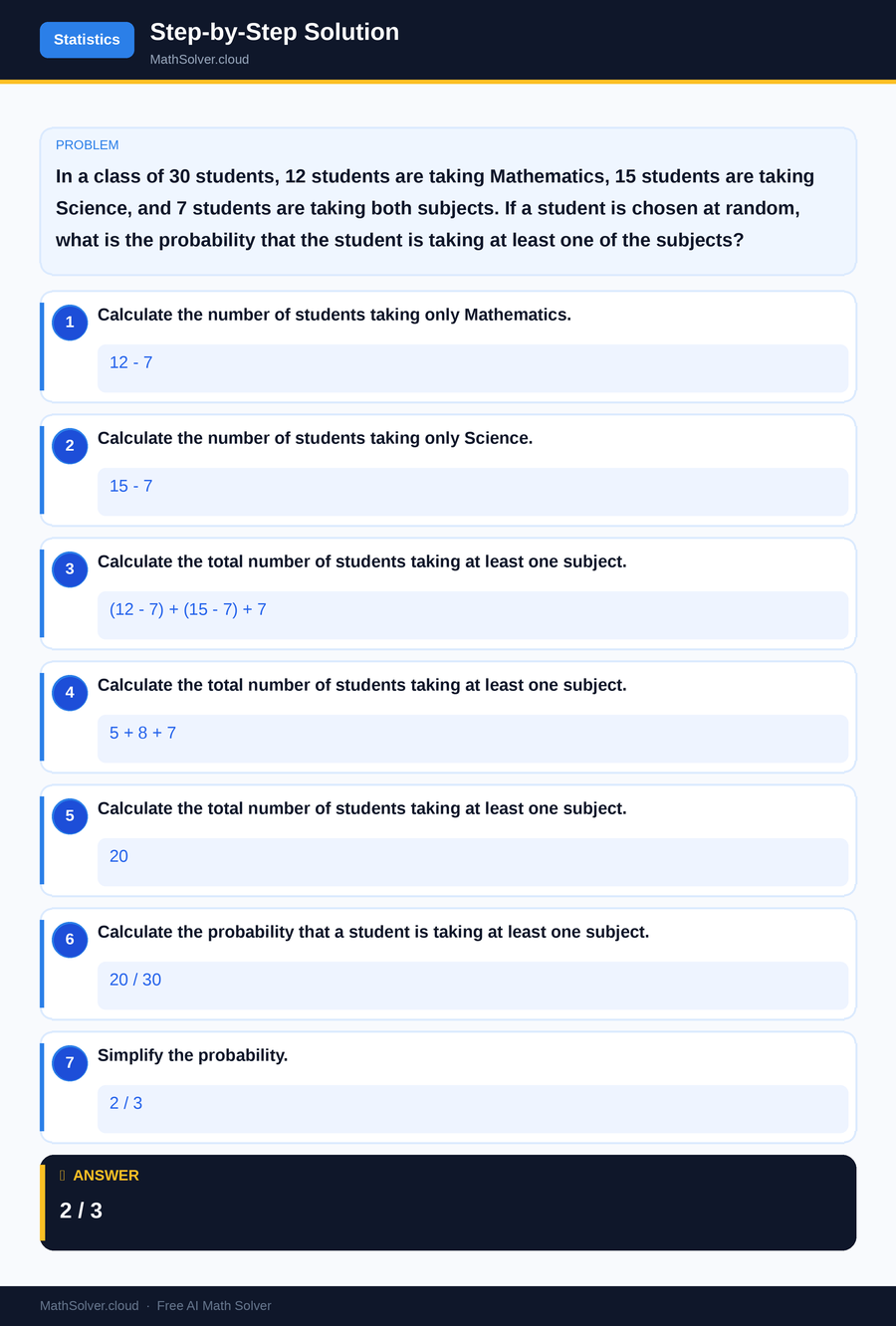
MathSolver Chrome extension solving this problem step-by-step
Common Mistakes to Avoid
A common mistake in solving probability equations is misidentifying the sample space. Students often overlook the total number of possible outcomes, leading to incorrect probability calculations. To avoid this, always begin by clearly defining the sample space and ensuring all possible outcomes are accounted for. Additionally, misunderstanding the event in question and miscounting favorable outcomes can lead to errors. Always double-check to ensure the correct outcomes are being considered.
Another frequent error is misapplying the probability formula, especially in complex scenarios involving multiple events or conditions. Students might incorrectly add or subtract probabilities without considering the rules of probability. To avoid such mistakes, thoroughly understand the problem context and apply probability rules consistently. Practice with diverse problems will also help solidify these concepts and reduce errors.
Real-World Applications
Probability equations have numerous real-world applications, making them a valuable tool in various fields. In finance, probability is used to assess risks and make investment decisions. Financial analysts use probability equations to predict stock market trends and the likelihood of economic events, helping investors make informed choices. Similarly, insurance companies rely on probability to calculate premiums and assess risks associated with policyholders.
In healthcare, probability equations play a crucial role in medical research and decision-making. Clinicians use probability to interpret diagnostic tests, evaluate treatment effectiveness, and predict patient outcomes. For example, the probability of a patient having a particular disease given a positive test result can be calculated using probability equations, aiding in diagnosis and treatment plans. These real-world applications underscore the importance of mastering probability equations.
Frequently Asked Questions
❓ What are probability equations used for?
❓ Why do students struggle with probability equations?
❓ How can AI help with probability equations?
❓ What is the difference between variance and standard deviation?
❓ How do probability equations relate to regression analysis?
🚀 Solve any math problem instantly
2,000+ students use MathSolver every day — join them for free
📥 Add to Chrome — It's Free