Mastering the Standard Deviation Equation
📋 In this guide
The standard deviation equation is a fundamental concept in statistics, representing how much variation or dispersion exists from the average (mean) of a set of data. It's an essential tool for students looking to understand data trends and variability in their studies, yet many find it challenging due to its complexity and the steps involved in its calculation. This article aims to break down the standard deviation equation into digestible parts, providing clarity and confidence in tackling this statistical measure.
Students often struggle with the standard deviation equation because it involves multiple steps and mathematical operations, such as finding the mean, squaring differences, and calculating the square root of deviations. These steps can seem daunting, especially if you’re new to statistical concepts. However, once you grasp the process, you’ll find that calculating standard deviation becomes much more manageable.
In this article, you will not only learn how to calculate the standard deviation equation step-by-step but also understand its real-world applications. You'll see worked examples that clarify the process and learn how to avoid common mistakes. By the end, you'll have a thorough understanding of both the sample and population standard deviation equations, as well as insights into using the mean and standard deviation equation effectively.
Step-by-Step: How to Solve Standard Deviation Equation
Step 1: Calculate the Mean
The first step in calculating the standard deviation equation is to find the mean of your data set. The mean is the average value of the data points. To calculate this, add up all the data points and then divide by the number of data points. For example, if you have data points 4, 8, 6, 5, and 3, the mean is (4 + 8 + 6 + 5 + 3) / 5 = 26 / 5 = 5.2.
Step 2: Determine Each Deviation from the Mean
Next, you need to find out how far each data point is from the mean. This is done by subtracting the mean from each data point. Using our example, the deviations from the mean 5.2 would be -1.2 for 4, 2.8 for 8, 0.8 for 6, -0.2 for 5, and -2.2 for 3. These deviations tell you how much each number differs from the average.
Step 3: Square Each Deviation
The third step involves squaring each of the deviations calculated in the previous step. Squaring the deviations ensures that we treat all deviations as positive values, preventing the positive and negative deviations from cancelling each other out. For instance, the squared deviations for our example are 1.44, 7.84, 0.64, 0.04, and 4.84.
Step 4: Calculate the Standard Deviation
Finally, sum up all the squared deviations, divide by the number of data points (for population standard deviation) or by one less than the number of data points (for sample standard deviation), and then take the square root. For our example, the sum of squared deviations is 14.8. For a sample, the calculation would be sqrt(14.8 / (5 - 1)), resulting in a standard deviation of approximately 1.92. For a population, it would be sqrt(14.8 / 5), approximately 1.72.
🤖 Stuck on a math problem?
Take a screenshot and let our AI solve it step-by-step in seconds
⚡ Try MathSolver Free →Worked Examples
Example 1
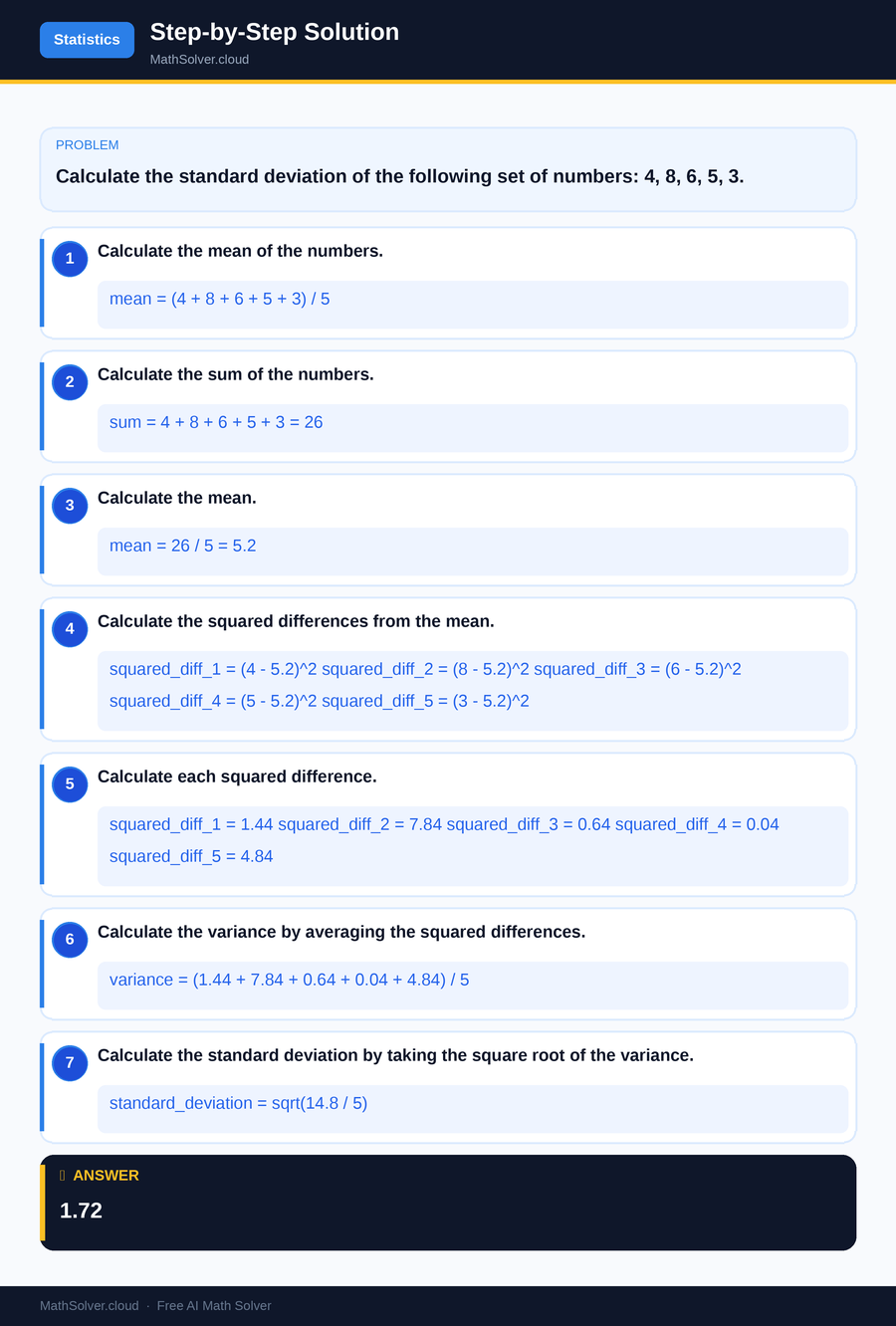
MathSolver Chrome extension solving this problem step-by-step
Example 2
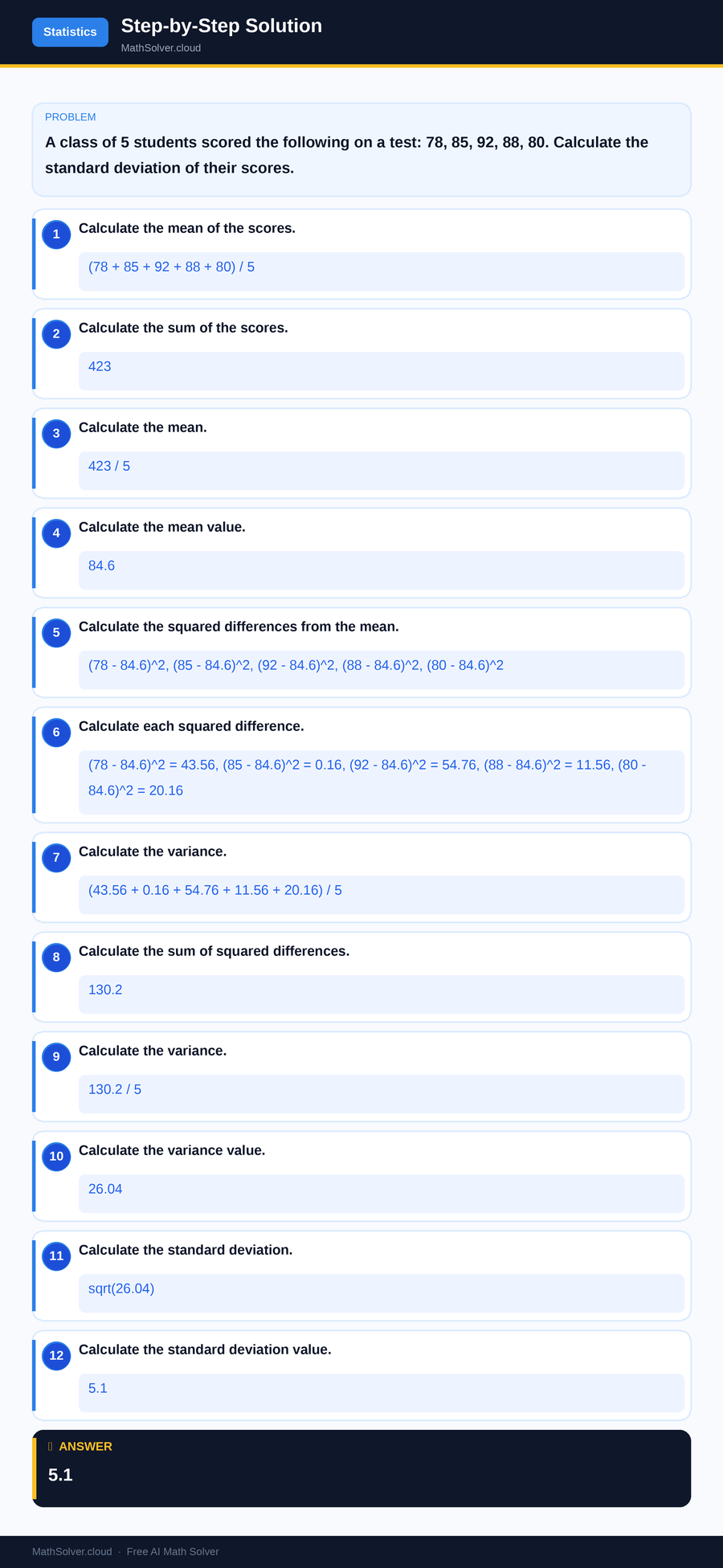
MathSolver Chrome extension solving this problem step-by-step
Common Mistakes to Avoid
One common mistake when using the standard deviation equation is forgetting whether you are calculating a population or sample standard deviation. This affects whether you divide by N or n-1, which can drastically alter your result. Always double-check which type of data set you're working with.
Another error is neglecting to square the deviations. This step is crucial as it ensures that all deviations contribute positively to the final standard deviation value. Skipping this step can lead to incorrect results. It's also important to remember to take the square root at the end, as this brings the units back to the original scale of the data.
Real-World Applications
The standard deviation equation is widely used in various fields to understand data variability. For instance, in finance, it helps assess the risk associated with investment portfolios. A higher standard deviation indicates more volatility and potential risk.
In manufacturing, standard deviation is used to measure product quality. By analyzing the standard deviation of product dimensions, companies ensure that their products meet quality standards consistently. This is crucial in industries where precision is key, such as aerospace and automotive.
Frequently Asked Questions
❓ What is the standard deviation equation used for?
❓ How does the standard deviation equation differ for samples and populations?
❓ How can AI help with standard deviation equation calculations?
❓ Why is the standard deviation equation important in statistics?
❓ Can you use the standard deviation equation for non-numeric data?
🚀 Solve any math problem instantly
2,000+ students use MathSolver every day — join them for free
📥 Add to Chrome — It's Free