Exploring Pre Algebra Concepts
📋 In this guide
Pre algebra is often the first step students take into the world of more advanced mathematics. It serves as a bridge between basic arithmetic and the formal study of algebra. Many students find pre algebra challenging due to the introduction of abstract concepts such as variables and equations. However, overcoming these initial hurdles is crucial as it lays the foundation for higher-level math courses like Algebra 1, Algebra 2, and even calculus.
Students typically struggle with pre algebra because it requires a shift from concrete numerical operations to more abstract thinking. Understanding how to manipulate variables and solve equations can be daunting at first. However, with practice and the right resources, such as pre algebra worksheets and interactive platforms like Khan Academy pre algebra, students can master these concepts. By delving into pre algebra, students will learn essential skills such as solving equations, understanding proportions, and working with integers, which are vital for future success in mathematics.
Ultimately, the goal of pre algebra is to prepare students for the challenges of more advanced math courses. By developing a solid understanding of pre algebra, students will be well-equipped to tackle algebraic expressions, work with quadratic equations, and solve complex problems in Algebra 1 and beyond. Tools like pre algebra calculators can also aid in this learning process by providing step-by-step solutions and explanations, making it easier for students to grasp difficult concepts.
Step-by-Step: How to Solve Pre Algebra
Understanding Variables and Constants
The first step in mastering pre algebra is understanding the difference between variables and constants. A variable is a symbol that can take on various values, whereas a constant is a fixed value. For example, in the expression 4x + 7, x is the variable, and 7 is the constant. Recognizing these components is crucial for simplifying expressions and solving equations.
Simplifying Algebraic Expressions
Once you understand variables and constants, the next step is to learn how to simplify algebraic expressions. This involves combining like terms and performing arithmetic operations. For instance, consider the expression 2x + 3x - 4. To simplify, combine the like terms 2x and 3x to get 5x, resulting in the simplified expression 5x - 4. Simplification is a fundamental skill in pre algebra that helps make complex problems more manageable.
Solving Simple Equations
The third step in pre algebra is solving simple equations. An equation is a mathematical statement that asserts the equality of two expressions. For example, consider the equation x + 5 = 9. To solve for x, you need to isolate the variable on one side of the equation. Subtract 5 from both sides to get x = 4. Solving equations is essential for tackling more complex problems in algebra.
Working with Fractions and Decimals
The final step involves working with fractions and decimals, which are common in pre algebra problems. Understanding how to add, subtract, multiply, and divide fractions and decimals is crucial. For example, to add the fractions 1/3 and 2/5, find a common denominator to get 5/15 + 6/15 = 11/15. Mastery of these operations is vital for success in algebra and other areas of mathematics.
🤖 Stuck on a math problem?
Take a screenshot and let our AI solve it step-by-step in seconds
⚡ Try MathSolver Free →Worked Examples
Example 1
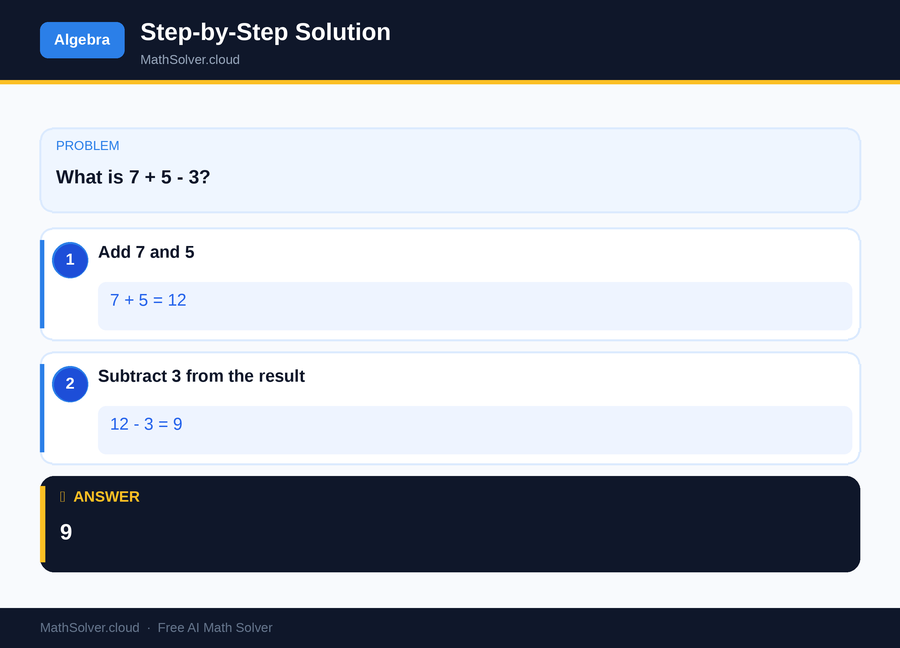
MathSolver Chrome extension solving this problem step-by-step
Example 2
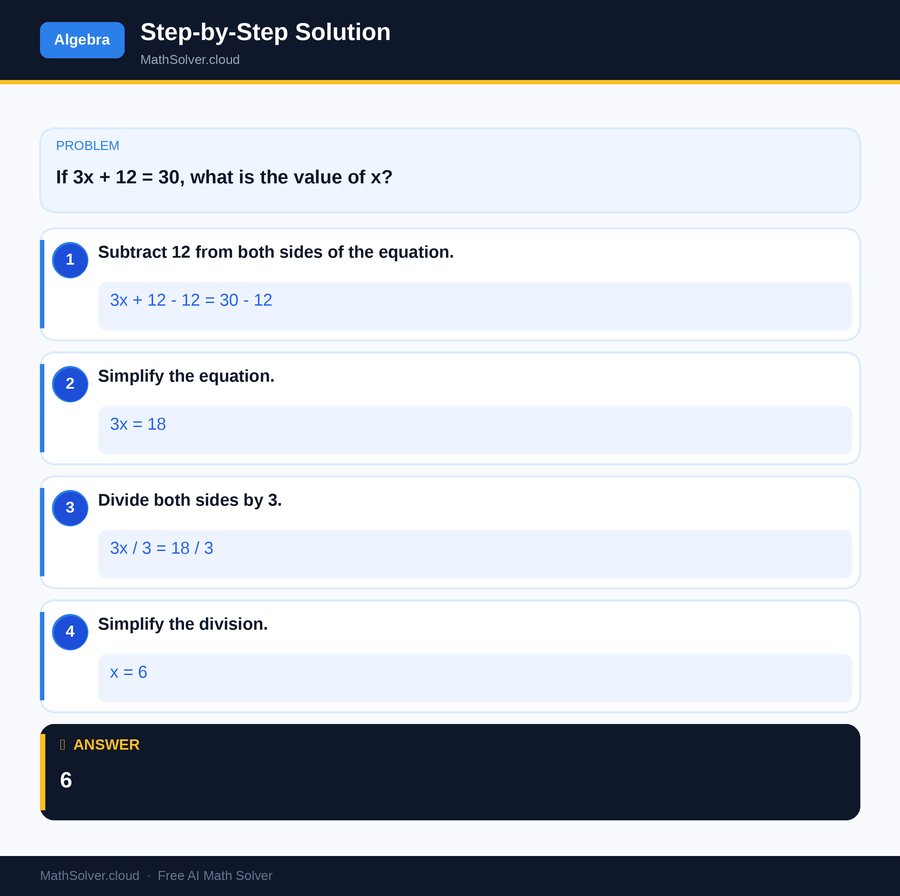
MathSolver Chrome extension solving this problem step-by-step
Common Mistakes to Avoid
One common mistake students make in pre algebra is not properly combining like terms. For example, in the expression 2x + 3 + x, students might forget to combine the x terms, resulting in an incorrect simplification. To avoid this mistake, always ensure that you identify and combine like terms correctly, which means adding or subtracting terms with the same variable and exponent.
Another frequent error is neglecting the order of operations, often remembered by the acronym PEMDAS (Parentheses, Exponents, Multiplication and Division, Addition and Subtraction). Misapplying this order can lead to incorrect solutions. For example, in the expression 3 + 4 * 2, you must first perform the multiplication (4 * 2 = 8) before the addition (3 + 8 = 11). Always remember to follow the order of operations to avoid such mistakes.
Real-World Applications
Pre algebra is not just an academic exercise; it has practical applications in everyday life. For instance, budgeting involves understanding and manipulating numbers, which is a fundamental skill taught in pre algebra. When planning a budget, you need to set aside fixed amounts for expenses and calculate the remaining balance, often requiring the use of algebraic expressions and solving equations.
Another real-world application of pre algebra is in cooking and baking. Recipes often require adjustments based on the number of servings needed. This involves understanding proportions and ratios, which are key concepts in pre algebra. By mastering these skills, you can easily scale recipes up or down, ensuring you get the desired results every time.
Frequently Asked Questions
❓ What is pre algebra?
❓ Why do students find pre algebra difficult?
❓ How can AI help with pre algebra?
❓ What resources are available to help with pre algebra?
❓ How is pre algebra used in real life?
🚀 Solve any math problem instantly
2,000+ students use MathSolver every day — join them for free
📥 Add to Chrome — It's Free