Understanding the Median Definition in Math
📋 In this guide
The median definition math is a fundamental concept in statistics and mathematics that refers to the middle value in a set of numbers. It's essential for students to grasp because it provides a measure of central tendency, offering insights into data distribution. However, many students find median definition math challenging due to misconceptions about how to properly arrange data sets and identify the middle value, especially when dealing with large or complex numbers. By exploring this concept, students will not only learn how to calculate the median but also understand its significance in various mathematical contexts.
The median is crucial in data analysis as it helps to accurately describe the center of a data set, unlike the mean, which can be skewed by outliers. Students will discover that mastering the median can illuminate aspects of data that are not apparent through other statistical measures. In this article, we will delve into the median definition math, provide a clear formula, and guide you through step-by-step calculations. Whether you're tackling mystatlab homework answers statistics or determining which regression equation best fits the data, understanding the median is vital.
We'll also explore the application of the median in real-world scenarios, such as economics, healthcare, and social sciences, where it plays a pivotal role in data interpretation. By the end of this guide, you'll have a comprehensive understanding of the median definition math and be equipped to apply it confidently across various mathematical and statistical problems.
Step-by-Step: How to Solve Median Definition Math
Step 1: Arrange the Numbers in Order
To begin calculating the median, the first step is to arrange your data set in either ascending or descending order. This organization is essential because the median is the middle value, and finding it requires a clear view of the data's progression. For instance, if you have the numbers 9, 2, and 5, you would rearrange them as 2, 5, and 9. This step helps avoid errors and provides a solid foundation for identifying the median accurately.
Step 2: Identify the Number of Data Points
Once your numbers are in order, determine how many data points are in your set. This is crucial because whether the number of data points is odd or even will dictate how you find the median. Counting these numbers will guide the subsequent steps. For instance, with a data set of 4, 8, 15, 16, 23, you know there are five data points, indicating an odd number set.
Step 3: Locate the Middle Number
With an odd number of observations, the median is simply the middle number after arranging the data set. If you have an even number of observations, calculate the median by taking the average of the two middle numbers. This step ensures you accurately pinpoint the median, which represents the data's central tendency. For example, in a data set of 5, 10, 15, the median is 10.
Step 4: Double-Check Your Work
Finally, double-check your calculations. Ensuring your data is correctly ordered and that you've accurately applied the median formula is crucial for reliable results. Mistakes often occur in data arrangement or arithmetic calculations, which can lead to incorrect medians. Reviewing your work helps solidify your understanding and ensures precision, especially in complex data sets.
🤖 Stuck on a math problem?
Take a screenshot and let our AI solve it step-by-step in seconds
⚡ Try MathSolver Free →Worked Examples
Example 1
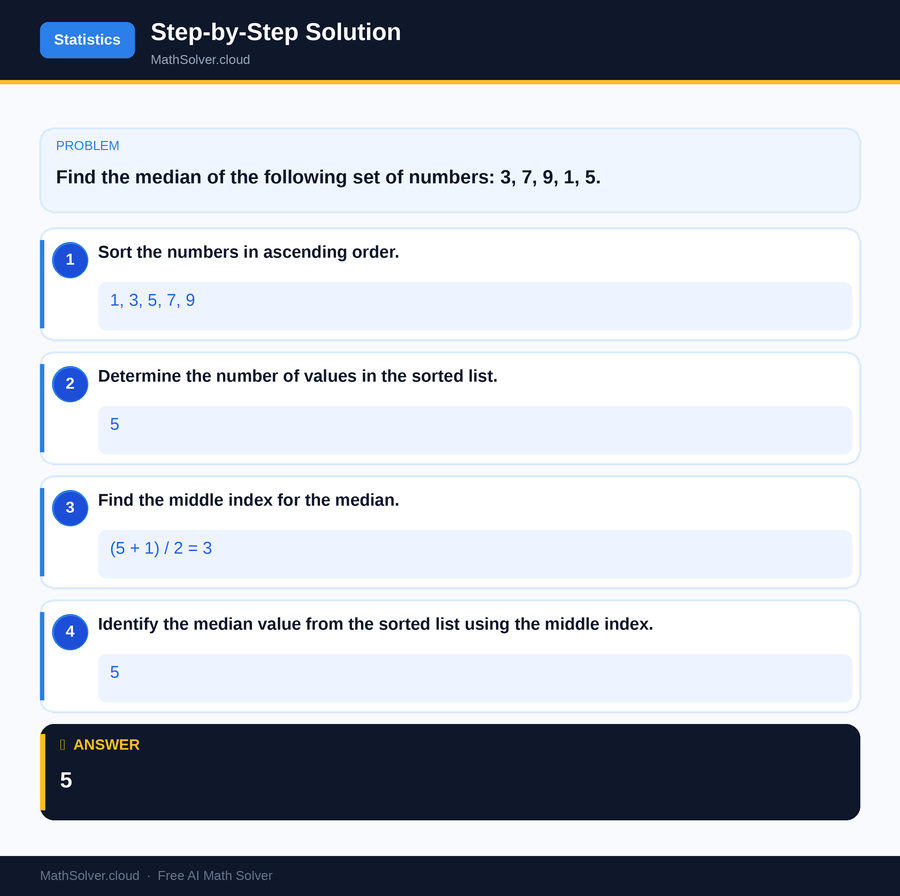
MathSolver Chrome extension solving this problem step-by-step
Example 2
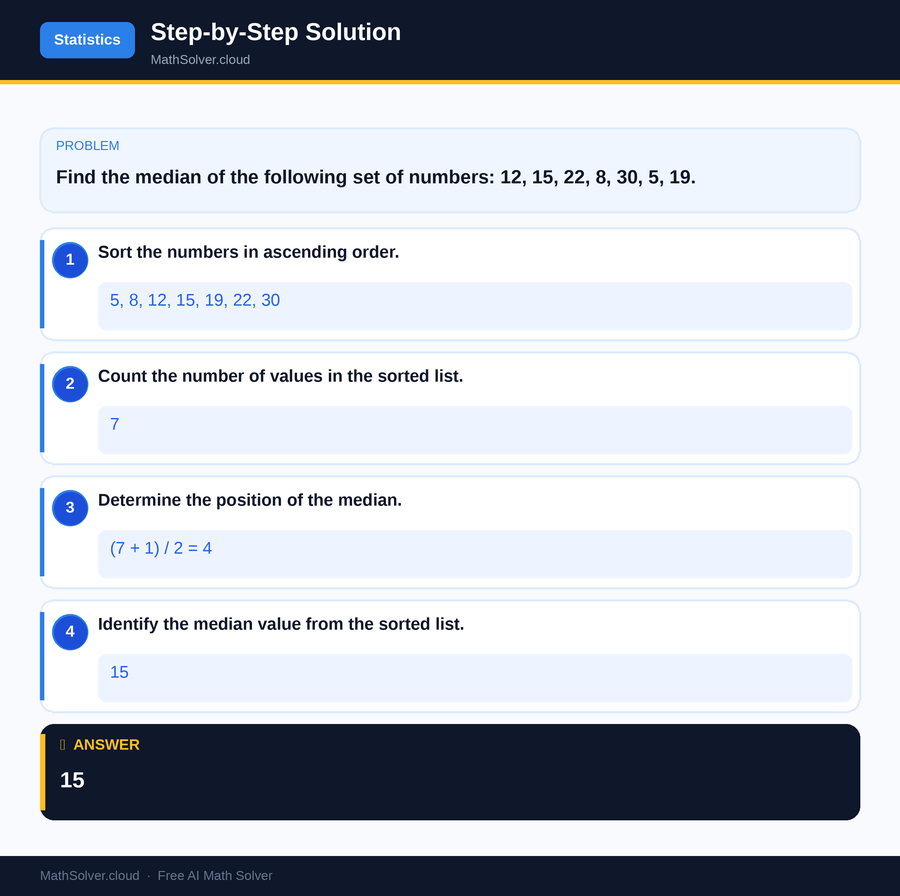
MathSolver Chrome extension solving this problem step-by-step
Common Mistakes to Avoid
A typical mistake in calculating the median is failing to properly order the data set before identifying the middle value. This error can significantly impact the result, as the median is dependent on the sequence of numbers. Always ensure the data is sorted to avoid this pitfall.
Another mistake is miscounting the number of data points, particularly when determining whether the set is odd or even. Missteps here can lead to the wrong application of the median formula. Double-check your data count to ensure accurate median calculations.
Real-World Applications
In real life, the median is often used in economics to determine income or wealth distribution, offering a clearer picture than the mean in cases with significant outliers. For instance, median income provides a more accurate measure of typical earnings by not being skewed by extremely high incomes.
In healthcare, the median is used to analyze data like patient recovery times or the spread of disease, which helps in planning medical resource allocation effectively. Understanding the median assists in making informed decisions, demonstrating its importance beyond pure mathematics.
Frequently Asked Questions
❓ Q1: What is the median definition math in simple terms?
❓ Q2: Why is the median important in statistics?
❓ Q3: How can AI help with median definition math?
❓ Q4: How does the median differ from the mean?
❓ Q5: What are some practical uses of the median?
🚀 Solve any math problem instantly
2,000+ students use MathSolver every day — join them for free
📥 Add to Chrome — It's Free