Demystifying the Mean Math Definition
📋 In this guide
The mean math definition is a fundamental concept in mathematics and statistics, often introduced in the early stages of education. It is a measure of central tendency that represents the average of a set of numbers. However, despite its apparent simplicity, many students struggle with understanding and applying the mean math definition. This struggle often arises from confusion about the steps involved in its calculation and the nuances of different types of means, such as arithmetic and geometric means. In this article, we will demystify the mean math definition, explore its various forms, and provide clear, step-by-step examples to help students grasp this essential concept.
Understanding the mean math definition is crucial because it forms the basis for more advanced statistical concepts, such as variance and standard deviation. These concepts are essential for analyzing data, whether in academic settings or real-world applications like finance and research. By mastering the mean, students can build a strong foundation for further studies in statistics and data analysis.
In this comprehensive guide, you will learn not only the mean math definition but also how to calculate it accurately and efficiently. We will walk you through the key formula, provide worked examples, and offer practical tips to avoid common mistakes. By the end of this article, you should feel confident in your ability to calculate and interpret the mean in various contexts. Let’s dive in!
Step-by-Step: How to Solve Mean Math Definition
Step 1: Gather Your Data
Before you can calculate the mean, you need to have a clear set of data. This data could be anything from test scores to sales figures. Ensure that you have all the necessary numbers and that they are organized in a list. For example, if you are calculating the mean score of a test taken by several students, list all the scores.
Step 2: Sum the Values
The next step in applying the mean math definition is to add up all the numbers in your data set. This might seem straightforward, but it’s crucial to be accurate. Take your time to ensure that you’ve added every value correctly. The sum of these numbers will be used in the next step to find the mean.
Step 3: Count the Numbers
Once you have the total sum of your data, count how many numbers are in your set. This count is essential for the division step, as dividing by the correct number ensures that your mean is accurate. Double-check your count to avoid any errors, as this is a common area where mistakes can occur.
Step 4: Calculate the Mean
Finally, divide the sum of the numbers by the count of the numbers. This division gives you the mean, which represents the average value of your data set. Ensure your division is correct, and remember that the mean can be a whole number or a decimal, depending on your data. This final step completes the process of applying the mean math definition.
🤖 Stuck on a math problem?
Take a screenshot and let our AI solve it step-by-step in seconds
⚡ Try MathSolver Free →Worked Examples
Example 1
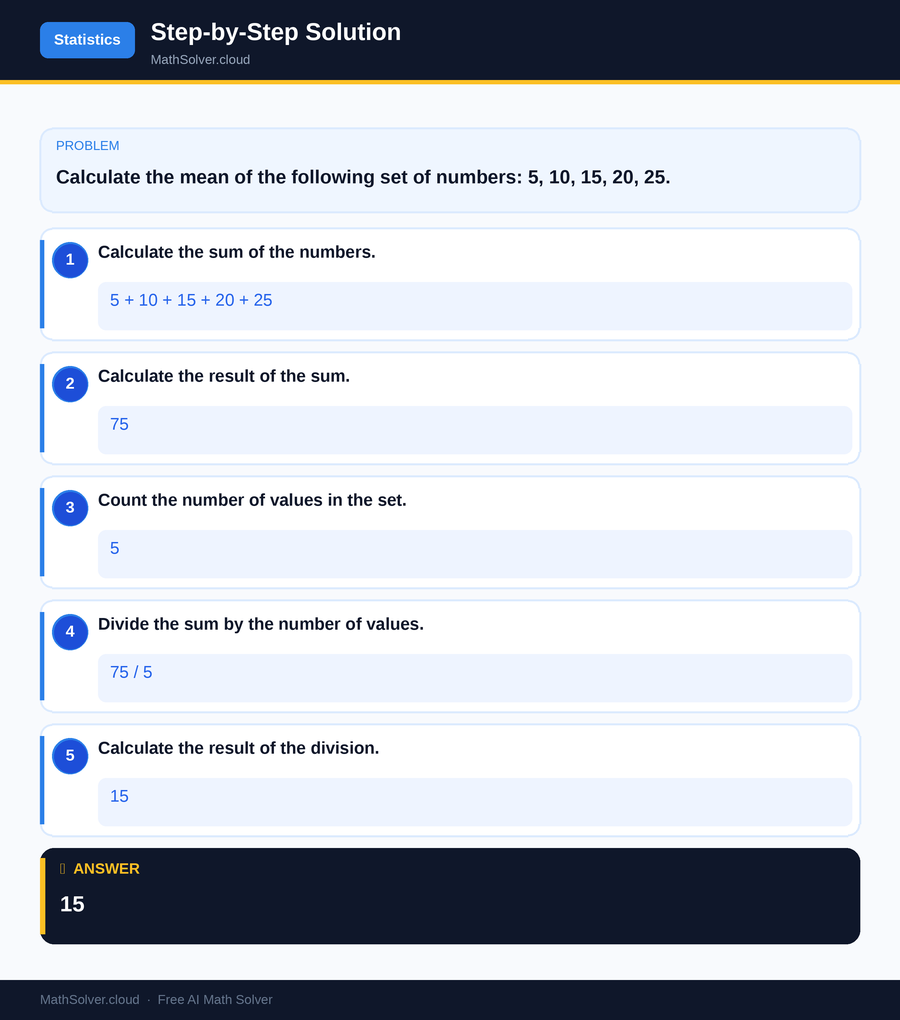
MathSolver Chrome extension solving this problem step-by-step
Example 2
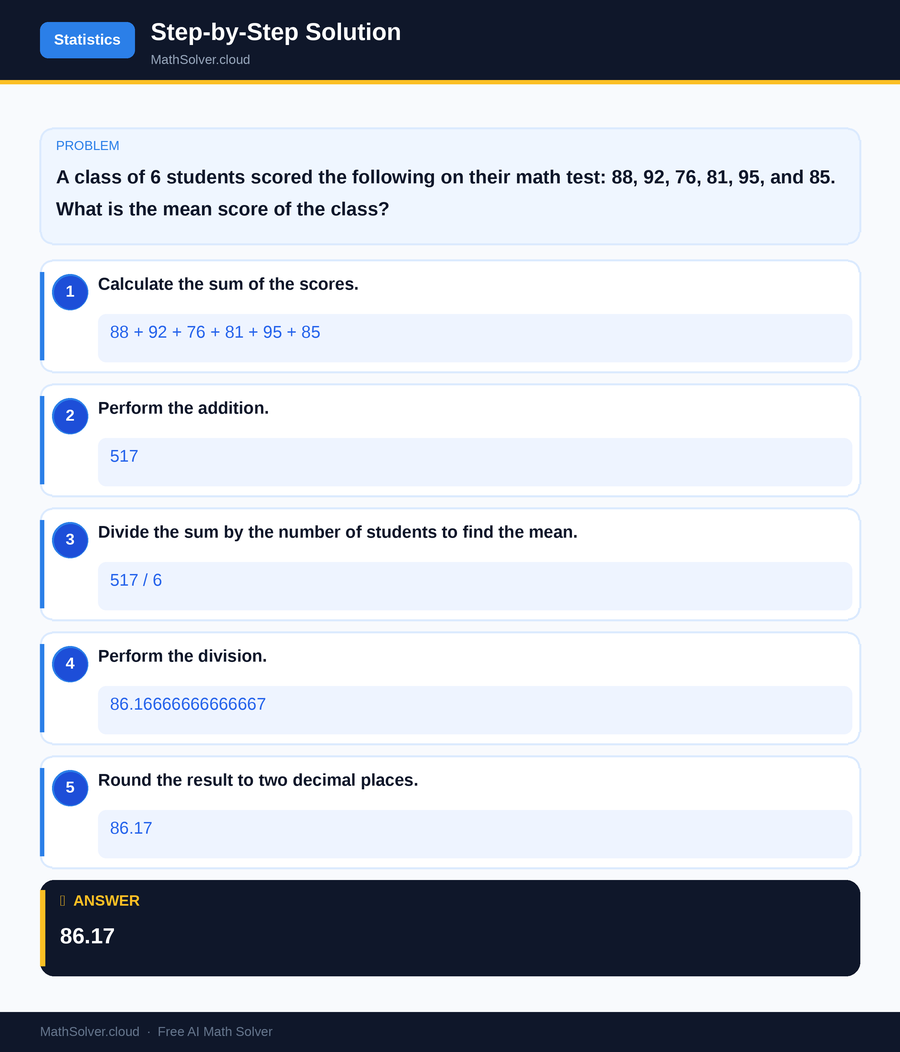
MathSolver Chrome extension solving this problem step-by-step
Common Mistakes to Avoid
One common mistake students make when applying the mean math definition is forgetting to include all data points in the sum. This error can lead to an inaccurate mean, as excluding even one number can skew the result significantly. To avoid this mistake, double-check your list and ensure every number is included in the calculation.
Another mistake is miscounting the number of data points, which affects the division step. Students often overlook this step, leading to a mean that does not accurately represent the data set. To avoid this, always recount your data points before dividing to ensure accuracy.
Real-World Applications
The mean math definition has numerous real-world applications, making it an essential tool in various fields. In business, companies use the mean to analyze sales data and make informed decisions about product pricing and inventory management. By understanding the average sales figures, businesses can optimize their strategies to maximize profit.
In the field of education, teachers use the mean to assess class performance on tests and assignments. By calculating the average score, educators can identify trends and areas where students may need additional support. This information is vital for adjusting teaching methods and improving student outcomes.
Frequently Asked Questions
❓ What is the mean math definition?
❓ What is a common student question about this topic?
❓ How can AI help with the mean math definition?
❓ What is the geometric mean math definition?
❓ How is the mean math definition used in statistics?
🚀 Solve any math problem instantly
2,000+ students use MathSolver every day — join them for free
📥 Add to Chrome — It's Free