Understanding the Mean in Math Definition
📋 In this guide
Understanding the mean in math definition is crucial for students as it is a fundamental concept that underpins many areas of mathematics and statistics. The mean, often referred to as the average, is a measure of central tendency that provides insight into the data's overall distribution. Despite its simplicity, students often struggle with the mean, primarily due to confusion with other measures like median and mode, misunderstandings about formula application, or errors in calculation. This article will guide you through the mean in math definition, offer step-by-step instructions on how to calculate it, and provide examples and practical applications to solidify your understanding.
By the end of this article, you will have a comprehensive grasp of what is the mean in math definition, how to calculate it accurately, and its significance in real-world scenarios. We will also explore common mistakes to avoid and answer frequently asked questions to enhance your learning experience. Additionally, you'll learn how tools like the MathSolver Chrome extension can assist you in solving mean-related problems quickly and efficiently.
Whether you are tackling mystatlab homework answers statistics or exploring which regression equation best fits the data, understanding the mean is indispensable. So let's dive in and demystify the mean in math definition, ensuring you have all the knowledge and tools at your disposal.
Step-by-Step: How to Solve Mean In Math Definition
Step 1: Identify the Set of Numbers
To calculate the mean, the first step is to clearly identify the set of numbers you are working with. This set can consist of any number of values, whether they are test scores, data points, or financial figures. Ensure you have the complete list, as missing even one number can lead to incorrect calculations. Understanding the context of the numbers can also give you insights into what the mean represents in that particular scenario.
Step 2: Sum the Numbers
Once you have your set of numbers, the next step is to sum them all together. This involves adding each number in your set to obtain a total. It's essential to be meticulous in this step, especially with larger data sets, to avoid errors. Double-check your addition to ensure accuracy, as the sum is a critical component of the mean calculation.
Step 3: Count the Numbers
After obtaining the sum, the next step is to count how many numbers are in your set. This count will be the divisor in your mean calculation. Ensure you count all the numbers accurately, as an incorrect count will result in an incorrect mean. This step is straightforward but requires attention to detail, especially when dealing with larger sets of data.
Step 4: Divide the Sum by the Count
In the final step, you will divide the sum of your numbers by the count of numbers. This division will yield the mean of your data set. Ensure you perform this division carefully to avoid rounding errors, especially if your sum and count result in a decimal. The result of this division is the mean, providing insight into the central tendency of your data set.
🤖 Stuck on a math problem?
Take a screenshot and let our AI solve it step-by-step in seconds
⚡ Try MathSolver Free →Worked Examples
Example 1
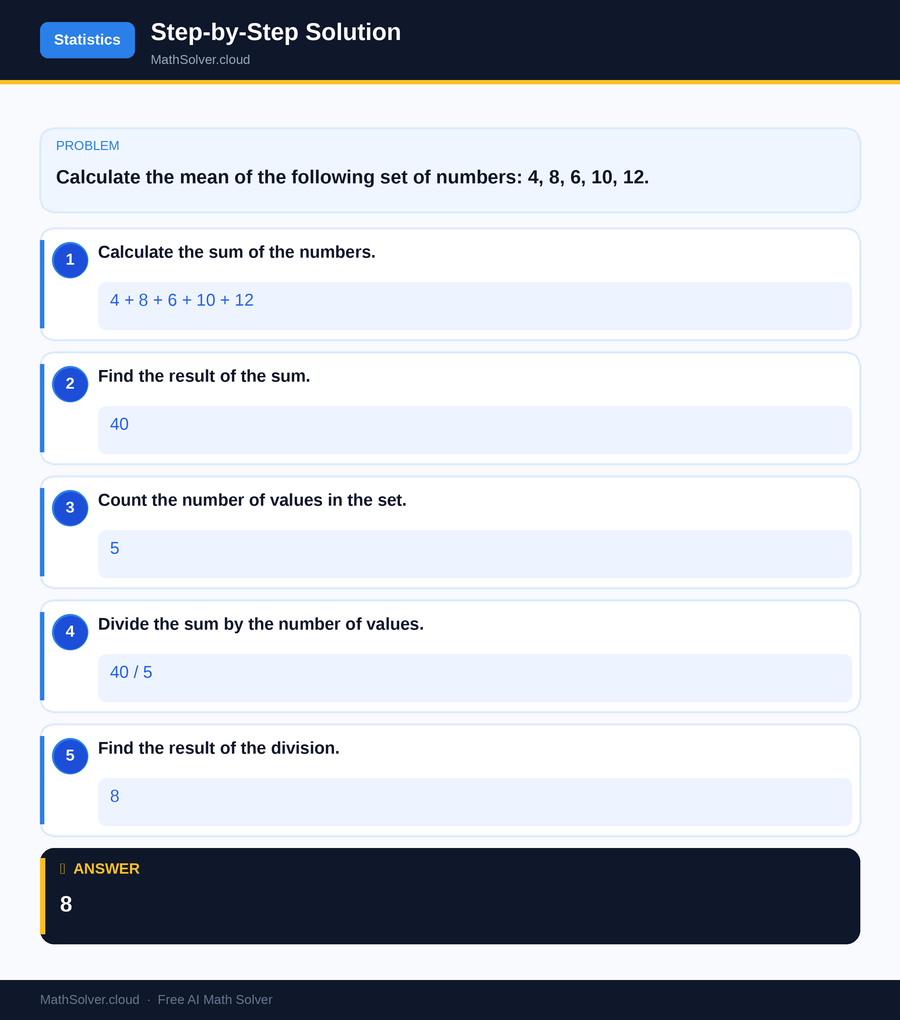
MathSolver Chrome extension solving this problem step-by-step
Example 2
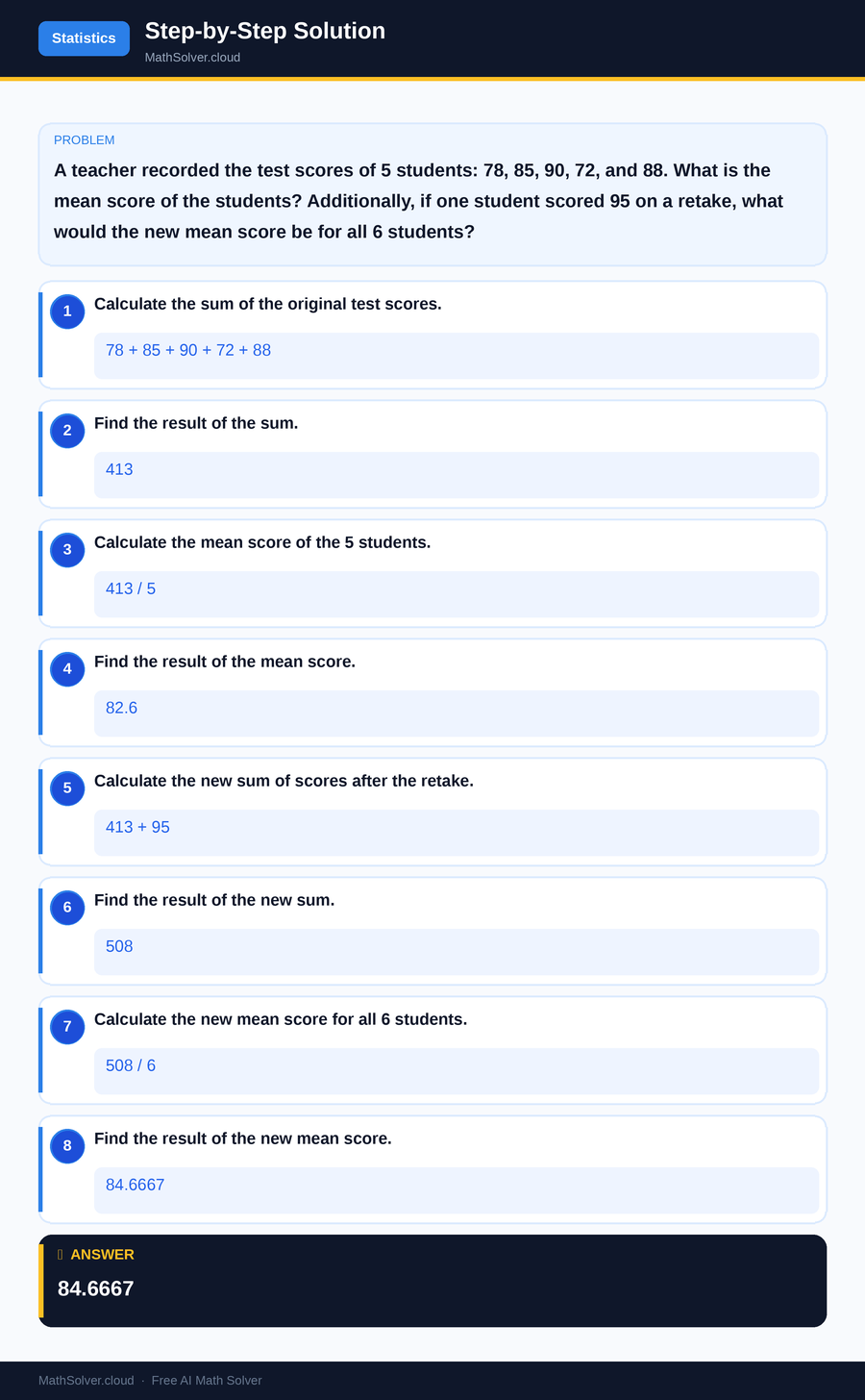
MathSolver Chrome extension solving this problem step-by-step
Common Mistakes to Avoid
One common mistake students make when calculating the mean is neglecting to include all numbers in the sum. This oversight can lead to an incorrect result. Always double-check that your sum includes every number in the set. Another frequent error is miscounting the total number of numbers, which affects the divisor in your calculation. Be sure to count carefully and accurately.
Additionally, students sometimes confuse the mean with the median or mode. Remember that the mean is the arithmetic average of a set, while the median is the middle value when data is ordered, and the mode is the most frequently occurring value. Understanding these differences will help you apply the correct concept to the problem at hand.
Real-World Applications
The mean in math definition is widely used in various real-world applications. In the field of finance, for instance, calculating the mean is essential for determining the average return on investments, which helps investors make informed decisions. Similarly, businesses use the mean to analyze sales data, track performance metrics, and forecast future trends.
In education, the mean is often used to calculate average test scores, helping educators assess overall student performance and identify areas for improvement. Additionally, the mean is crucial in research and data analysis, where it provides insights into the central tendency of data, enabling researchers to draw meaningful conclusions. These examples highlight the practical importance of understanding the mean in math definition.
Frequently Asked Questions
❓ What is the mean in math definition?
❓ Why do students confuse the mean with the median and mode?
❓ How can AI help with mean in math definition?
❓ What does mode mean in math definition, and how does it differ from the mean?
❓ When is it more appropriate to use the mean instead of the median?
🚀 Solve any math problem instantly
2,000+ students use MathSolver every day — join them for free
📥 Add to Chrome — It's Free