Understanding the Mean Definition Math
📋 In this guide
The mean definition math is a fundamental concept that often forms the foundation for statistical analysis, yet many students find it challenging to grasp fully. At its core, the mean, commonly known as the average, is a measure of central tendency that provides an overall summary of a data set. It is widely used in various fields, from academic assessments to financial analysis, to offer quick insights into the data at hand. Understanding the mean is crucial for students, as it serves as a stepping stone to more complex statistical concepts such as variance and standard deviation.
Despite its apparent simplicity, students frequently struggle with the mean definition math due to misunderstandings about its calculation, its interpretation, or when to apply it. Some students may confuse it with other measures of central tendency, such as the median or mode. Others might have difficulty computing the mean when faced with large data sets or when dealing with special types of mean like the weighted mean or geometric mean. This article aims to clarify these points and provide a comprehensive understanding of the mean definition math.
By the end of this article, students will gain a solid grasp of what the mean is, how to compute it, and where it can be applied in real-life scenarios. We will delve into the key formulas, provide step-by-step guidance, and illustrate the concept with worked examples. Additionally, we'll address common mistakes, explore real-world applications, and answer frequently asked questions to ensure a thorough comprehension of this essential mathematical term.
Step-by-Step: How to Solve Mean Definition Math
Step 1: Gather Your Data
The first step in calculating the mean definition math is to gather all the data points you want to analyze. Ensure that your data set is complete and accurate, as any missing or incorrect data can lead to inaccurate results. This step also involves deciding whether you are dealing with a sample or an entire population, as this will affect further statistical analysis but not the basic calculation of the mean itself.
Step 2: Sum Up the Data Points
Once you have your complete data set, the next step is to add up all the individual values. This sum is an essential component of the mean definition math formula. For example, if your data set is 3, 5, and 7, you would calculate the sum as 3 + 5 + 7 = 15. Make sure to double-check your calculations to avoid errors at this stage.
Step 3: Count the Number of Data Points
After summing up your data, the next step is to determine the total number of data points. This will serve as the divisor in the mean definition math formula. Continuing with the example above, the data set 3, 5, and 7 consists of 3 data points. Accurate counting is crucial, especially in larger data sets, where it's easy to miscount.
Step 4: Calculate the Mean
Finally, divide the sum of the data points by the number of data points to find the mean. In our example, the mean would be calculated as 15 (sum) / 3 (number of data points) = 5. This result represents the arithmetic mean of your data set, providing a central value that summarizes the data.
🤖 Stuck on a math problem?
Take a screenshot and let our AI solve it step-by-step in seconds
⚡ Try MathSolver Free →Worked Examples
Example 1
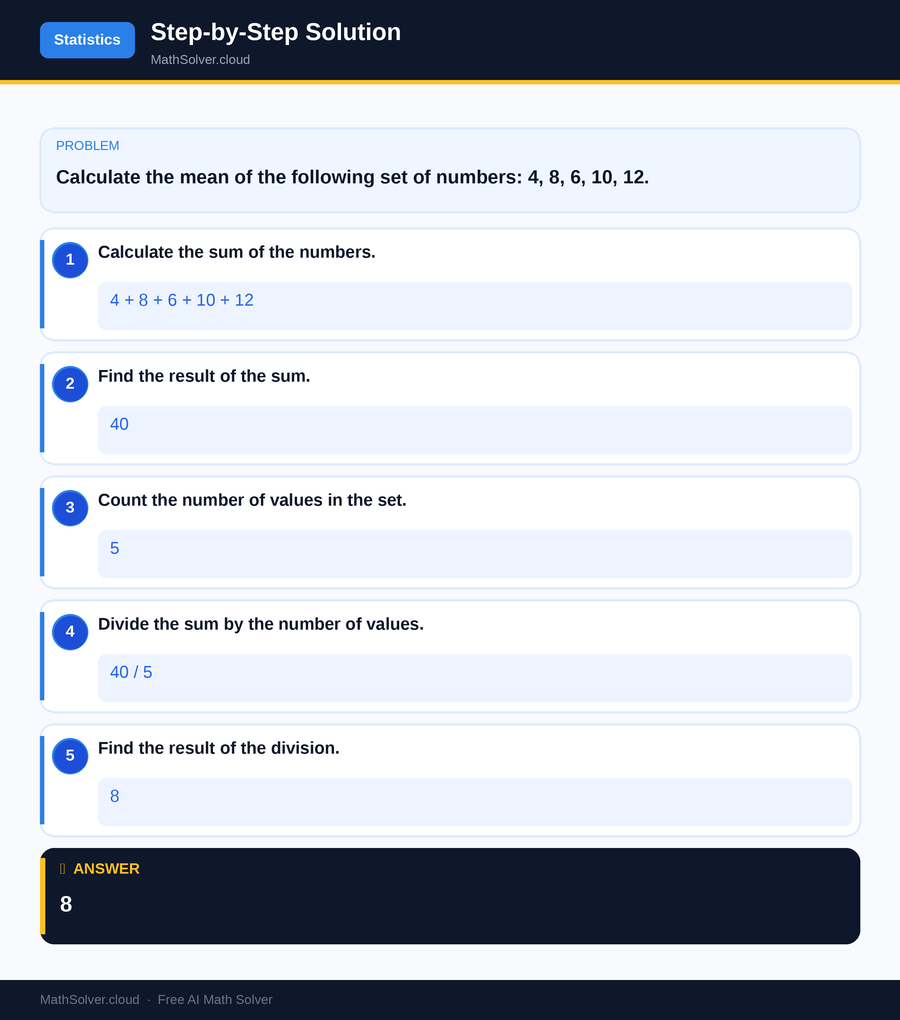
MathSolver Chrome extension solving this problem step-by-step
Example 2
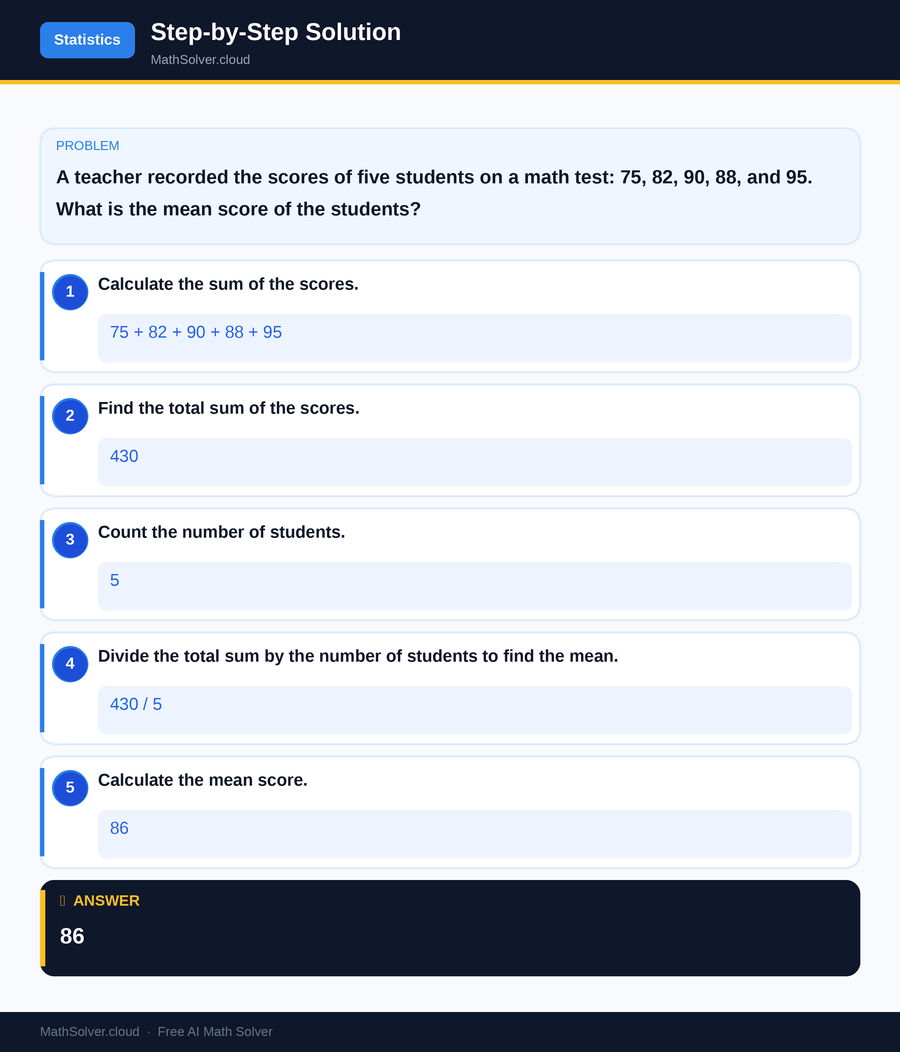
MathSolver Chrome extension solving this problem step-by-step
Common Mistakes to Avoid
One common mistake students make when working with mean definition math is forgetting to include all data points in the sum. Omitting even a single number can significantly alter the outcome. Another frequent error is miscounting the number of data points, which can lead to incorrect division and, therefore, an inaccurate mean. To avoid these mistakes, it's vital to double-check your initial data set and your calculations at each step of the process.
Additionally, students sometimes confuse the mean with other statistical terms, such as the median or mode. While all these terms describe measures of central tendency, they differ in calculation and interpretation. Ensuring a clear understanding of each term's definition and application is essential for accurate statistical analysis.
Real-World Applications
The mean definition math is used extensively in real-world scenarios. In business and economics, the mean can provide insights into average sales figures, helping companies make informed decisions about production and marketing strategies. For instance, knowing the average sales per month can aid in forecasting demand and managing inventory levels effectively.
In social sciences, the mean is often used to describe average income levels, health statistics, or educational outcomes, providing a baseline for policy-making and research. For example, calculating the average income of a population can guide decisions on tax policies or social welfare programs. Understanding these applications highlights the importance of mastering the mean definition math for practical and professional purposes.
Frequently Asked Questions
❓ What is the mean definition math, and how is it used?
❓ How does the mean differ from the median and mode?
❓ How can AI help with mean definition math?
❓ What is the geometric mean, and how does it relate to the mean definition math?
❓ How is the weighted mean different from the regular mean?
🚀 Solve any math problem instantly
2,000+ students use MathSolver every day — join them for free
📥 Add to Chrome — It's Free