Mastering the Mean Arterial Pressure Equation
📋 In this guide
The mean arterial pressure equation is a crucial concept in both medical and mathematical contexts. This equation helps in determining the average blood pressure in a person's arteries during one cardiac cycle, providing valuable insights into a patient's cardiovascular health. Despite its importance, many students struggle with the mean arterial pressure equation due to its combination of mathematical precision and physiological application. In this article, you'll learn what the mean arterial pressure equation is, its significance, and how to solve related problems with ease.
Understanding the mean arterial pressure equation requires a grasp of basic algebra equations, as well as an appreciation for how these principles apply to physiological processes. Students often find it challenging to bridge the gap between abstract mathematical concepts and real-world applications, like those found in medical diagnostics. By breaking down this topic into manageable steps, this article aims to clarify these concepts and build your confidence in solving mean arterial pressure problems.
Throughout this guide, we'll explore the mean arterial pressure equation in detail, providing step-by-step instructions for solving specific problems. You'll learn not only to calculate mean arterial pressure but also to avoid common mistakes and appreciate its real-world applications. Whether you're studying for a test or seeking to understand this equation's practical uses, this article is your comprehensive resource for mastering the mean arterial pressure equation.
Step-by-Step: How to Solve Mean Arterial Pressure Equation
Step 1: Understand the Components
Before diving into calculations, it's essential to understand the components of the mean arterial pressure equation. Systolic blood pressure (SBP) is the pressure in the arteries when the heart beats, while diastolic blood pressure (DBP) is the pressure when the heart is at rest between beats. The equation uses these two values to determine the mean arterial pressure (MAP), providing a single value that represents the average blood pressure during one cardiac cycle. Grasping these definitions will help you apply the formula correctly.
Step 2: Identify the Variables
In any problem involving the mean arterial pressure equation, the first step is to identify the given values of SBP and DBP. These measurements are typically provided in millimeters of mercury (mmHg). For example, a problem might state that a patient has an SBP of 120 mmHg and a DBP of 80 mmHg. Clearly identifying these variables ensures that you can substitute them accurately into the equation, setting you up for a successful calculation.
Step 3: Substitute and Simplify
Once you've identified the SBP and DBP, substitute these values into the mean arterial pressure equation: MAP = DBP + 1/3(SBP - DBP). Begin by calculating the difference between the SBP and DBP, then multiply this result by 1/3 to find the contribution of the pulse pressure to the MAP. Finally, add this value to the DBP to determine the mean arterial pressure. This step involves basic algebra equations, so take your time to ensure accuracy in each calculation.
Step 4: Verify Your Solution
Verification is a critical final step in solving any equation. After calculating the mean arterial pressure, double-check your work by reviewing each step and ensuring that all calculations are correct. Consider whether the result makes sense in the context of the problem, and if necessary, compare it to expected physiological ranges. This step helps prevent common errors and reinforces your understanding of the mean arterial pressure equation.
🤖 Stuck on a math problem?
Take a screenshot and let our AI solve it step-by-step in seconds
⚡ Try MathSolver Free →Worked Examples
Example 1
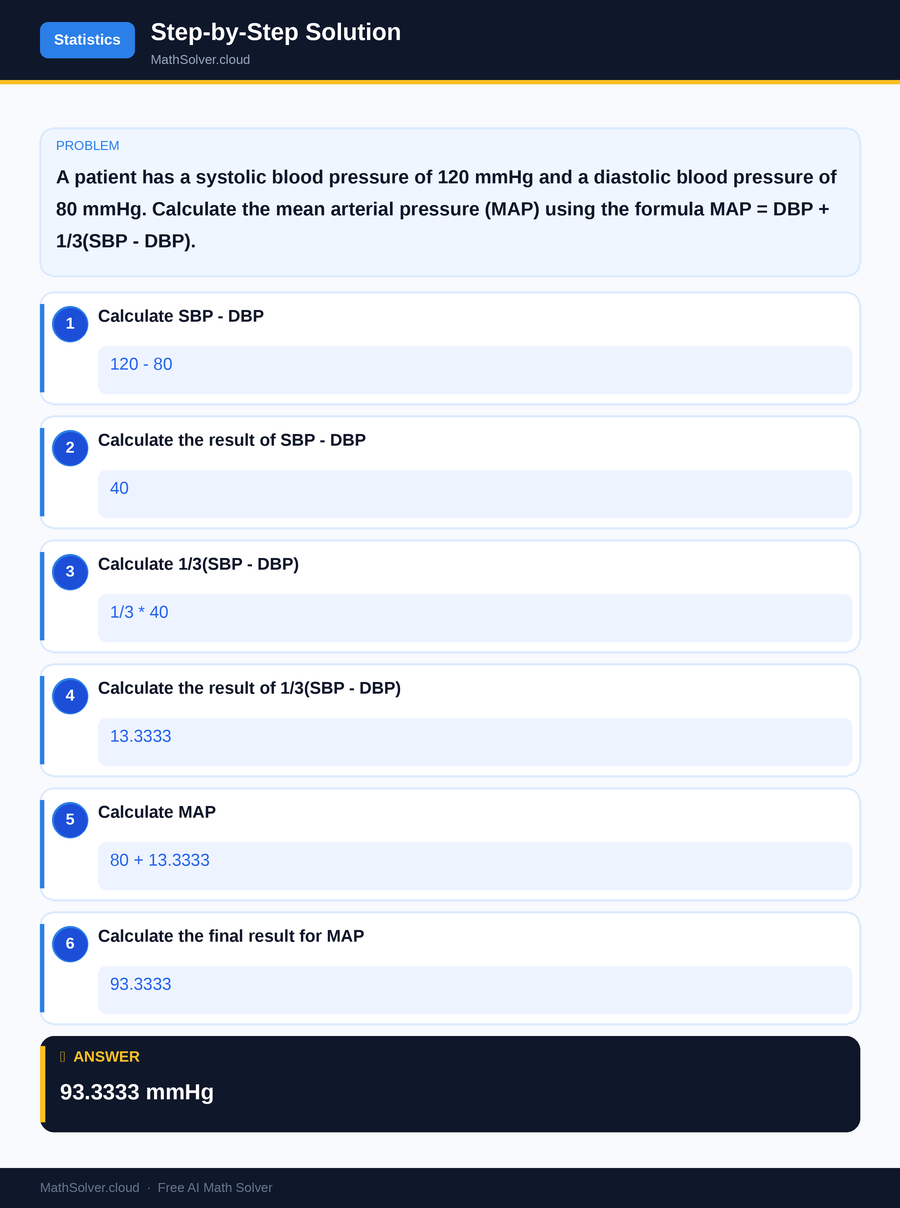
MathSolver Chrome extension solving this problem step-by-step
Example 2
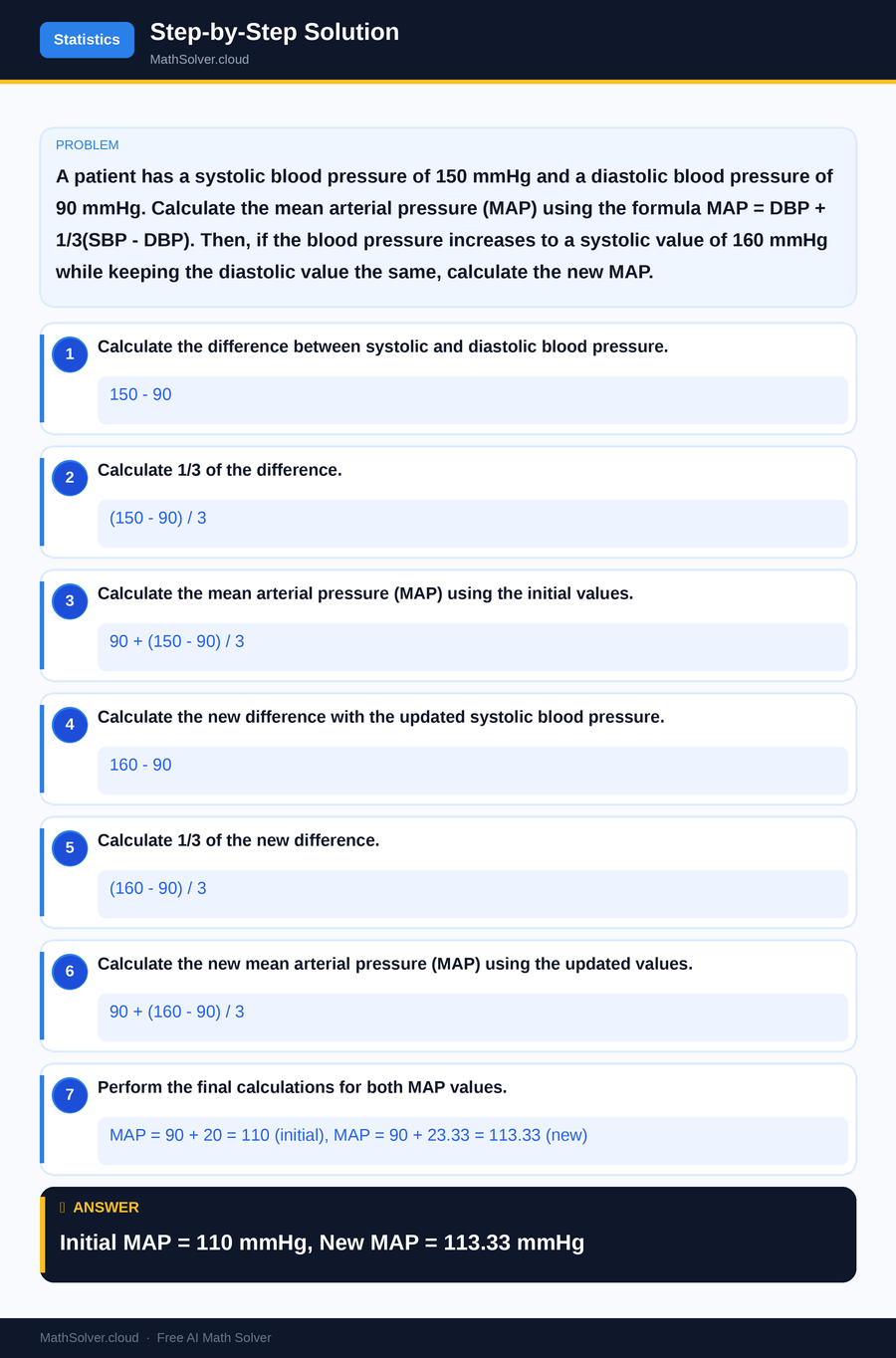
MathSolver Chrome extension solving this problem step-by-step
Common Mistakes to Avoid
Students often make errors in the mean arterial pressure equation by misidentifying the SBP and DBP values. It’s crucial to carefully read the problem and ensure you’re substituting the correct numbers into the equation. Another common mistake involves arithmetic errors, particularly when calculating the difference between SBP and DBP and multiplying by 1/3. Double-checking each step can help prevent these errors.
Another pitfall is failing to interpret the results within a physiological context. Remember that the mean arterial pressure should fall within a reasonable range, typically between 70 and 110 mmHg for healthy adults. If your calculated MAP falls outside this range, it may indicate an error in your calculations or the problem’s parameters.
Real-World Applications
The mean arterial pressure equation is widely used in medical settings to monitor a patient's cardiovascular health. It provides healthcare professionals with a quick and reliable estimate of blood flow to organs, which is crucial in diagnosing conditions like hypertension and shock. Understanding how to calculate and interpret MAP enables medical professionals to make informed decisions about treatment and patient care.
Beyond healthcare, the mean arterial pressure equation also serves as an example of how mathematical principles apply to real-world scenarios. It showcases the intersection of physiology and algebra, demonstrating how equations like the quadratic equation and kinematic equations can be used to solve complex problems in various fields. This broader understanding can inspire students to explore other applications of mathematics, such as the photosynthesis equation in biology.
Frequently Asked Questions
❓ What is the mean arterial pressure equation?
❓ Why do students often struggle with the mean arterial pressure equation?
❓ How can AI help with the mean arterial pressure equation?
❓ How is mean arterial pressure different from regular blood pressure readings?
❓ How do I know if my calculated MAP is accurate?
🚀 Solve any math problem instantly
2,000+ students use MathSolver every day — join them for free
📥 Add to Chrome — It's Free