Mastering the Math Calculator: A Comprehensive Guide
📋 In this guide
A math calculator is an essential tool for students and professionals alike, designed to simplify complex mathematical operations and provide accurate results quickly. Many students find themselves struggling with math due to the vast array of formulas, theorems, and problem-solving techniques that must be mastered. This can lead to frustration and a lack of confidence in their mathematical abilities. However, with the right tools and guidance, such as a math calculator, students can overcome these challenges. In this article, you'll learn about different types of math calculators, their functionalities, and how to use them effectively to enhance your math-solving skills.
Math calculators come in various forms, ranging from basic arithmetic calculators to advanced scientific calculators capable of solving complex equations. With the rise of technology, many students now have access to online math calculators that offer step-by-step solutions, making it easier to understand the problem-solving process. These tools are invaluable for students who need extra help with algebra, calculus, or even matrix operations. By understanding how to utilize a math calculator effectively, students can improve their problem-solving skills and excel in their studies.
In addition to helping with homework and exams, math calculators are also used in various professional fields. Engineers, scientists, and financial analysts rely on math calculators to perform precise calculations that are crucial to their work. By mastering the use of these calculators, students not only prepare themselves for academic success but also gain valuable skills applicable in the workforce. Throughout this article, we'll explore the different types of math calculators, provide detailed examples of how to use them, and share tips for avoiding common mistakes.
Step-by-Step: How to Solve Math Calculator
Step 1: Understanding the Basics of Math Calculators
To effectively use a math calculator, it's crucial to understand its basic functions. Most calculators include standard operations such as addition, subtraction, multiplication, and division. However, scientific calculators offer additional capabilities like calculating exponents, logarithms, trigonometric functions, and more. Familiarize yourself with the layout of the calculator, including the keypad and display. Look for buttons that allow you to switch between different modes, such as degree and radian mode for trigonometric functions. Understanding these basics will set the foundation for tackling more complex problems.
Step 2: Learning to Input Equations Correctly
One of the most important skills in using a math calculator is learning how to input equations correctly. This involves understanding the order of operations, commonly known as PEMDAS (Parentheses, Exponents, Multiplication and Division, Addition and Subtraction). Ensure that you enter equations using this order to avoid errors. For instance, when solving an equation like 3 + 5 * 2, input it as 3 + (5 * 2) to get the correct result of 13. Pay attention to parentheses and use them to group terms as needed. This ensures that your calculator performs calculations in the correct sequence.
Step 3: Utilizing Advanced Functions and Features
For more complex problems, such as those involving algebra or calculus, you'll need to utilize the advanced functions of your math calculator. This includes solving equations with unknowns, calculating derivatives, and evaluating integrals. Many calculators have specific keys or menus for these functions. For example, a math calculator algebra feature may allow you to solve for x in equations like 2x + 3 = 7. Additionally, some calculators provide a math calculator with steps feature, which shows the solution process. Explore these features to expand your problem-solving capabilities and gain a deeper understanding of the underlying mathematics.
Step 4: Verifying Results and Error Checking
After obtaining a solution from your math calculator, it's essential to verify the result to ensure accuracy. This involves checking your input for any errors and reviewing the steps taken by the calculator, if available. Double-check critical numbers and operations, especially in complex calculations. If the calculator offers a step-by-step breakdown, review it to understand how the solution was reached. This not only helps in confirming the accuracy of the result but also aids in learning the problem-solving process. Additionally, cross-reference your result with other sources or methods to ensure consistency.
🤖 Stuck on a math problem?
Take a screenshot and let our AI solve it step-by-step in seconds
⚡ Try MathSolver Free →Worked Examples
Example 1

MathSolver Chrome extension solving this problem step-by-step
Example 2
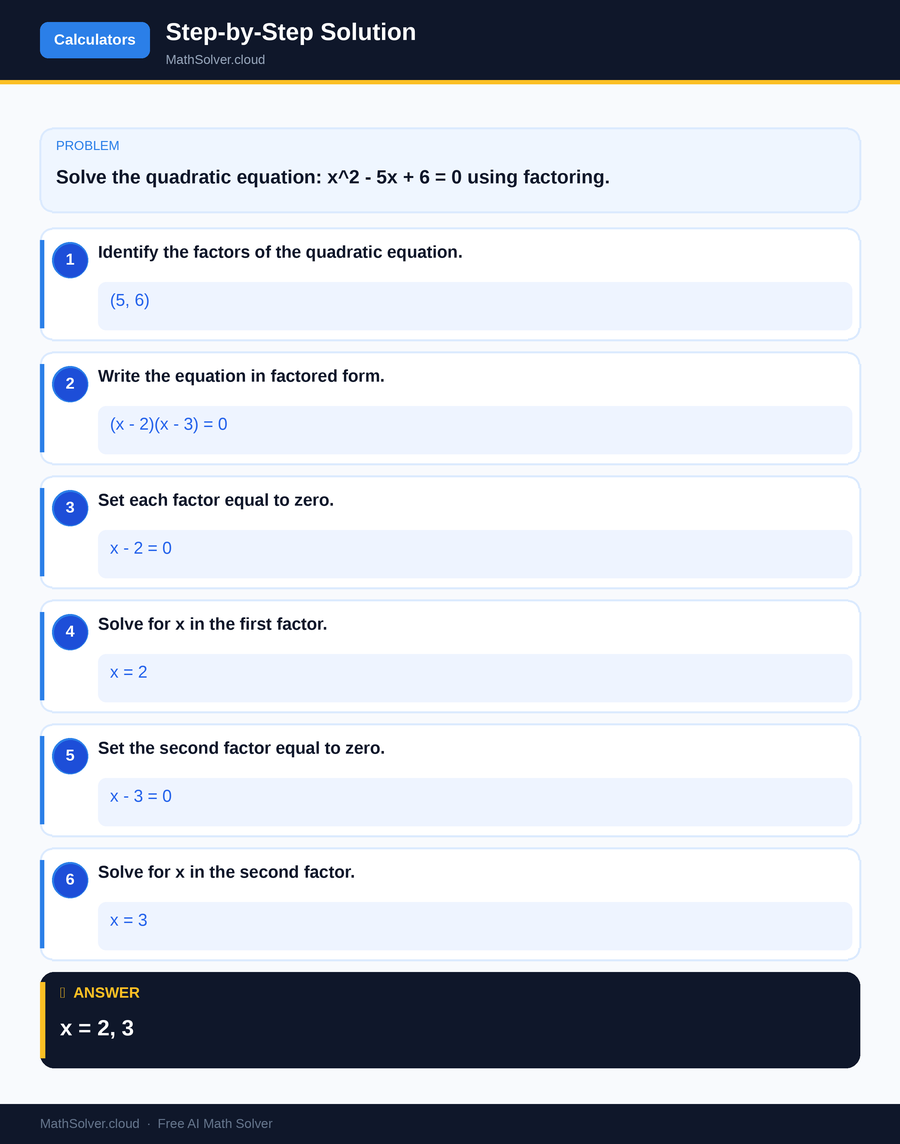
MathSolver Chrome extension solving this problem step-by-step
Common Mistakes to Avoid
One common mistake when using a math calculator is inputting equations incorrectly. This often occurs when users neglect the order of operations or forget to use parentheses to group terms. To avoid this, always double-check your input before pressing the equal sign. Another frequent error is misinterpreting the calculator's output. For example, some calculators might display results in scientific notation, which can be confusing if you're not familiar with it. Make sure to understand how your calculator presents results and, if necessary, convert them to a more familiar form.
Another pitfall is over-reliance on calculators without understanding the underlying math concepts. While calculators are excellent tools for verification and complex calculations, they should not replace fundamental understanding. Students should practice solving problems manually to develop their mathematical intuition and use calculators as a supplementary tool. This approach ensures that you are capable of solving problems even when a calculator is not available.
Real-World Applications
Math calculators are essential in many real-world scenarios. Engineers use them to perform complex calculations needed for designing structures, analyzing electrical circuits, and optimizing systems. For instance, a structural engineer might use a matrix math calculator to analyze forces and stresses in a building design. These calculations are critical to ensure safety and efficiency.
In the financial sector, analysts rely on math calculators to evaluate investment opportunities, calculate interest rates, and assess risk. A va math calculator, for example, may be used to determine the value at risk for a portfolio, helping investors make informed decisions. These applications demonstrate the versatility and importance of math calculators beyond the classroom.
Frequently Asked Questions
❓ Q1: What is the best way to use a math calculator for learning?
❓ Q2: Why do some students struggle with math calculators?
❓ Q3: How can AI help with math calculators?
❓ Q4: What are some alternatives to traditional math calculators?
❓ Q5: How can I choose the right math calculator for my needs?
🚀 Solve any math problem instantly
2,000+ students use MathSolver every day — join them for free
📥 Add to Chrome — It's Free