Understanding Linear Equations
📋 In this guide
Linear equations are a fundamental concept in algebra, representing relationships between variables that result in a straight line when graphed. Students often find linear equations challenging because they involve understanding abstract concepts and manipulating variables. However, mastering linear equations can open doors to more advanced mathematical topics and real-world problem-solving. In this guide, you'll learn the key concepts of linear equations, how to solve them, and their applications in everyday life.
A linear equation in one variable is typically in the form "ax + b = c," where "a," "b," and "c" are constants and "x" is the variable. These equations are called "linear" because they graph as straight lines. Understanding the structure of linear equations and how to manipulate them is crucial for success in algebra courses, such as those covered in the edmentum mastery test answers algebra 1 or algebra 1 regents exams.
By the end of this article, you will be equipped with the knowledge to solve linear equations, set up systems of linear equations, and understand how these mathematical tools apply in various contexts. We will also explore common mistakes students make and how to avoid them to ensure your success in mastering this essential algebraic concept.
Step-by-Step: How to Solve Linear Equations
Step 1: Isolate the Variable
The first step in solving a linear equation is to isolate the variable. Begin by moving all terms containing the variable to one side of the equation and the constant terms to the other. This is achieved by performing the same operation on both sides of the equation. For example, if you have the equation "2x + 5 = 15," subtract 5 from both sides to get "2x = 10."
Step 2: Simplify the Equation
Once the variable is isolated, the next step is to simplify the equation. This involves combining like terms and reducing fractions if necessary. Continuing from our example, "2x = 10" is already simplified, but if you had "4x + 2x = 12," you would combine like terms to get "6x = 12."
Step 3: Solve for the Variable
After simplification, solve for the variable by performing operations that will leave the variable alone on one side of the equation. Typically, this involves dividing or multiplying both sides by the coefficient of the variable. In the example "2x = 10," divide both sides by 2 to solve for "x," resulting in "x = 5."
Step 4: Check Your Solution
The final step is to verify your solution by substituting the value back into the original equation. This ensures that the solution satisfies the equation. Substituting "x = 5" back into the original equation "2x + 5 = 15" confirms the solution since "2(5) + 5 = 15" is true.
🤖 Stuck on a math problem?
Take a screenshot and let our AI solve it step-by-step in seconds
⚡ Try MathSolver Free →Worked Examples
Example 1
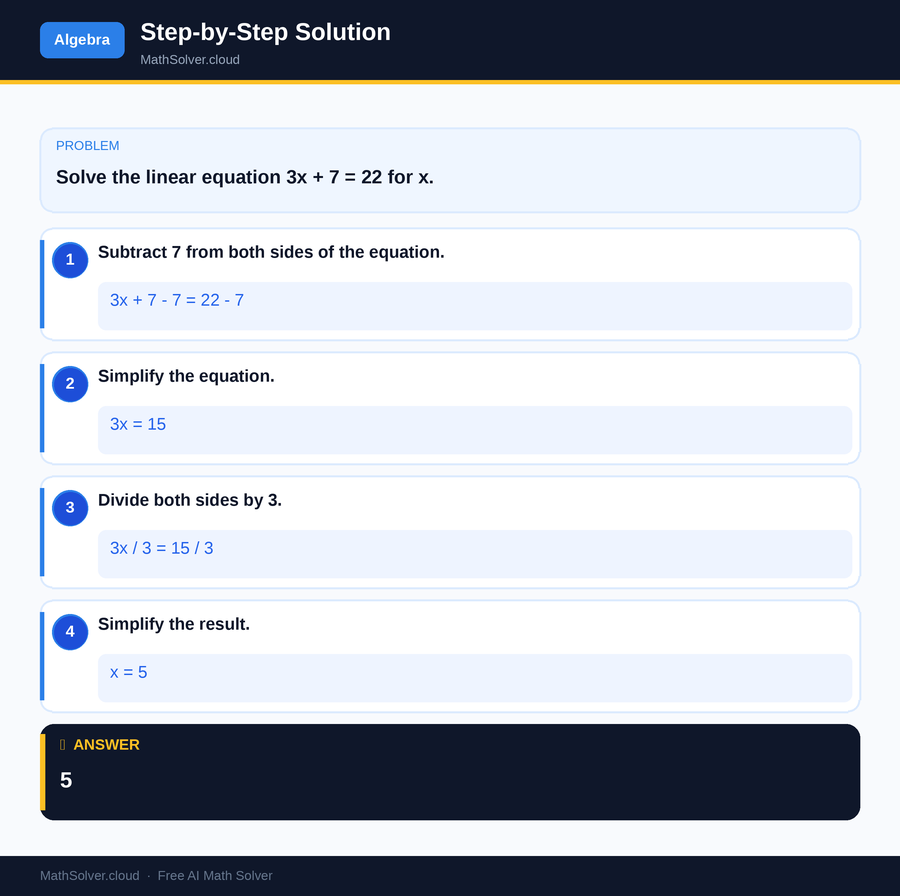
MathSolver Chrome extension solving this problem step-by-step
Example 2
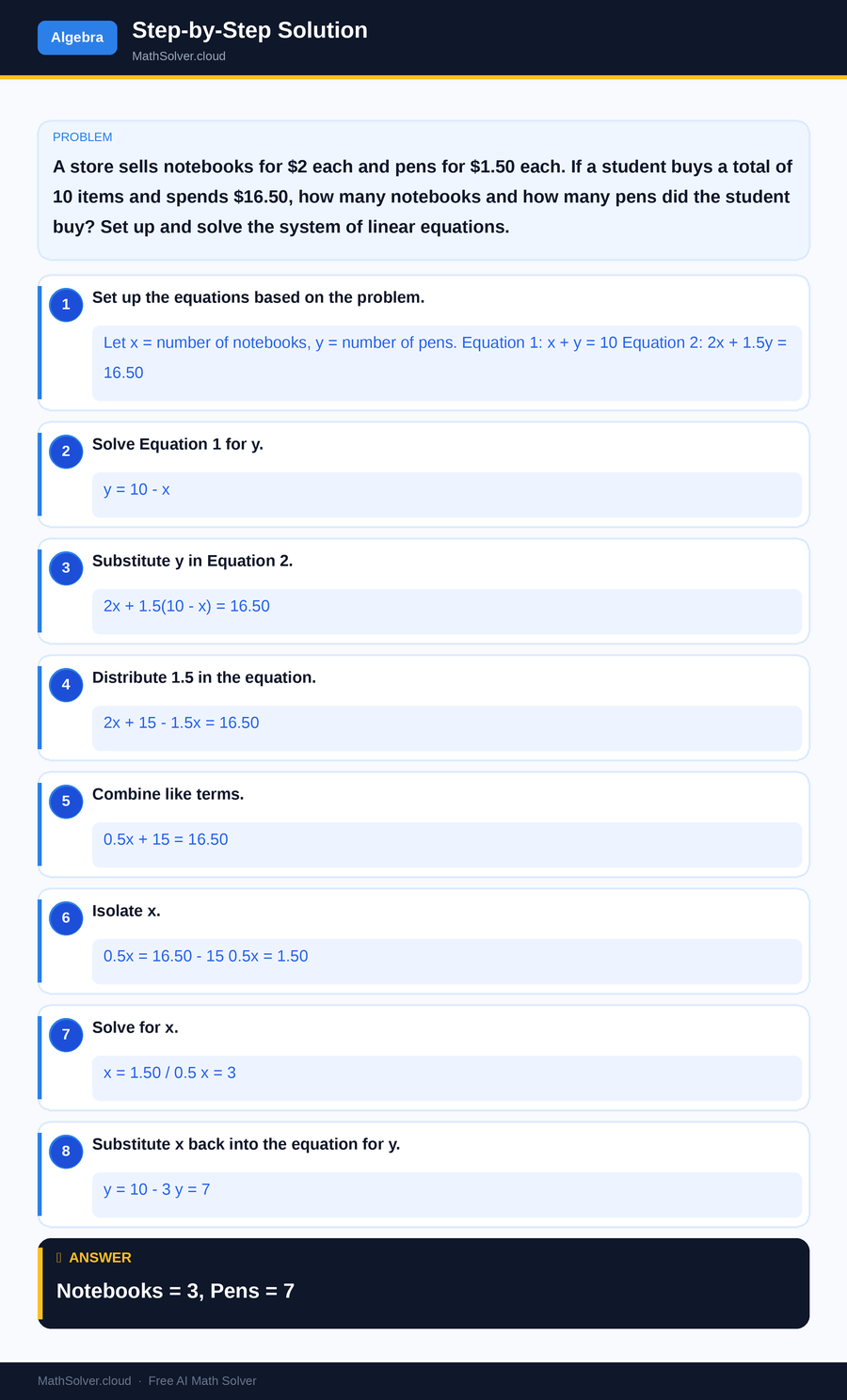
MathSolver Chrome extension solving this problem step-by-step
Common Mistakes to Avoid
One common mistake when solving linear equations is failing to perform the same operation on both sides of the equation. This can lead to incorrect solutions. Always ensure that whatever operation you do to one side, you do to the other to maintain the equation's balance.
Another frequent error is not checking your solution. After finding a value for the variable, substitute it back into the original equation to confirm it satisfies the equation. This step is crucial because it helps catch any arithmetic errors made during calculations.
Real-World Applications
Linear equations are not just academic exercises; they have practical applications in various fields. For example, in business, linear equations can model profit and loss scenarios or calculate break-even points. By setting up equations that represent revenue and costs, businesses can predict outcomes and make informed decisions.
In science, linear equations are used to describe relationships between variables, such as speed, distance, and time. Engineers use linear equations to design and analyze systems and structures, ensuring safety and efficiency. Understanding how to apply linear equations in these contexts is essential for problem-solving in many professions.
Frequently Asked Questions
❓ What are linear equations?
❓ Why do students struggle with linear equations?
❓ How can AI help with linear equations?
❓ What is a system of linear equations?
❓ How are linear equations used in daily life?
🚀 Solve any math problem instantly
2,000+ students use MathSolver every day — join them for free
📥 Add to Chrome — It's Free