Mastering Linear Equations
📋 In this guide
A linear equation is a fundamental concept in algebra that represents a relationship between variables where each term is either a constant or the product of a constant and a single variable. Despite its seeming simplicity, students often struggle to grasp linear equations because they serve as a gateway to more complex mathematical concepts. Understanding linear equations is crucial, as it forms the basis for solving more complicated problems in algebra, calculus, and beyond. In this article, you'll learn not only what a linear equation is but also how to solve it systematically. We’ll cover essential formulas, offer step-by-step guides, and provide worked-out examples to solidify your understanding.
Linear equations are ubiquitous in mathematics education and appear in various standardized tests like the Algebra 1 Regents and Edmentum Mastery Test Answers Algebra 1. While they may appear straightforward, the challenge often lies in applying the concepts accurately and consistently. This article will help demystify linear equations, enabling you to tackle them with confidence and competence. Whether you are just beginning your algebra journey or preparing for exams, mastering linear equations is a critical skill.
By the end of this article, you will have a comprehensive understanding of linear equations, including how to solve them, avoid common pitfalls, and recognize their real-world applications. We'll also address frequently asked questions and explain how modern tools like AI and the MathSolver Chrome extension can assist you in mastering this essential mathematical concept. Our aim is to make linear equations approachable and to provide you with the tools you need to succeed in your studies.
Step-by-Step: How to Solve Linear Equation
Step 1: Identify the Linear Equation
The first step in solving a linear equation is to correctly identify it. Recognizing a linear equation involves looking for the highest power of the variable, which should be one. If you encounter an equation like 3x + 5 = 20 or y = 2x + 3, you are dealing with linear equations. Understanding that the variable should not be squared or cubed is crucial for correct identification. Once you have identified the equation as linear, you can proceed with solving it using algebraic methods.
Step 2: Simplify Both Sides
After identifying the linear equation, the next step is to simplify both sides of the equation if necessary. This involves combining like terms and eliminating any parentheses. For example, in the equation 3x + 5 = 20, there are no like terms to combine or parentheses to remove, so it is already simplified. However, if you have an equation like 2(x + 3) = x + 12, you should distribute the 2 to get 2x + 6 = x + 12. Simplifying makes it easier to isolate the variable in the following steps.
Step 3: Isolate the Variable
The goal in solving a linear equation is to isolate the variable on one side of the equation. This often involves moving terms from one side to the other. Returning to our example 3x + 5 = 20, you would subtract 5 from both sides to get 3x = 15. If the equation was more complex, you might need to perform additional steps to isolate the variable. Ensuring that you perform the same operation on both sides of the equation is crucial for maintaining balance and accuracy.
Step 4: Solve for the Variable
Once the variable is isolated, the final step is to solve for it. In the equation 3x = 15, divide both sides by 3 to find x = 5. If you had an equation with a more complex coefficient, you would still aim to isolate the variable by performing the opposite operation. Solving for the variable gives you the solution to the linear equation, and you can double-check your work by plugging the solution back into the original equation to ensure it holds true.
🤖 Stuck on a math problem?
Take a screenshot and let our AI solve it step-by-step in seconds
⚡ Try MathSolver Free →Worked Examples
Example 1
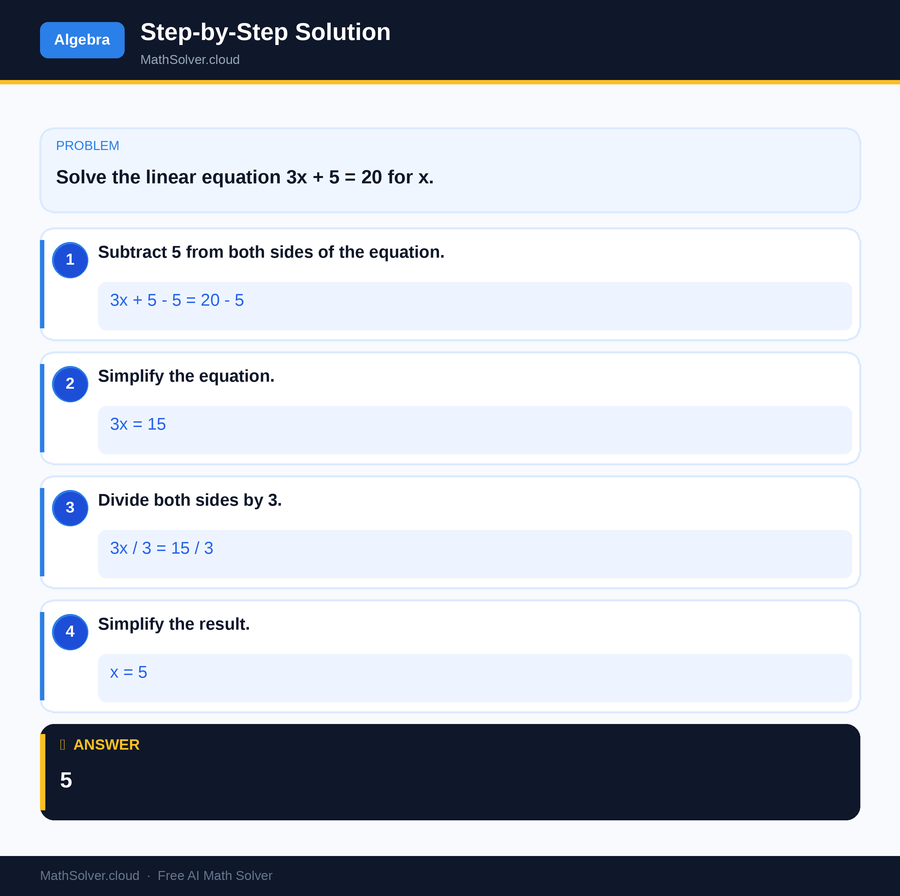
MathSolver Chrome extension solving this problem step-by-step
Example 2
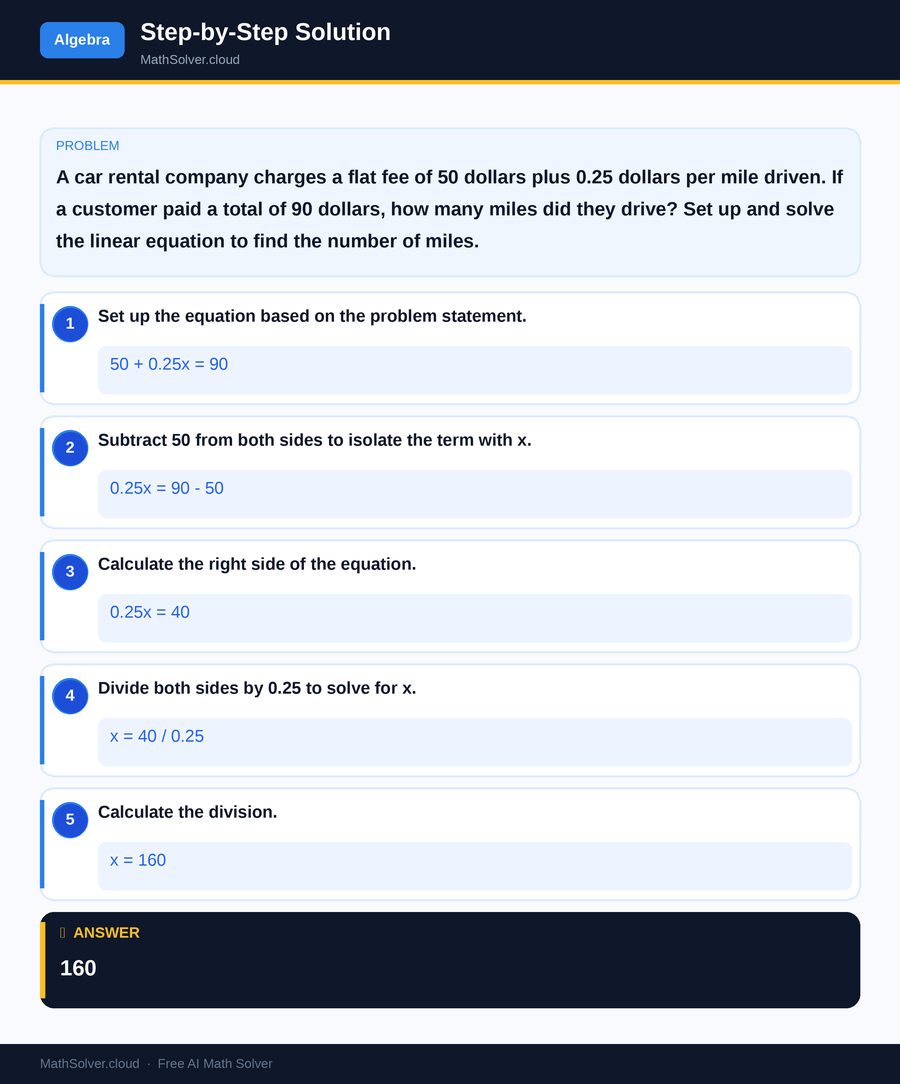
MathSolver Chrome extension solving this problem step-by-step
Common Mistakes to Avoid
One common mistake when solving linear equations is neglecting to apply the same operation to both sides of the equation. This oversight can lead to incorrect solutions. Always ensure that any operation you perform on one side is mirrored on the other. Another frequent error involves incorrect simplification, such as combining unlike terms or mishandling negative signs. Double-check your work by reviewing each step to confirm that simplification is done correctly.
Another pitfall is misinterpreting the equation's structure, particularly in word problems. Students might overlook key information that needs to be translated into the equation, leading to incorrect setups. To avoid this, carefully read the problem and identify all relevant information before attempting to write the equation. Practice translating words into mathematical expressions to improve accuracy.
Real-World Applications
Linear equations are not just confined to the classroom; they have numerous real-world applications. For instance, they are used in financial planning to calculate interest, budget expenses, and predict future costs based on current trends. Linear equations can also model population growth or decline, helping policymakers make informed decisions.
In engineering, linear equations are essential for calculating forces, determining load capacities, and optimizing design elements. Understanding how linear equations function in these contexts can provide valuable insights and aid in solving practical problems. Whether you're analyzing traffic flow or determining the dosage of medication, linear equations play a crucial role in making accurate predictions and decisions.
Frequently Asked Questions
❓ What is a linear equation?
❓ Why do students struggle with linear equations?
❓ How can AI help with linear equations?
❓ What is the difference between a linear equation and a quadratic equation?
❓ How are systems of linear equations used in real life?
🚀 Solve any math problem instantly
2,000+ students use MathSolver every day — join them for free
📥 Add to Chrome — It's Free