Mastering Linear Algebra: A Comprehensive Guide
📋 In this guide
Linear algebra is a branch of mathematics that focuses on vectors, vector spaces, linear transformations, and systems of linear equations. It is a foundational subject in mathematics, essential for advanced studies in fields like computer science, engineering, and physics. Despite its importance, many students find linear algebra challenging due to its abstract nature and the need for a solid understanding of mathematical concepts such as matrices and determinants.
As students delve into linear algebra, they encounter a range of topics that require them to think critically and apply theoretical concepts to solve practical problems. This can be daunting, especially if they are more accustomed to the concrete problems typically found in earlier math courses like algebra 1 or algebra 2.0. However, with patience and practice, students can master linear algebra and appreciate its utility in various real-world applications.
Through this article, you'll gain a clear understanding of what linear algebra involves, discover step-by-step methods for solving linear problems, and learn how to avoid common mistakes. We'll also explore the practical uses of linear algebra in everyday life and provide answers to frequently asked questions. By the end of this guide, you should feel more confident in your ability to tackle linear algebra problems and appreciate its relevance in various fields.
Step-by-Step: How to Solve Linear Algebra
Step 1: Understanding Vectors and Matrices
The first step in mastering linear algebra is to understand the basic building blocks: vectors and matrices. A vector is a mathematical object with both direction and magnitude, often represented as a column or row of numbers. A matrix is a rectangular array of numbers arranged in rows and columns. Understanding how to perform operations such as addition, subtraction, and multiplication of vectors and matrices is crucial. For example, matrix multiplication involves taking the dot product of the rows of the first matrix with the columns of the second matrix. Familiarizing yourself with these operations is foundational to solving more complex linear algebra problems.
Step 2: Solving Systems of Linear Equations
The next step involves solving systems of linear equations, which can be expressed in matrix form. These systems consist of multiple linear equations that need to be solved simultaneously. The most common methods for solving these systems include substitution, elimination, and matrix operations like Gaussian elimination. For instance, to solve the system 2x + 3y = 12 and x - y = 1, you can use substitution or elimination to find the values of x and y. Mastering these techniques is essential for efficiently solving linear algebra problems.
Step 3: Exploring Linear Transformations
Linear transformations are functions that map vectors to other vectors in a linear manner, preserving operations of vector addition and scalar multiplication. Understanding linear transformations involves analyzing how matrices can be used to perform operations such as rotations, reflections, and scalings. This step requires a grasp of concepts like eigenvectors and eigenvalues, which describe the behavior of these transformations. By studying linear transformations, you gain insight into how linear algebra can be applied in various fields, such as computer graphics and data analysis.
Step 4: Determinants and Their Applications
The final step involves learning about determinants, a critical concept in linear algebra. The determinant of a matrix provides important information about the matrix, such as whether it is invertible or the volume of a parallelepiped defined by its rows or columns. Calculating the determinant of a 3x3 matrix, such as A = [[1, 2, 3], [4, 5, 6], [7, 8, 9]], involves using the formula det(A) = a(ei − fh) − b(di − fg) + c(dh − eg). A solid understanding of determinants helps in solving systems of equations and analyzing matrix properties.
🤖 Stuck on a math problem?
Take a screenshot and let our AI solve it step-by-step in seconds
⚡ Try MathSolver Free →Worked Examples
Example 1
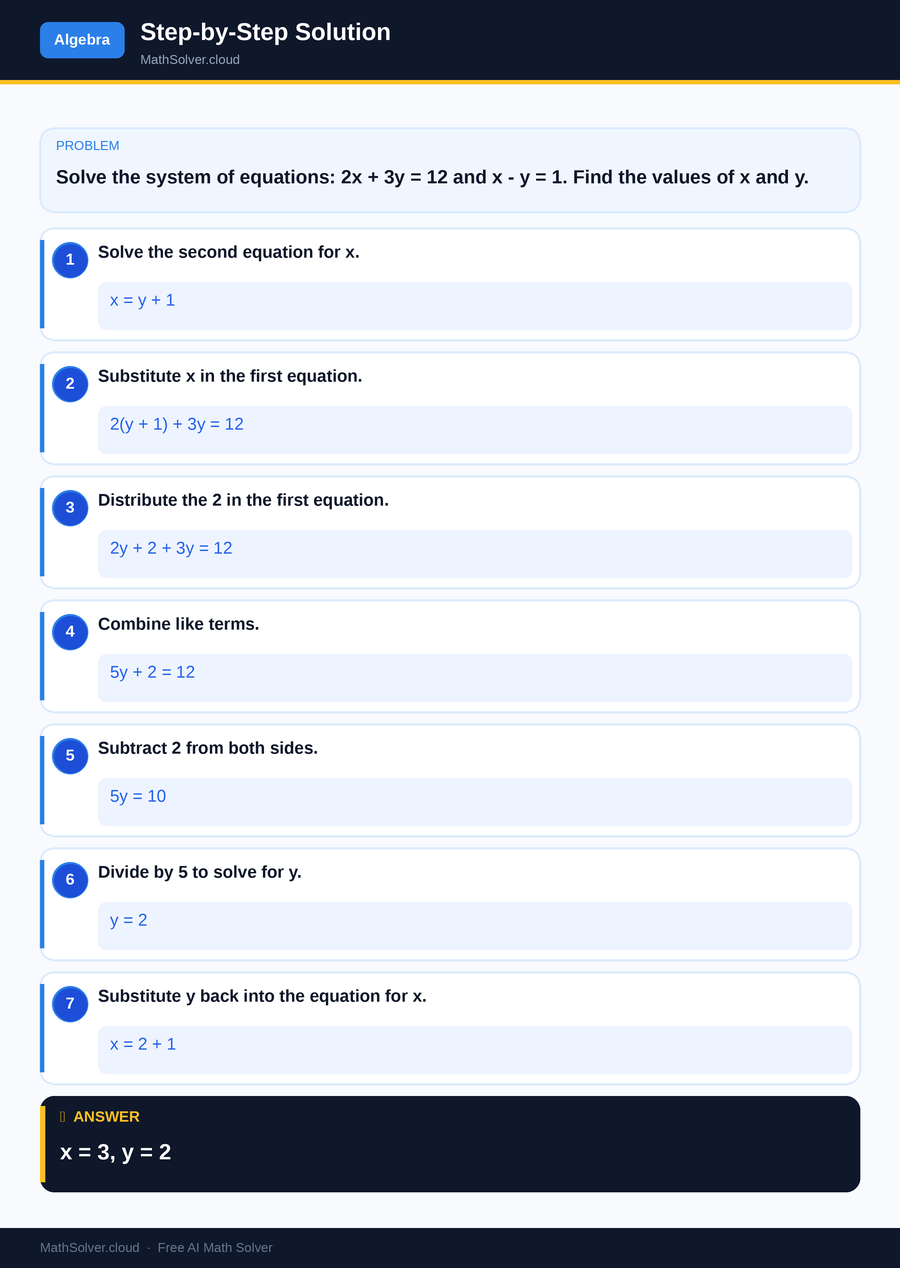
MathSolver Chrome extension solving this problem step-by-step
Example 2
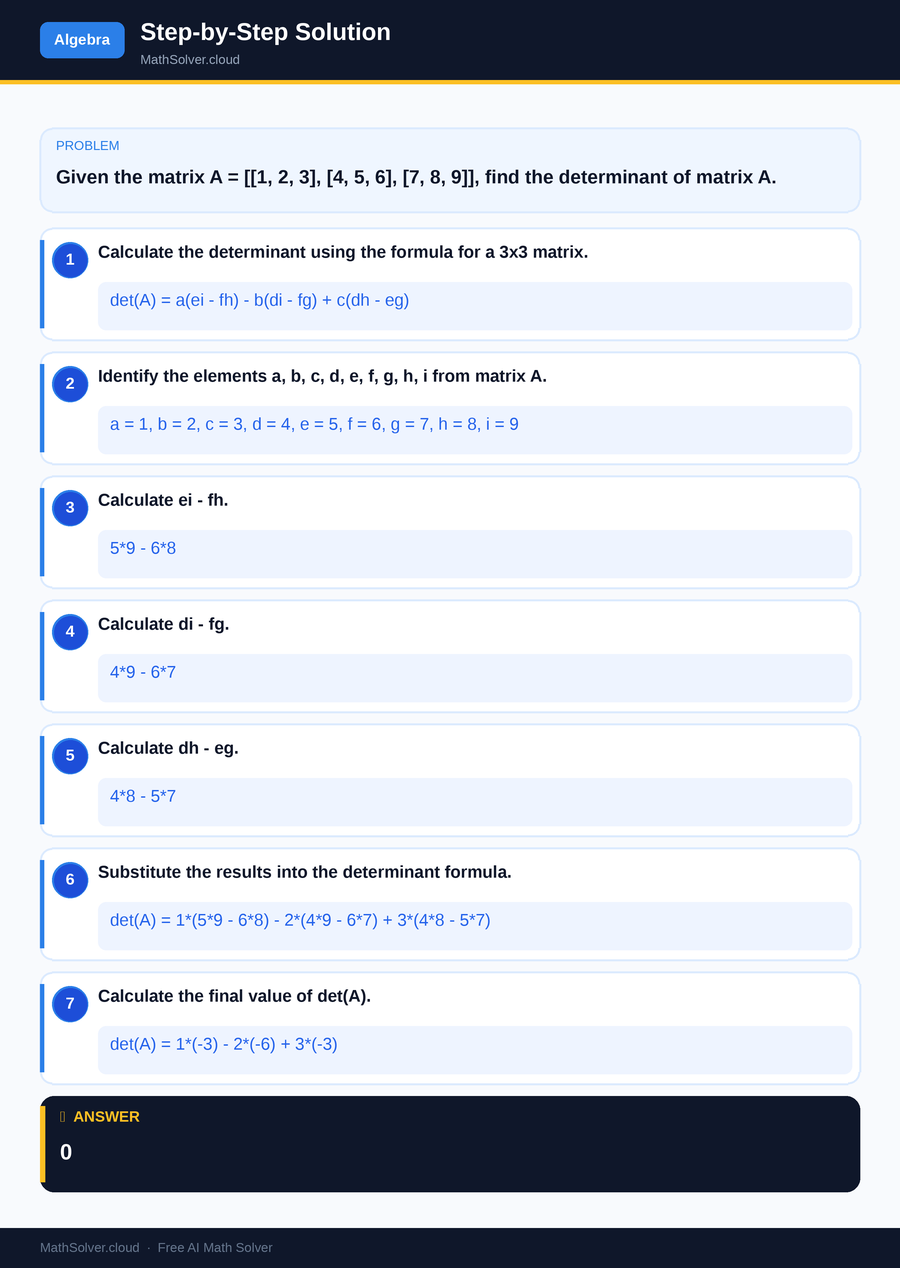
MathSolver Chrome extension solving this problem step-by-step
Common Mistakes to Avoid
One common mistake in linear algebra is miscalculating matrix multiplication, particularly when the dimensions of the matrices don't align for multiplication. Always ensure that the number of columns in the first matrix matches the number of rows in the second matrix. Additionally, students often forget to apply the distributive property correctly during matrix and vector operations, leading to incorrect solutions.
Another frequent error is neglecting to check the conditions for the existence and uniqueness of solutions to a system of equations. For instance, if the determinant of the coefficient matrix is zero, the system may not have a unique solution. Always verify these conditions before proceeding with complex calculations, and practice solving different types of systems to build confidence.
Real-World Applications
Linear algebra has numerous real-world applications, making it a valuable tool in various fields. In computer graphics, linear algebra is used to create and manipulate images, animations, and simulations. Concepts like linear transformations and matrix operations are fundamental in rendering 3D models and applying effects.
In data science, linear algebra is essential for machine learning algorithms, particularly in handling large datasets and performing operations like principal component analysis (PCA). By understanding linear algebra, data scientists can optimize and analyze data more effectively, leading to better decision-making and insights.
Frequently Asked Questions
❓ What is linear algebra?
❓ Why do students struggle with linear algebra?
❓ How can AI help with linear algebra?
❓ How is linear algebra related to other branches of algebra?
❓ How is linear algebra used in engineering?
🚀 Solve any math problem instantly
2,000+ students use MathSolver every day — join them for free
📥 Add to Chrome — It's Free