Understanding the Law of Sines Equation
📋 In this guide
The law of sines equation is a fundamental principle in trigonometry that relates the lengths of sides of a triangle to the sines of its angles. Students often find this topic challenging due to the abstract nature of trigonometric relationships and the need for precise calculations. However, mastering the law of sines can simplify complex problems and is crucial for solving triangles, especially when working with non-right triangles. In this comprehensive guide, you'll learn how the law of sines equation works, how to apply it through detailed steps, and how to avoid common pitfalls. We'll also explore real-world applications and answer frequently asked questions to ensure you have a solid understanding of this essential concept.
The law of sines equation is critical for solving various mathematical problems and has practical applications in fields like physics, engineering, and even biology. While some students might initially struggle with its application, understanding the underlying principles and practicing with examples can greatly enhance your problem-solving skills. By the end of this article, you'll have a clear grasp of how to use the law of sines equation in both academic and real-world settings.
Whether you're tackling algebra equations, quadratic equations, or exploring the kinematic equations in physics, the law of sines provides a powerful tool for analyzing and solving problems. This guide will walk you through the key formula, provide step-by-step instructions for applying it, and highlight the common errors to avoid. Our goal is to make the law of sines equation approachable and applicable, helping you feel confident in your trigonometry skills.
Step-by-Step: How to Solve Law Of Sines Equation
Step 1: Identify the Known Values
To use the law of sines equation effectively, begin by identifying the known values in your triangle. Determine which angles and side lengths are given in the problem. This step is crucial as it sets the foundation for the rest of the problem-solving process. For instance, if you know two angles and one side of a triangle, you can use the law of sines to find the unknown sides.
Step 2: Set Up the Equation
Once you have identified the known values, set up the law of sines equation using these values. Choose the appropriate ratio based on the known side and angle. For example, if you know side a and angle A, and you need to find side b with angle B, use the equation a/sin(A) = b/sin(B). This step involves plugging the known values into the equation, which will allow you to solve for the unknowns.
Step 3: Solve for the Unknown
With the equation set up, the next step is to solve for the unknown value. Rearrange the equation to isolate the unknown variable on one side. Ensure that you perform accurate calculations, especially when dealing with trigonometric functions. This step requires precision as any small error can lead to incorrect results. Use a calculator if necessary to find the sine of the given angles and solve the equation.
Step 4: Verify Your Solution
After solving for the unknown, verify your solution by checking if it makes sense within the context of the problem. Ensure that the side lengths and angles are reasonable and consistent with the properties of triangles. Verifying your solution helps to catch any errors early and confirm the accuracy of your work. This step is crucial for building confidence in your ability to handle similar problems.
🤖 Stuck on a math problem?
Take a screenshot and let our AI solve it step-by-step in seconds
⚡ Try MathSolver Free →Worked Examples
Example 1
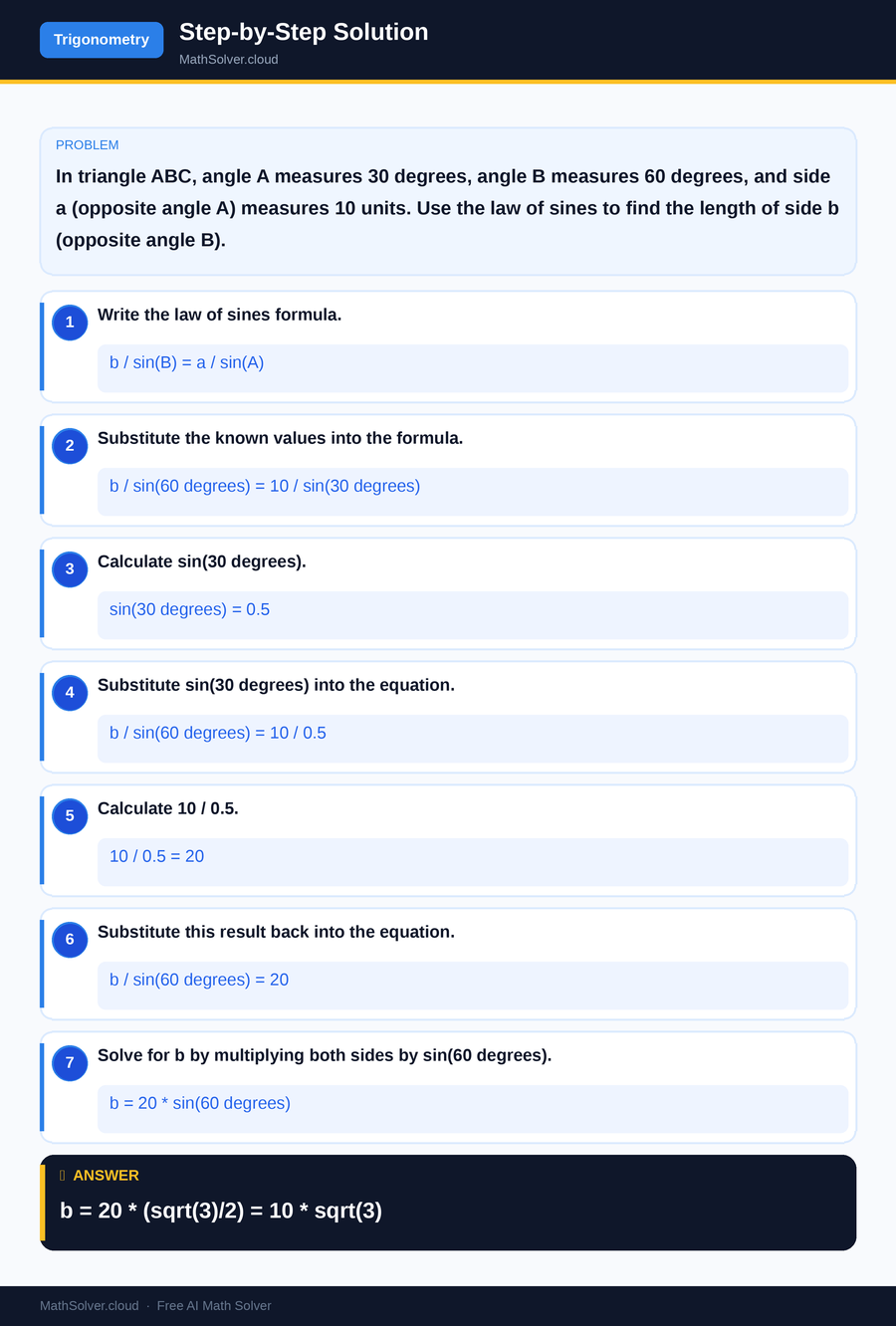
MathSolver Chrome extension solving this problem step-by-step
Example 2
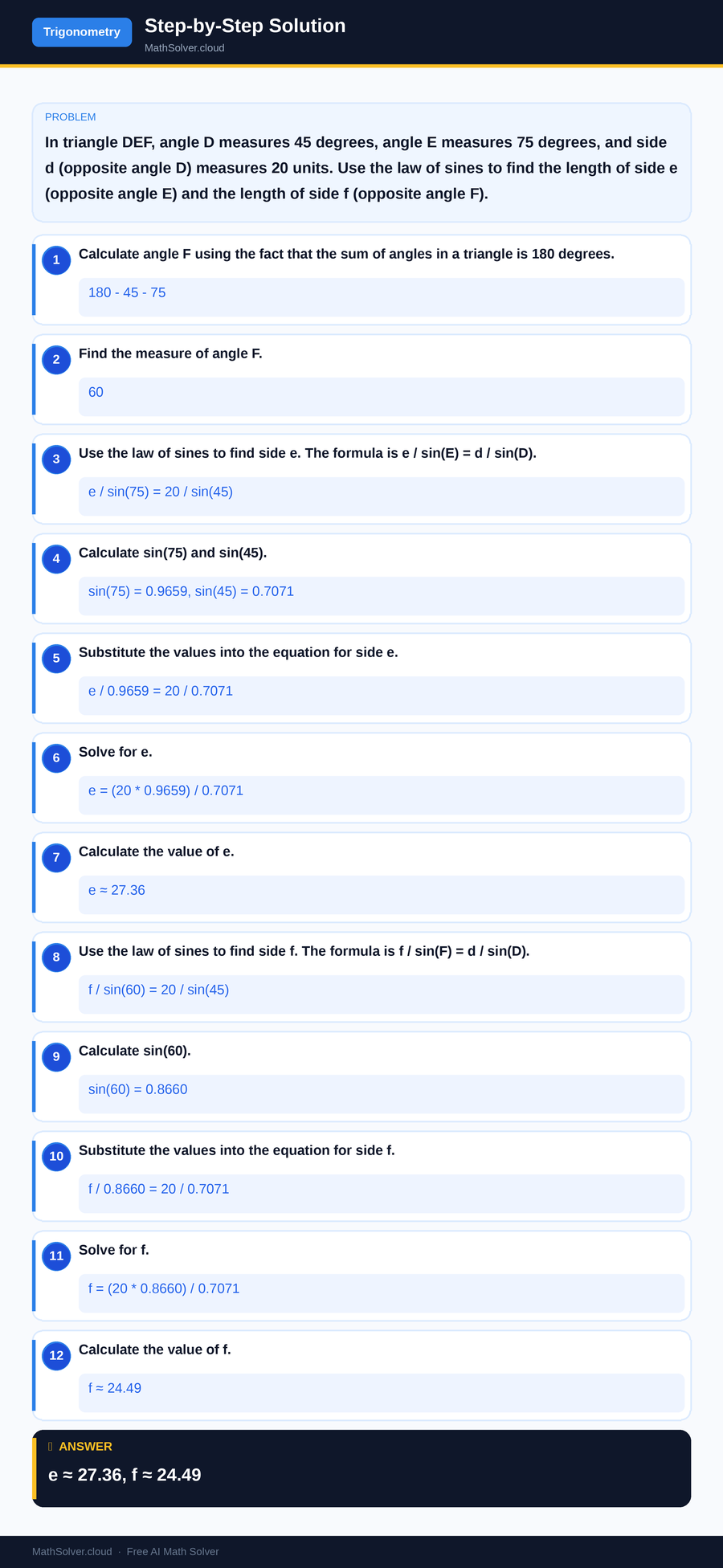
MathSolver Chrome extension solving this problem step-by-step
Common Mistakes to Avoid
One common mistake is incorrectly setting up the equation by not matching the right side with the correct opposite angle. To avoid this, double-check the side-angle pairs before proceeding with calculations. Another frequent error is incorrect trigonometric calculations, such as using the wrong sine values for angles. Always verify your calculations with a calculator to ensure accuracy.
Additionally, students often forget to simplify their final answers, leaving them in a less understandable form. Simplifying fractions and ensuring units are consistent can help make solutions clearer. Lastly, remember to verify that your solution is logical within the context of the problem, as this final check can catch simple errors before they become problematic.
Real-World Applications
The law of sines equation is widely used in real-world scenarios, particularly in fields like navigation, astronomy, and engineering. For example, in navigation, it helps sailors determine their position relative to landmarks by solving for unknown distances. Similarly, in astronomy, the law of sines allows scientists to calculate the distances between celestial bodies based on observed angles.
In engineering, the law of sines is essential for designing structures and analyzing forces in non-right triangles. It is used to calculate load distributions and optimize material usage. Understanding the law of sines equation can also be beneficial in fields like biology, where it may help model phenomena like the photosynthesis equation, which involves angles of light incidence on leaves.
Frequently Asked Questions
❓ What is the law of sines equation?
❓ Why do students struggle with the law of sines?
❓ How can AI help with the law of sines equation?
❓ How is the law of sines different from the law of cosines?
❓ Can the law of sines be used for right triangles?
🚀 Solve any math problem instantly
2,000+ students use MathSolver every day — join them for free
📥 Add to Chrome — It's Free