Understanding the Law of Cosines Equation
📋 In this guide
The law of cosines equation is a fundamental concept in trigonometry that extends the Pythagorean theorem to non-right triangles. This equation is particularly useful when dealing with oblique triangles, where no angle is 90 degrees. Students often find the law of cosines equation challenging due to its complexity and the need to integrate multiple mathematical concepts simultaneously. In this article, we'll break down the law of cosines equation, explore its applications, and guide you through solving problems step by step.
The primary goal of this article is to demystify the law of cosines equation. You'll learn how to apply it to find missing sides or angles in triangles, understand the common mistakes to avoid, and discover its real-world applications. By the end, you'll be equipped with the knowledge and confidence to tackle any problem involving this essential trigonometric tool.
Whether you're a student grappling with algebra equations, a teacher looking for effective ways to explain trigonometry, or someone simply curious about mathematical concepts, this comprehensive guide will serve as a valuable resource. So, let's dive in and explore the intricacies of the law of cosines equation and how it fits into the vast landscape of mathematical equations.
Step-by-Step: How to Solve Law Of Cosines Equation
Step 1: Identify the Known Values
Before using the law of cosines equation, identify the given values in the problem. Typically, you'll have two sides and the included angle, or three sides of a triangle. It's crucial to correctly assign these values to the variables a, b, c, and the angle C.
Step 2: Rearrange the Formula if Necessary
Depending on the given information, you may need to rearrange the law of cosines equation. If you're solving for a side, use the formula as it is. However, if you're solving for an angle, rearrange the formula to isolate the cosine term, such as cos(C) = (a^2 + b^2 - c^2) / (2ab).
Step 3: Plug in the Known Values
Insert the known values into the equation. Be precise with your calculations, especially when dealing with angles in degrees or radians. Use a calculator for accurate results, ensuring the mode matches the angle measurement (degree or radian).
Step 4: Solve the Equation
Perform the necessary calculations to find the unknown value. If you're solving for a side, take the square root of the result. If you're solving for an angle, use the inverse cosine function to find the angle in degrees or radians. Double-check your work for accuracy.
🤖 Stuck on a math problem?
Take a screenshot and let our AI solve it step-by-step in seconds
⚡ Try MathSolver Free →Worked Examples
Example 1
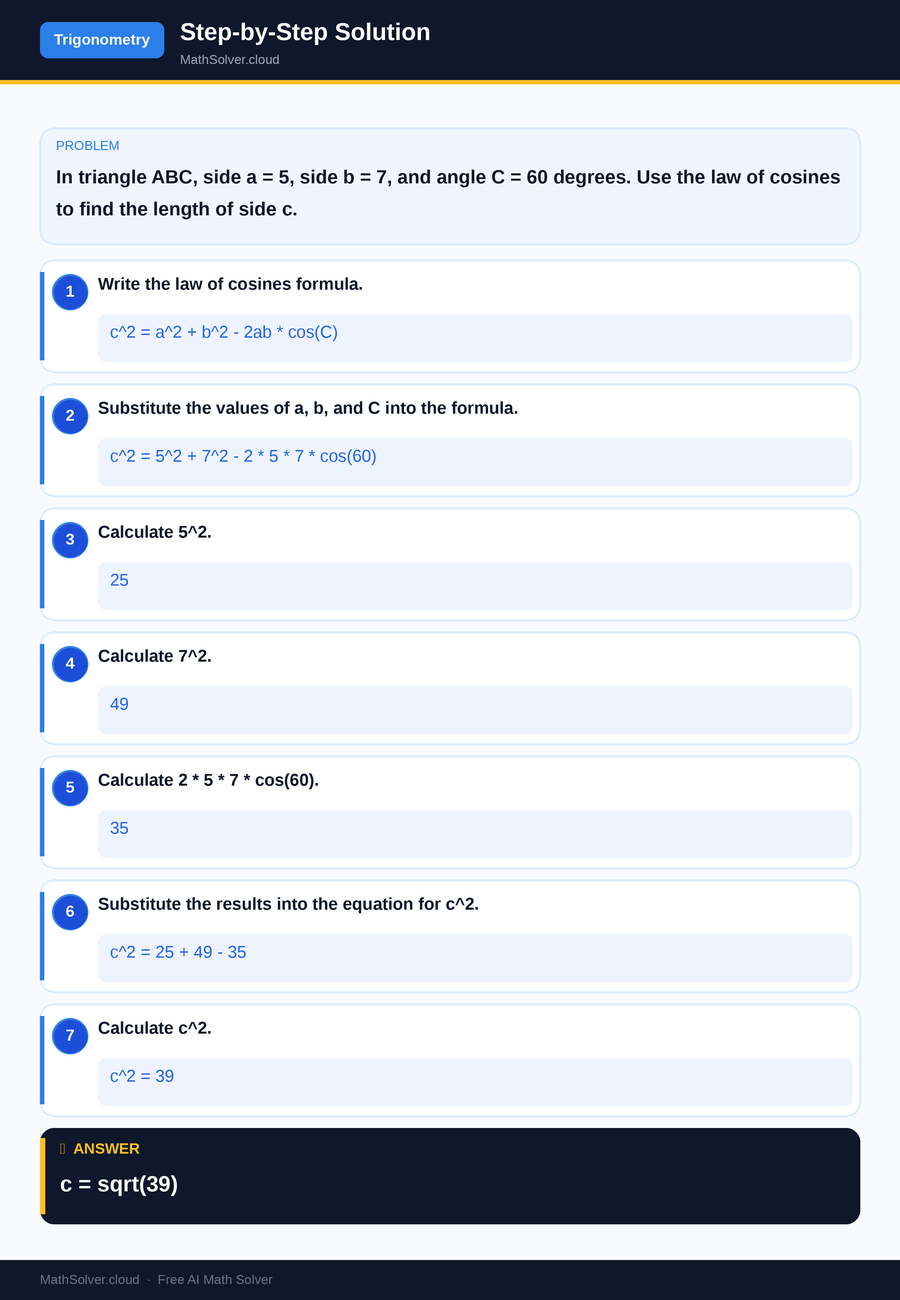
MathSolver Chrome extension solving this problem step-by-step
Example 2
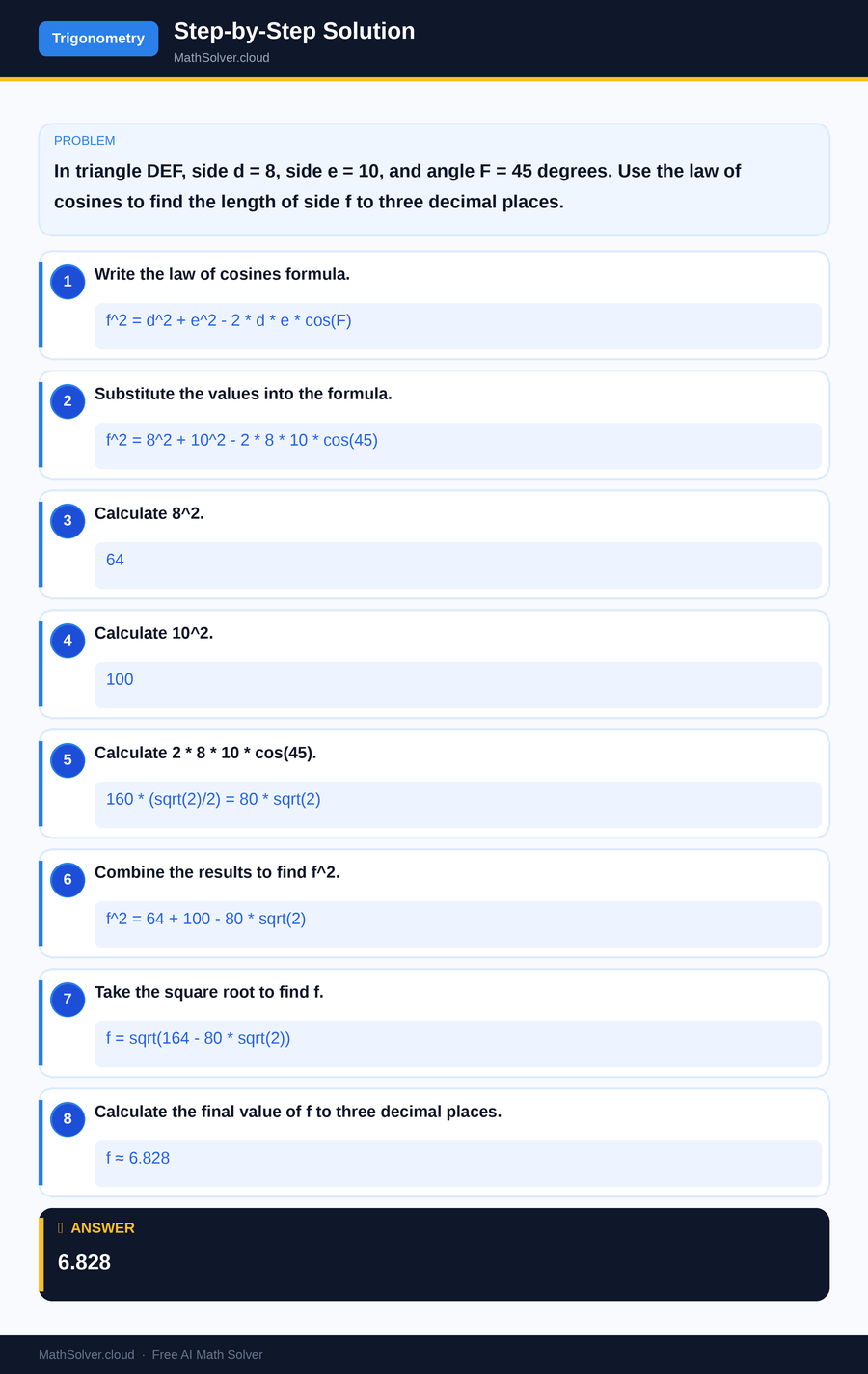
MathSolver Chrome extension solving this problem step-by-step
Common Mistakes to Avoid
One common mistake when using the law of cosines equation is incorrect angle measurement. Ensure your calculator is set to the correct mode, whether degrees or radians, to avoid calculation errors. Another frequent error is mislabeling sides and angles. Always double-check that you've assigned the correct variables to the sides and angles before plugging them into the equation.
It's also easy to make arithmetic mistakes, especially when handling complex numbers or fractions. To prevent this, work through each step methodically and verify your calculations. These precautions will help you avoid common pitfalls and ensure accurate results.
Real-World Applications
The law of cosines equation has practical applications in various fields. For example, in navigation and surveying, it helps calculate distances and angles between landmarks or points on a map. This is particularly useful in fields like cartography and civil engineering.
In physics, the law of cosines can be applied in kinematic equations to determine the resultant vector when two vectors are combined at an angle. It's also used in architecture to design structures that require precise angle and length measurements, ensuring stability and accuracy.
Frequently Asked Questions
❓ What is the law of cosines equation and when is it used?
❓ How does the law of cosines equation differ from the Pythagorean theorem?
❓ How can AI help with the law of cosines equation?
❓ Can the law of cosines be used to find angles?
❓ What is the importance of the law of cosines in real-life applications?
🚀 Solve any math problem instantly
2,000+ students use MathSolver every day — join them for free
📥 Add to Chrome — It's Free