How to Find the Equation of a Tangent Line
📋 In this guide
How to find the equation of a tangent line is a fundamental concept in calculus that plays a crucial role in understanding the behavior of functions at specific points. Many students find this topic challenging because it involves an interplay between algebra, calculus, and geometry. The tangent line to a curve at a given point is the straight line that just "touches" the curve at that point. It reflects the instantaneous rate of change or the slope of the curve at that particular point. This concept is pivotal in calculus for graphing functions and understanding their behavior.
Students often struggle with how to find the equation of a tangent line because it requires a solid grasp of derivatives and algebraic manipulation. Derivatives provide the tool to determine the slope of the tangent line, while algebra helps in formulating the equation of the line itself. In this article, you'll learn how to tackle this topic with clarity and confidence. We'll walk through the steps needed to find the equation of a tangent line, explore common mistakes, and see how this concept applies in real-world scenarios.
By the end of this guide, you will have a comprehensive understanding of how to find the equation of a tangent line using calculus, and you'll be able to apply this knowledge to solve various problems. You'll also discover the tools available, such as calculators and software, that can assist in finding tangent lines, making the process more accessible and less intimidating. Let's dive in and explore the steps involved in mastering this essential calculus concept.
Step-by-Step: How to Solve How To Find The Equation Of A Tangent Line
Step 1: Find the Derivative of the Function
The first step in how to find the equation of a tangent line is to determine the derivative of the function, f(x). The derivative, denoted as f'(x), represents the rate of change or the slope of the function at any given point. Calculating this derivative is essential because it provides the slope of the tangent line. For example, if f(x) = x^2, the derivative f'(x) = 2x. When dealing with more complex functions, use differentiation rules such as the product rule, quotient rule, or chain rule to find the derivative accurately.
Step 2: Evaluate the Derivative at the Given Point
Once you have the derivative, the next step is to evaluate this derivative at the specific point of interest, x = a. This involves substituting the value of a into the derivative function to find f'(a). The result will give you the slope of the tangent line at that point. For instance, if you're working with f(x) = x^2 and need the tangent line at x = 3, substitute 3 into f'(x) = 2x to get f'(3) = 6. This means the slope of the tangent line at x = 3 is 6.
Step 3: Use the Point-Slope Formula
With the slope f'(a) known, use the point-slope formula of a line to find the equation of the tangent line. The formula is y - f(a) = f'(a)(x - a), where (a, f(a)) is the point on the curve. This formula incorporates both the slope and the point to establish the equation. Continuing our example with f(x) = x^2 at x = 3, we have f(3) = 9. So, the equation becomes y - 9 = 6(x - 3), which simplifies to y = 6x - 9.
Step 4: Simplify the Equation
The final step is to simplify the equation of the tangent line into a more standard linear form, such as y = mx + b, where m is the slope and b is the y-intercept. Simplifying the equation helps in graphing and further analysis. For the example y = 6x - 9, this is already in a simplified form. Ensure that all calculations are correct and the equation accurately represents the tangent line to the curve at the given point.
🤖 Stuck on a math problem?
Take a screenshot and let our AI solve it step-by-step in seconds
⚡ Try MathSolver Free →Worked Examples
Example 1
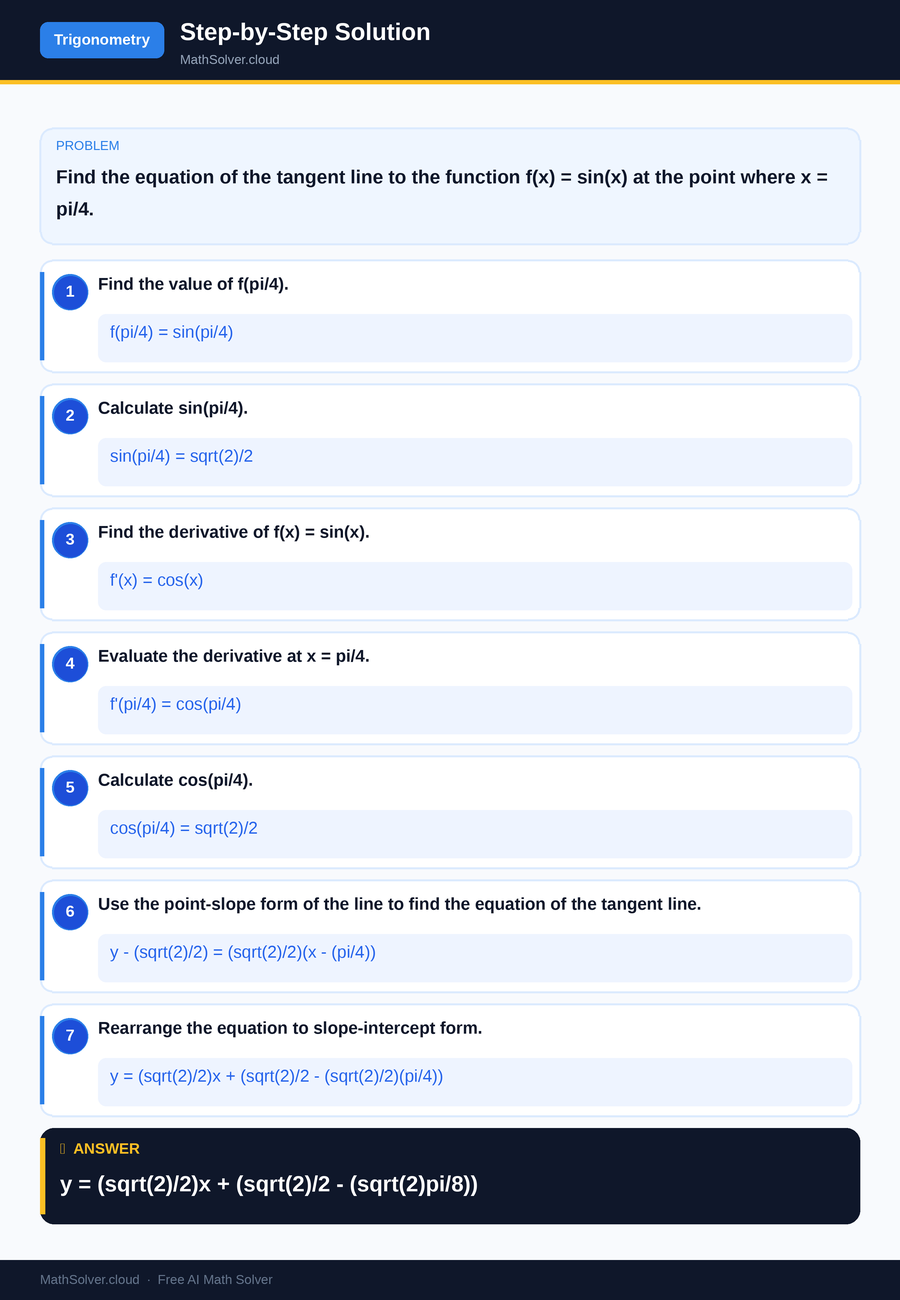
MathSolver Chrome extension solving this problem step-by-step
Example 2
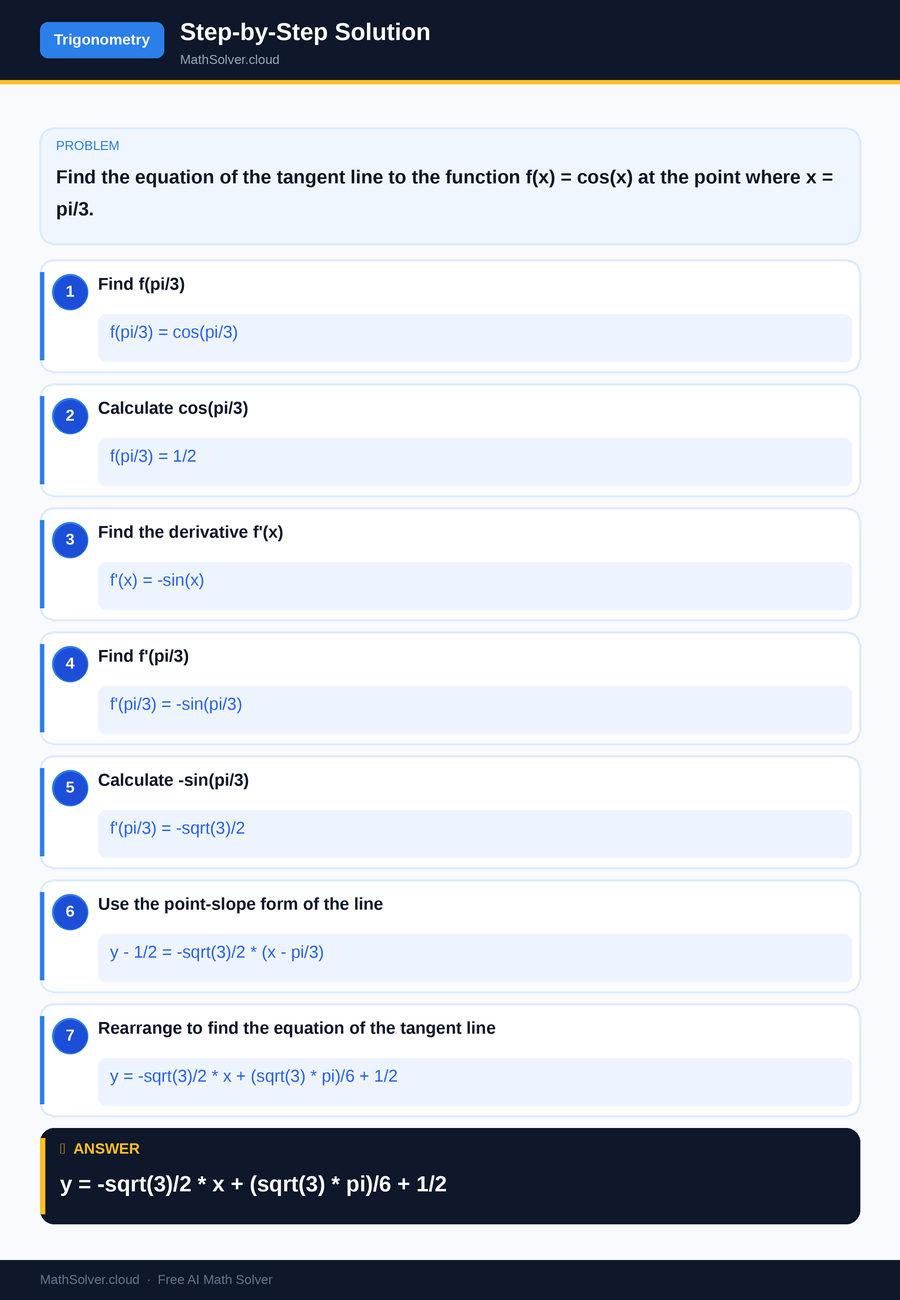
MathSolver Chrome extension solving this problem step-by-step
Common Mistakes to Avoid
A common mistake when learning how to find the equation of a tangent line is neglecting to correctly evaluate the derivative at the specific point. This step is crucial because it determines the slope of the tangent line. Another frequent error is improperly applying the point-slope formula, leading to incorrect line equations. To avoid these mistakes, double-check your derivative calculations and ensure that you correctly identify the point (a, f(a)) on the curve.
Another pitfall is not simplifying the final equation of the tangent line. Simplification is essential for clear communication and further analysis. Students sometimes leave their answers in a complex form, making it difficult to interpret or use in additional calculations. Always aim to express the tangent line equation in a standard linear form whenever possible.
Real-World Applications
Understanding how to find the equation of a tangent line is not just an academic exercise; it has practical applications in various fields. For instance, in physics, tangent lines are used to determine the instantaneous velocity of an object in motion. The slope of the tangent line to a position-time graph represents the object's velocity at a particular moment.
In economics, tangent lines help in marginal analysis, where they are used to determine the marginal cost or marginal revenue at a given level of production. By finding the tangent line to a cost function or revenue function, businesses can make informed decisions about their production levels to maximize profit or minimize cost.
Frequently Asked Questions
❓ What is the process of how to find the equation of a tangent line?
❓ Why is the derivative important in finding tangent lines?
❓ How can AI help with how to find the equation of a tangent line?
❓ What is the difference between a tangent line and a tangent plane?
❓ Can you use a calculator to find the equation of a tangent line?
🚀 Solve any math problem instantly
2,000+ students use MathSolver every day — join them for free
📥 Add to Chrome — It's Free