How Do I Find the Equation of a Tangent Line?
📋 In this guide
How do I find the equation of a tangent line? This is a question that often perplexes students as they dive into the world of calculus. Understanding tangent lines is crucial because they provide a linear approximation of curves at a specific point, which is fundamental in many areas of mathematics and physics. However, many students struggle with this concept because it requires a solid grasp of derivatives and algebra equations. In this article, we will walk you through the process of finding the equation of a tangent line, ensuring you have a strong foundation to tackle related problems in calculus and beyond.
The difficulty often arises from the abstract nature of a tangent line. Unlike the straightforward algebra equations you might be used to, finding the equation of a tangent line involves calculus concepts like derivatives and limits. Students frequently find themselves asking, “What exactly is a tangent line, and how do I find its equation?” Our goal here is to demystify these concepts, providing clear explanations and practical examples that will make you comfortable with this fundamental topic.
By the end of this article, you'll know exactly how to find the equation of a tangent line, and you'll understand its significance in various mathematical contexts, including its role in solving quadratic equations and even its connection to real-world phenomena like kinematic equations and the photosynthesis equation. So, let’s dive in and solve this puzzle together!
Step-by-Step: How to Solve How Do I Find The Equation Of A Tangent Line
Step 1: Understand the Function and Point of Tangency
Before you can find the equation of a tangent line, you must thoroughly understand the function f(x) and the point of tangency where x = a. This involves identifying the function’s behavior, whether it's a polynomial, trigonometric, or another type of function. For example, if you're working with a quadratic equation, you'll recognize its parabolic shape, while a sine curve might remind you of the equation for diagonal to the right sine curve. Understanding the function helps in visualizing the tangent line you’re aiming to find.
Step 2: Calculate the Derivative
The next step involves finding the derivative of the function f(x). This derivative, f'(x), represents the slope of the tangent line at any point x on the curve. Calculating derivatives is a fundamental skill in calculus, and it’s important to remember the rules for different types of functions, such as power functions, trigonometric functions, and exponential functions. For instance, if f(x) is a sine or cosine function, you'll apply trigonometric differentiation rules, which are detailed in our complete Trigonometry guide.
Step 3: Evaluate the Derivative at the Point of Tangency
Once you have the general form of the derivative f'(x), the next step is to substitute the specific x-value of the point of tangency into this derivative. This will give you the slope of the tangent line at that exact point. For example, if your point of tangency is x = a, you substitute a into f'(x) to get f'(a). This step is crucial as it directly influences the steepness and direction of your tangent line.
Step 4: Use the Point-Slope Form to Write the Tangent Line Equation
With the slope f'(a) and the point of tangency (a, f(a)), you can now plug these values into the point-slope formula for a line: y - f(a) = f'(a) * (x - a). This equation represents your tangent line. It’s important to simplify this equation if needed, to make it easier to interpret or graph. This final equation can also be transformed into the slope-intercept form if required, which is particularly useful when comparing with other linear equations.
🤖 Stuck on a math problem?
Take a screenshot and let our AI solve it step-by-step in seconds
⚡ Try MathSolver Free →Worked Examples
Example 1
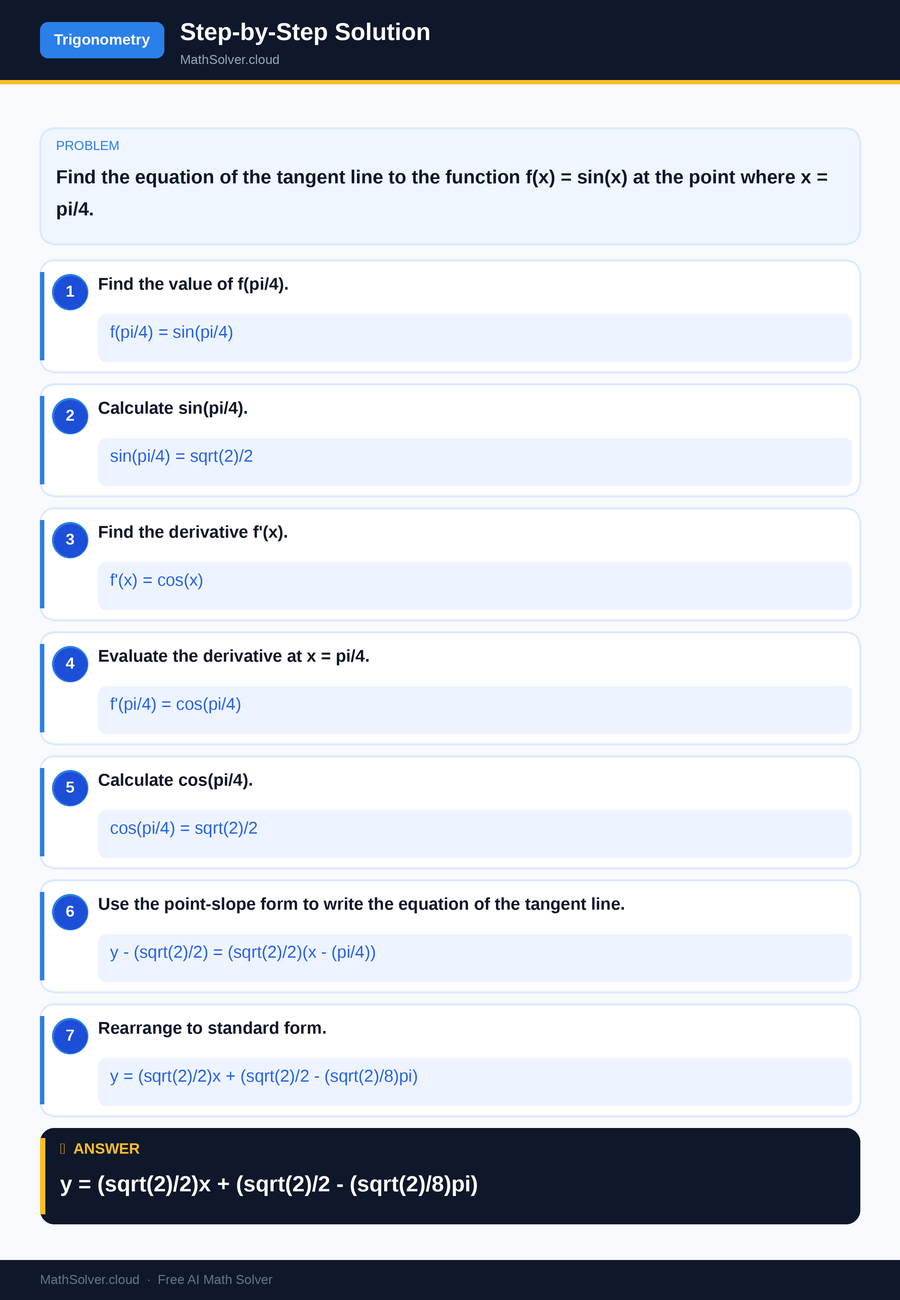
MathSolver Chrome extension solving this problem step-by-step
Example 2
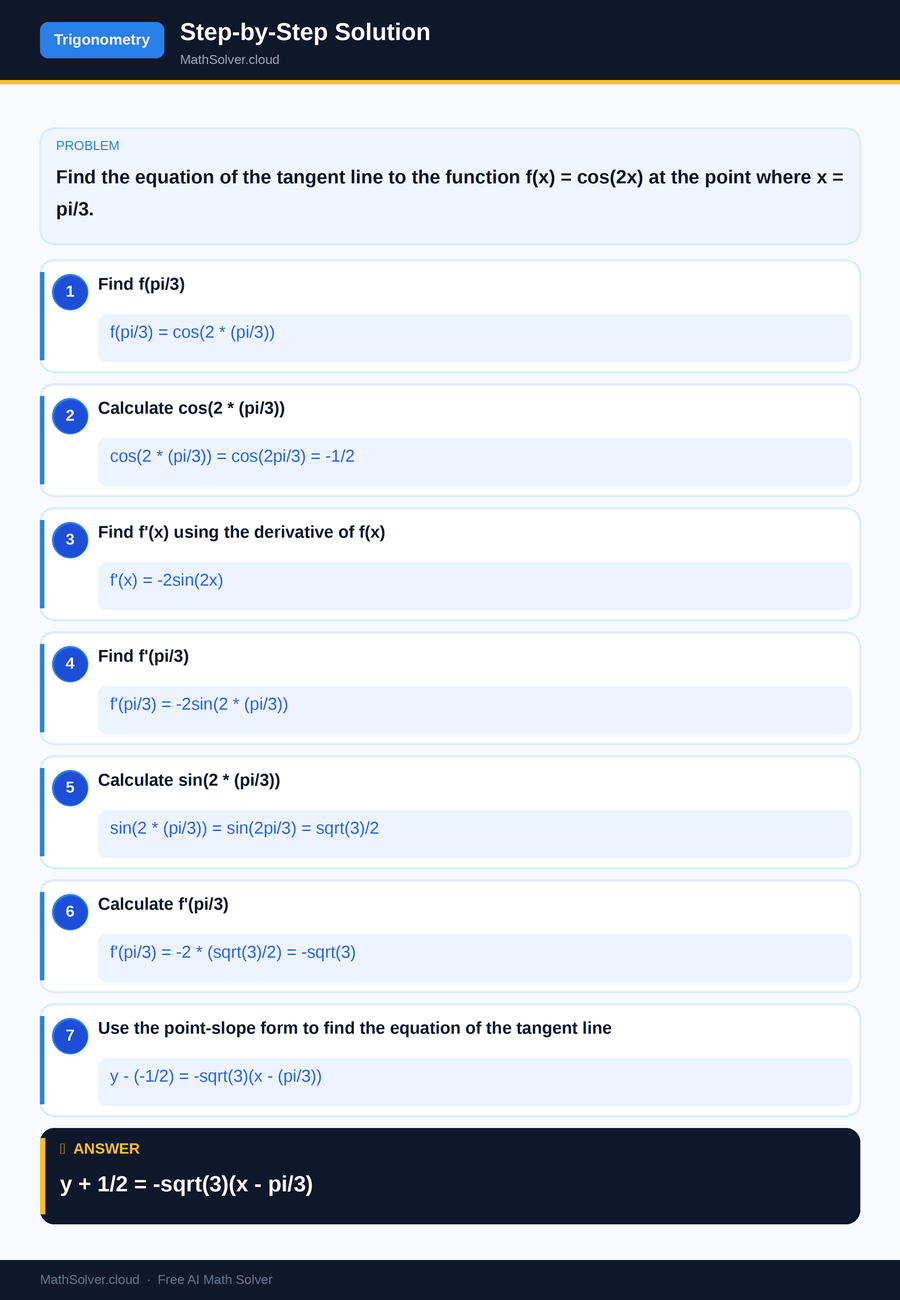
MathSolver Chrome extension solving this problem step-by-step
Common Mistakes to Avoid
One common mistake students make is neglecting to evaluate the derivative at the correct point of tangency. This error leads to an incorrect slope, which throws off the entire tangent line equation. Always double-check the point of tangency and ensure you substitute it correctly into the derivative.
Another frequent error involves algebraic simplification. After using the point-slope form, students sometimes forget to simplify the equation, making it difficult to interpret. Simplifying the equation not only makes it clearer but also ensures it is in a usable form for further calculations or graphing.
Real-World Applications
Finding the equation of a tangent line is not just an academic exercise; it has numerous real-world applications. In physics, tangent lines are used in kinematic equations to approximate velocity and acceleration at a specific moment. This is crucial in understanding the motion of objects and predicting future positions.
In biology, tangent lines can help model growth rates, such as in the photosynthesis equation, where they provide insights into how changes in environmental conditions affect plant growth rates. By understanding the slope at a particular point, scientists can make informed predictions about growth patterns.
Frequently Asked Questions
❓ How do I find the equation of a tangent line?
❓ What is the importance of the derivative in finding tangent lines?
❓ How can AI help with how do I find the equation of a tangent line?
❓ What if the function is not differentiable at a point?
❓ How are tangent lines related to tangent planes?
🚀 Solve any math problem instantly
2,000+ students use MathSolver every day — join them for free
📥 Add to Chrome — It's Free