Mastering the Harris Benedict Equation Calculator
📋 In this guide
The Harris Benedict equation calculator is an essential tool for anyone looking to understand their Basal Metabolic Rate (BMR), which is the number of calories your body needs to maintain basic physiological functions while at rest. Students often struggle with this topic because it requires a blend of biology, math, and an understanding of individual health factors. This article aims to demystify the Harris Benedict equation calculator and provide you with the tools to calculate your BMR accurately. By mastering this, you'll gain insight into how many calories your body requires and can make informed decisions about diet and exercise.
Understanding the Harris Benedict equation can be challenging due to its reliance on various inputs like age, weight, height, and gender. These variables can be confusing when you first encounter them, especially if your background is more in algebra equations or quadratic equations. However, the process becomes more manageable once you break it down into clear steps. This article will guide you through each part of the equation, showing you how to use a math calculator or algebra calculator effectively.
By the end of this article, you will not only understand the Harris Benedict equation but also be able to apply it confidently. Whether you're calculating your BMR or Total Daily Energy Expenditure (TDEE), you'll have a clear roadmap to follow. Additionally, we'll explore real-world applications and common mistakes to avoid, ensuring you have a comprehensive understanding of this important mathematical tool. So, let's dive in and explore the intricacies of the Harris Benedict equation calculator.
Step-by-Step: How to Solve Harris Benedict Equation Calculator
Step 1: Gather Necessary Information
Before you begin using the Harris Benedict equation calculator, it's crucial to gather all necessary personal information. This includes your age, gender, weight in kilograms, and height in centimeters. Having this information readily available ensures that you can input accurate data into the equation. For instance, if you're unsure of your weight in kilograms, you can easily convert it from pounds using an algebra calculator or a simple conversion factor. Ensuring precision in these initial inputs is vital as even small errors can lead to significant discrepancies in the final BMR calculation.
Step 2: Understand the Formula Components
Each component of the Harris Benedict equation plays a specific role in determining your BMR. The constants in the equation (655 for women and 66 for men) account for energy expenditure based on gender-specific physiological differences. The terms involving weight, height, and age are straightforward multipliers that represent how these physical attributes contribute to your energy needs. Understanding these components allows you to appreciate how changes in weight or age might affect your BMR, and it can help you make more informed decisions about lifestyle changes.
Step 3: Perform the Calculation
With your data in hand and a clear understanding of the formula, you can now perform the calculation. Start by multiplying your weight in kilograms by the respective factor (9.6 for women, 13.7 for men), and do the same for your height in centimeters (1.8 for women, 5 for men). Subtract the product of your age and its respective factor (4.7 for women, 6.8 for men) from the sum of the previous results and the constant. A reliable math calculator can ensure accuracy in these calculations, especially if you're not confident in your manual computation skills.
Step 4: Analyze and Apply the Results
Once you've calculated your BMR using the Harris Benedict equation calculator, it's time to analyze and apply the results. Understanding your BMR is crucial for determining your daily caloric needs. If your goal is to maintain weight, consume a number of calories equal to your BMR. For weight loss, aim to consume fewer calories, and for weight gain, consume more. Additionally, if you want to calculate your Total Daily Energy Expenditure (TDEE), you can multiply your BMR by an activity factor, which reflects your level of physical activity. This practical application of the Harris Benedict equation can guide your dietary and exercise decisions, making it a valuable tool in personal health management.
🤖 Stuck on a math problem?
Take a screenshot and let our AI solve it step-by-step in seconds
⚡ Try MathSolver Free →Worked Examples
Example 1
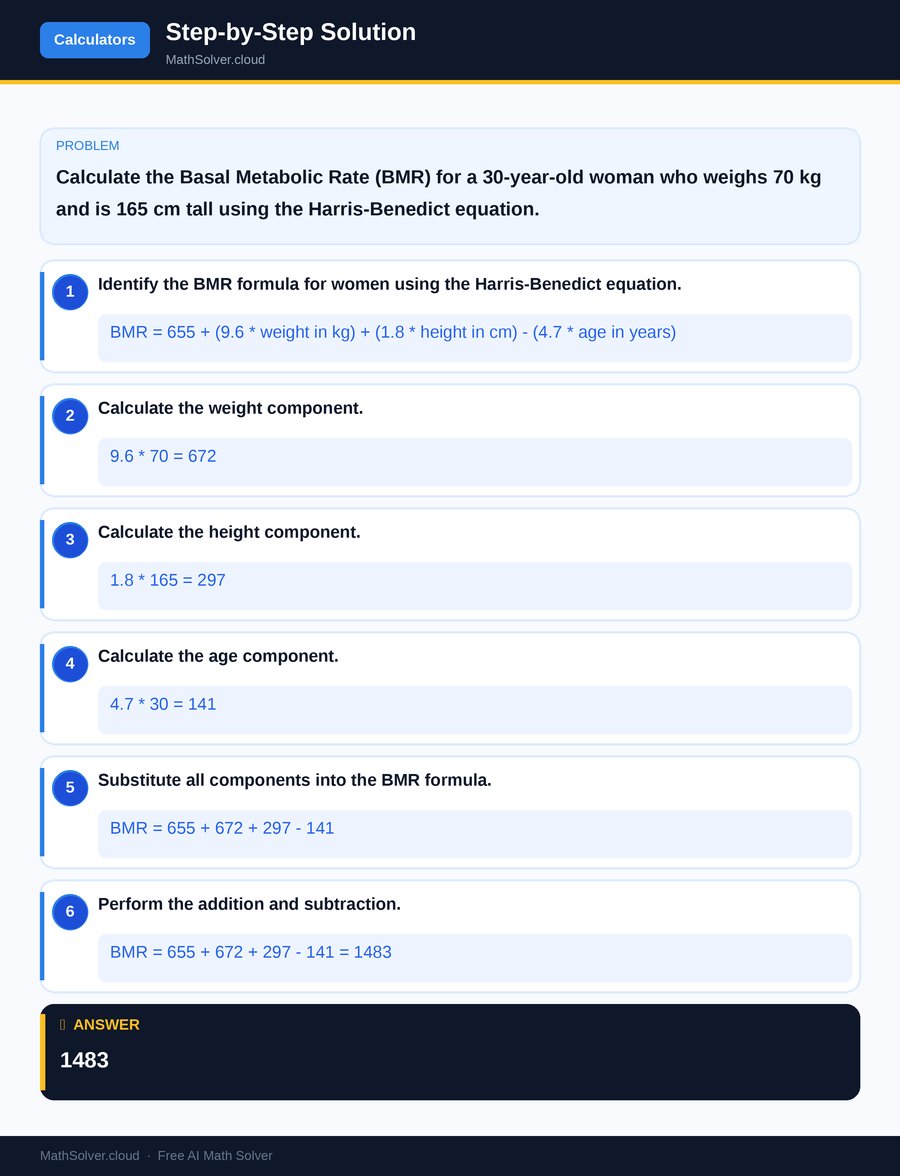
MathSolver Chrome extension solving this problem step-by-step
Example 2
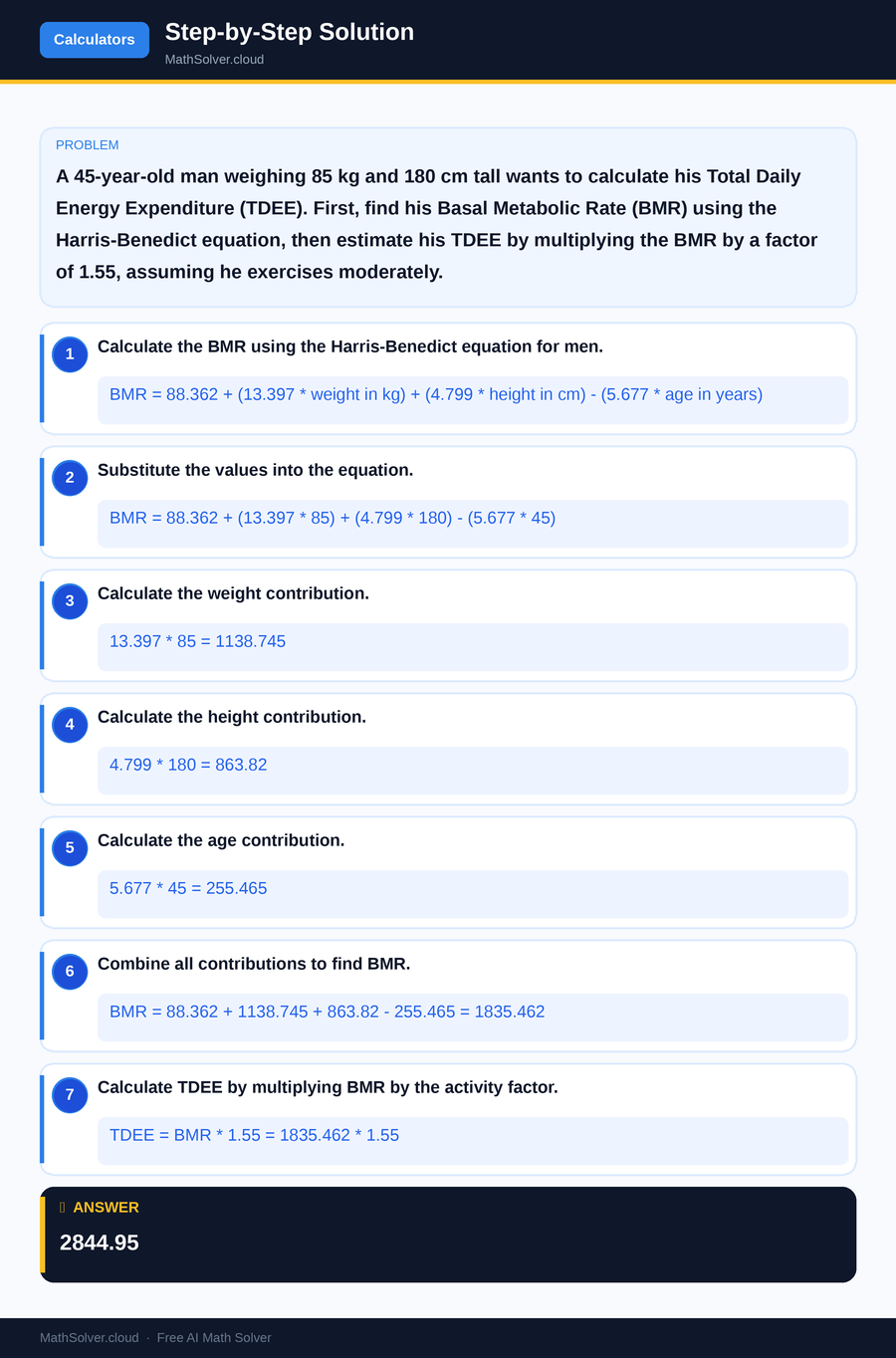
MathSolver Chrome extension solving this problem step-by-step
Common Mistakes to Avoid
One common mistake students make when using the Harris Benedict equation calculator is forgetting to convert their weight and height into the appropriate units. The formula requires weight in kilograms and height in centimeters, so using pounds or inches will lead to inaccurate results. To avoid this, double-check your units and use a kinematic equations calculator or algebra calculator if conversions are necessary.
Another frequent error is neglecting the importance of the activity factor when calculating Total Daily Energy Expenditure (TDEE). Many people stop at calculating the BMR, not realizing that their actual caloric needs depend on their level of physical activity. Always ensure that you apply the correct activity multiplier to get a realistic estimate of your daily energy needs. This will prevent errors in dietary planning and help you maintain or reach your desired weight.
Real-World Applications
The Harris Benedict equation calculator is widely used in various fields beyond just personal fitness. In healthcare, dietitians and nutritionists use BMR calculations to develop personalized diet plans for patients. Understanding a patient's metabolic rate allows for more targeted nutritional advice, whether the goal is weight loss, maintenance, or gain.
In sports and athletics, coaches and trainers use BMR and TDEE calculations to optimize athletes' dietary regimens. By knowing the exact caloric needs of an athlete, training programs can be tailored to enhance performance and recovery. This application of the Harris Benedict equation ensures athletes receive the appropriate amount of energy to fuel their activities, making it an invaluable tool in sports science.
Frequently Asked Questions
❓ How does the harris benedict equation calculator work?
❓ Why is it important to know my BMR?
❓ How can AI help with the harris benedict equation calculator?
❓ Can I use the Harris Benedict equation for children?
❓ What's the difference between BMR and TDEE?
🚀 Solve any math problem instantly
2,000+ students use MathSolver every day — join them for free
📥 Add to Chrome — It's Free