How to Find the Equation of the Tangent Line
📋 In this guide
When you need to find the equation of the tangent line, you're essentially trying to determine a linear approximation to a curve at a specific point. This concept is pivotal in calculus and helps in understanding how functions behave locally, which is crucial for students delving into the world of mathematics. However, many students struggle with this topic due to its abstract nature and the need to understand derivatives and slopes. In this article, you will learn the step-by-step process of finding the equation of a tangent line, understand the common pitfalls, and appreciate its applications in real-world scenarios. By the end of this guide, you will have a solid grasp of how to approach these problems and feel more confident in tackling them.
Understanding how to find the equation of the tangent line is not just about memorizing formulas. It requires a comprehension of the underlying principles of calculus, especially derivatives. Derivatives provide the slope of the tangent line at any given point on a curve, which is a key component in finding the tangent line equation. Many students find themselves asking, "How do you find the equation of the tangent line?" This guide aims to demystify the process by breaking it down into manageable steps and providing worked examples.
The ability to find the equation of the tangent line is not only a critical skill for calculus exams but also has practical applications in fields such as physics, engineering, and economics. Whether you're preparing for a test or looking to understand how this mathematical concept applies to real-world situations, this article will serve as your comprehensive resource. As we delve deeper, you will also learn about tools like the find the equation of the tangent line calculator, which can assist in solving these problems more efficiently.
Step-by-Step: How to Solve Find The Equation Of The Tangent Line
Step 1: Differentiate the Function
The first step in finding the equation of the tangent line involves differentiating the function to obtain its derivative. The derivative, f'(x), represents the slope of the tangent line at any point x on the curve. For instance, if you have a function f(x), apply the rules of differentiation to find f'(x). Understanding the rules of differentiation, such as the power rule, product rule, and chain rule, is essential for this step. Once you have the derivative, you are ready to find the slope of the tangent line at the specific point of interest.
Step 2: Evaluate the Derivative at the Given Point
After obtaining the derivative of the function, the next step is to evaluate this derivative at the specific x-value where you need the tangent line. This x-value is generally provided in the problem. Substituting this x-value into the derivative f'(x) will give you the slope m of the tangent line at that point. It's crucial to perform this calculation accurately, as the slope is a vital component in forming the equation of the tangent line.
Step 3: Determine the Point on the Curve
With the slope m in hand, you need to determine the y-coordinate of the point on the curve. This is done by substituting the given x-value into the original function f(x) to find f(x1). The point (x1, f(x1)) will serve as the point of tangency for your tangent line. This step ensures you have both the slope and a point on the line, which are necessary to write the equation of the line.
Step 4: Write the Equation of the Tangent Line
Now that you have both the slope m and the point (x1, f(x1)), you can substitute these values into the point-slope form of a line: y - f(x1) = m(x - x1). Simplify this equation to obtain the final equation of the tangent line. This equation represents the linear approximation of the function at the given point, providing a powerful tool for analyzing the function's behavior around that point.
🤖 Stuck on a math problem?
Take a screenshot and let our AI solve it step-by-step in seconds
⚡ Try MathSolver Free →Worked Examples
Example 1
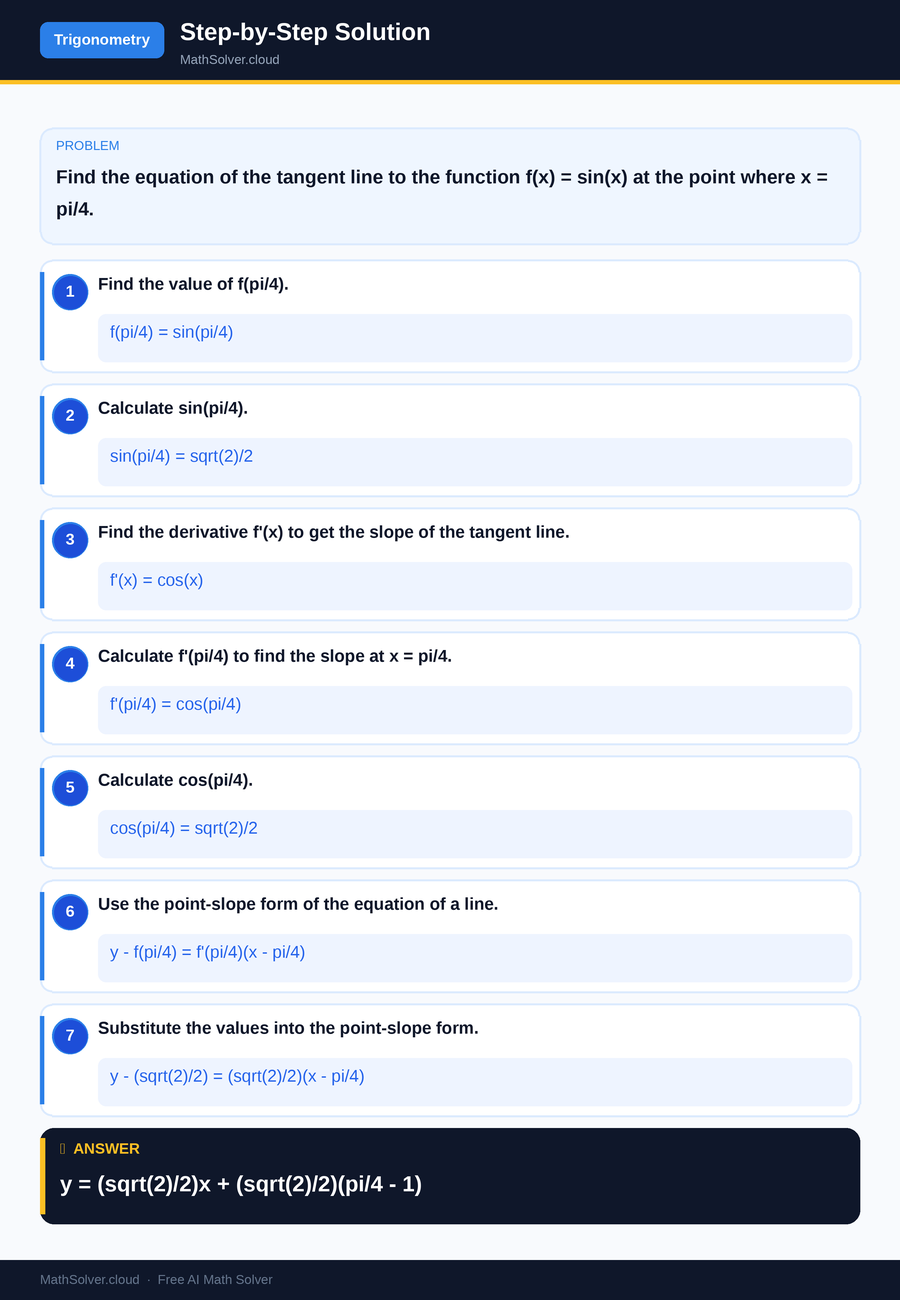
MathSolver Chrome extension solving this problem step-by-step
Example 2
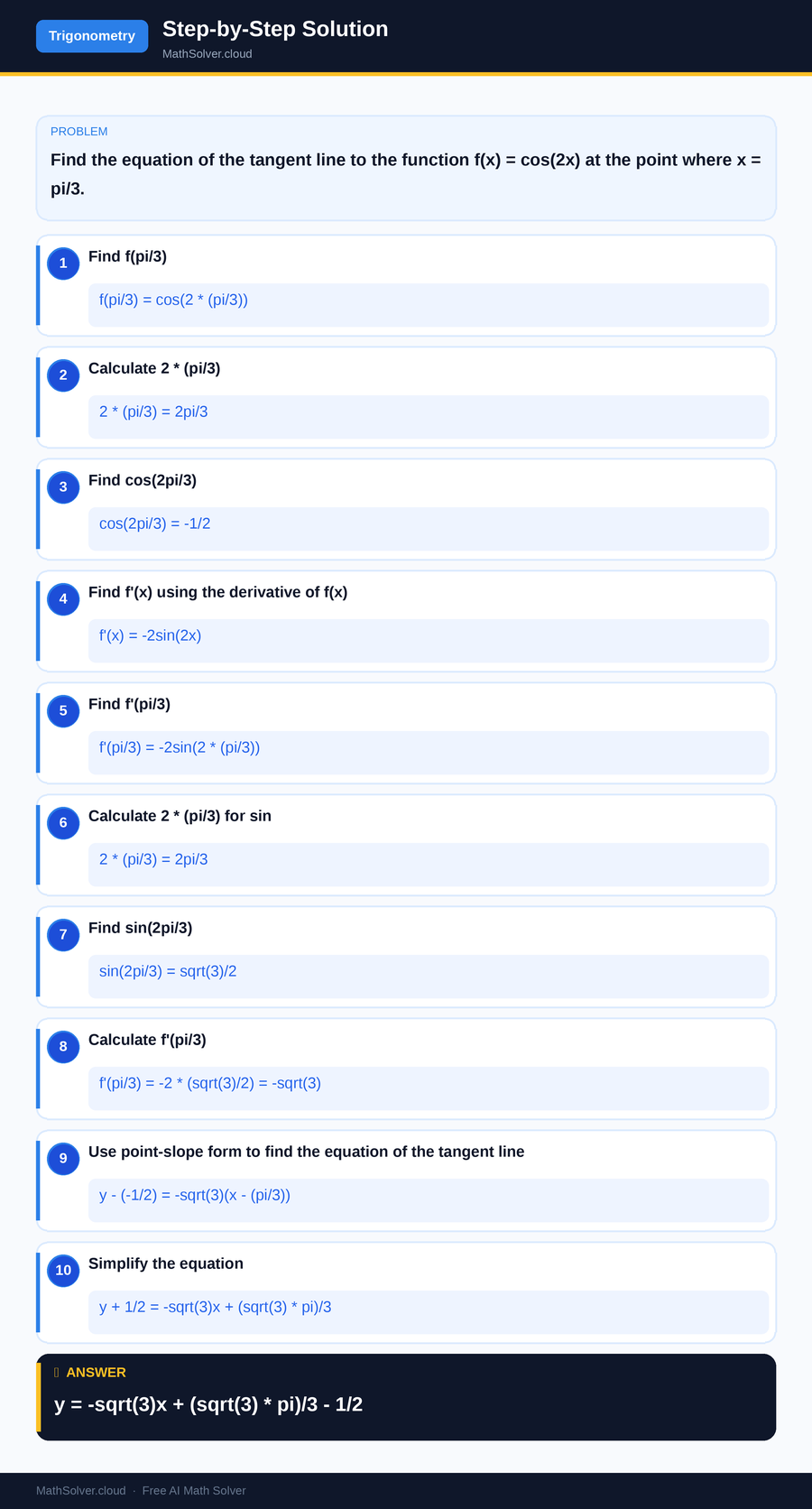
MathSolver Chrome extension solving this problem step-by-step
Common Mistakes to Avoid
One common mistake students make is neglecting to correctly differentiate the function. This error often leads to an incorrect slope for the tangent line, resulting in an inaccurate equation. To avoid this, ensure you apply the rules of differentiation carefully and double-check your work. Another frequent error is failing to substitute the x-value accurately into both the derivative and the original function, which can lead to incorrect points of tangency and slopes.
Another pitfall is misunderstanding the point-slope form of a line. Students sometimes mix up the coordinates or slope, leading to a flawed equation. To avoid this mistake, remember the formula y - y1 = m(x - x1) and ensure that you have accurately identified m, x1, and y1 from your calculations. By paying close attention to these details, you can avoid common errors and improve your proficiency in finding the equation of tangent lines.
Real-World Applications
The ability to find the equation of the tangent line has numerous applications in real life. In physics, for example, it can be used to determine instantaneous velocity or acceleration, as these are essentially tangent lines to curves that represent motion. Engineers often use tangent lines to approximate nonlinear behaviors in systems, allowing for simpler calculations that still provide valuable insights into system performance.
In economics, tangent lines help in understanding marginal concepts, such as marginal cost or marginal revenue, which are vital in making business decisions. These lines provide approximations that can predict changes in costs or revenues with changes in production levels. By mastering how to find the equation of the tangent line, you gain a powerful tool that is applicable across various scientific and economic disciplines.
Frequently Asked Questions
❓ How do you find the equation of the tangent line for a given curve?
❓ What are some common student questions about finding tangent lines?
❓ How can AI help with finding the equation of the tangent line?
❓ How do tangent planes relate to tangent lines?
❓ Where can I find more resources on trigonometry and calculus?
🚀 Solve any math problem instantly
2,000+ students use MathSolver every day — join them for free
📥 Add to Chrome — It's Free