How to Find an Equation of Tangent Line
📋 In this guide
To find an equation of tangent line is a fundamental skill in calculus that often baffles students. It involves determining a straight line that just "touches" a curve at a single point, effectively matching the slope of the curve at that specific point. Students frequently struggle with this concept due to the intricacies of calculus and the need to understand derivatives, which are central to this process. In this article, you'll learn how to find an equation of tangent line, understand its significance, and see how it connects to various mathematical concepts.
Many students find themselves puzzled by the algebra equations involved in this process. The notion of instantaneous rate of change, represented by the derivative, can be daunting at first. However, with a clear understanding and methodical approach, this topic can become much more accessible. By the end of this article, you'll understand the process of determining tangent lines, see practical examples, and learn how to avoid common pitfalls.
The goal is to alleviate the confusion surrounding how to find an equation of tangent line and equip you with the knowledge and confidence to tackle such problems. Whether you're dealing with a simple linear function or a more complex quadratic equation, the principles remain the same. So, let's dive into the world of calculus and uncover the mystery behind tangent lines.
Step-by-Step: How to Solve Find An Equation Of Tangent Line
Step 1: Find the Derivative of the Function
The first step in finding an equation of tangent line is to determine the derivative of the function. The derivative, often expressed as f'(x), represents the slope of the tangent line at any point on the function. For example, if you have a function f(x) = x^2, the derivative f'(x) would be 2x. Understanding how to find derivatives, whether through basic rules or more advanced techniques, is crucial. Remember, the derivative tells you how the function is changing at any given point, which is essential for finding the slope of the tangent line.
Step 2: Evaluate the Derivative at the Point of Interest
Once you have the derivative, the next step is to evaluate it at the specific point where you want to find the tangent line. If you're given a point x = a, substitute this value into the derivative to find f'(a), which gives you the slope of the tangent line at that point. For instance, if f'(x) = 2x and you're interested in the point where x = 3, then f'(3) = 6. This number is crucial as it indicates how steep or flat the tangent line will be at the point of contact.
Step 3: Use the Point-Slope Form of a Line
With the slope in hand, use the point-slope form of a line to write the equation of the tangent line. The point-slope formula is y - y1 = m(x - x1), where m is the slope, and (x1, y1) is the point of tangency on the function. Substitute f'(a) for m, and use the point (a, f(a)) for (x1, y1). This will allow you to express the equation of the tangent line in a clear and concise manner. Double-check your work to ensure that the values are correctly substituted.
Step 4: Simplify and Verify the Equation
The final step is to simplify the equation of the tangent line if necessary and verify that it accurately represents the tangent at the given point. Simplification may involve basic algebraic manipulation to express the equation in a more standard form, such as y = mx + b. Ensure that the tangent line equation correctly touches the curve at the specified point. Verifying your solution is key to ensuring accuracy and understanding.
🤖 Stuck on a math problem?
Take a screenshot and let our AI solve it step-by-step in seconds
⚡ Try MathSolver Free →Worked Examples
Example 1
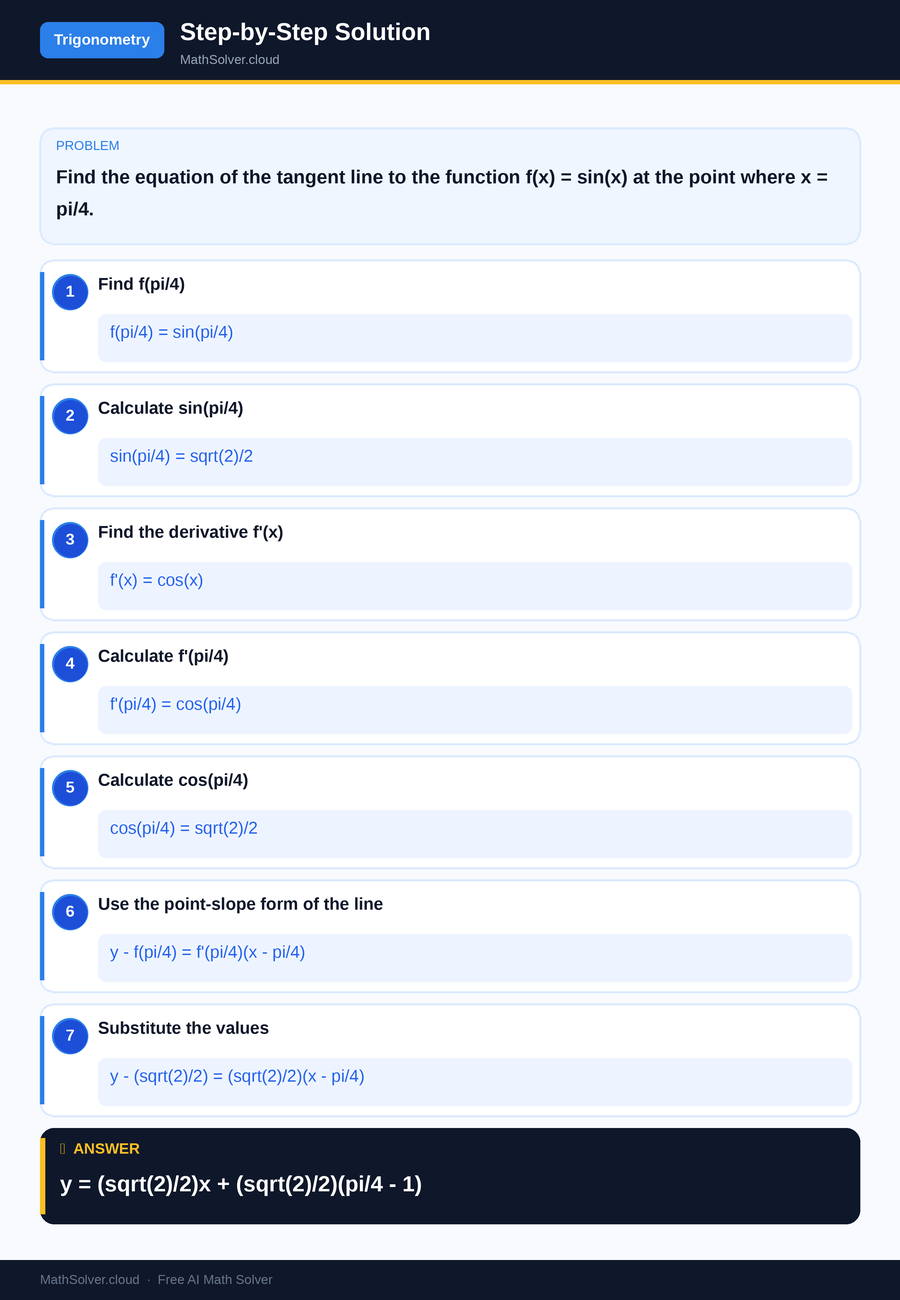
MathSolver Chrome extension solving this problem step-by-step
Example 2
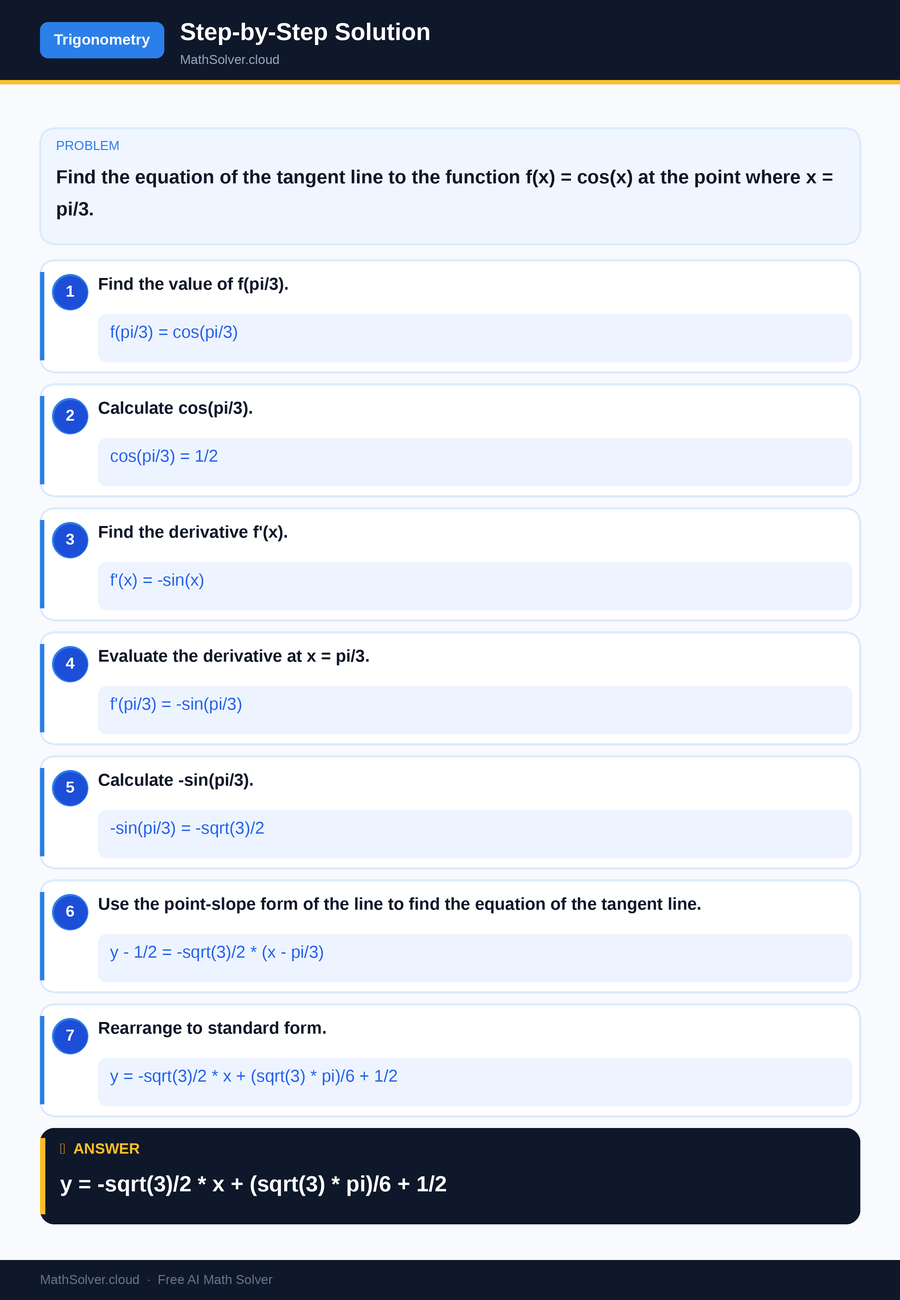
MathSolver Chrome extension solving this problem step-by-step
Common Mistakes to Avoid
One common mistake when trying to find an equation of tangent line is forgetting to evaluate the derivative at the specific point of interest. Students often calculate the derivative correctly but forget this crucial step, leading to an incorrect slope in their tangent line equation. Additionally, there's a tendency to misapply the point-slope formula by using incorrect values for the coordinates or slope. Double-check your substitutions to avoid these errors.
Another frequent error is simplifying the equation improperly. This can happen due to incorrect algebraic manipulation or oversight in arithmetic calculations. To avoid this, carefully follow each step of simplification, ensuring that each term is correctly handled. It's also beneficial to verify your final equation by substituting back into the original function to confirm it accurately represents the tangent line at the desired point.
Real-World Applications
The ability to find an equation of tangent line has numerous real-world applications. In physics, for instance, tangent lines are used extensively in kinematic equations to determine instantaneous velocity and acceleration. This is essential for understanding motion dynamics and engineering applications, where precise measurements are crucial.
In biology, tangent lines can be applied to study growth rates in populations or reactions, such as in photosynthesis equation models. Understanding how variables change instantaneously can provide insights into biological processes and help in developing models for ecosystems. The versatility of tangent lines makes them a powerful tool in various scientific fields.
Frequently Asked Questions
❓ How do you find an equation of tangent line for a curve?
❓ Why is finding the derivative important in this process?
❓ How can AI help with finding an equation of tangent line?
❓ What is the difference between a tangent line and a tangent plane?
❓ Can tangent lines be used in analyzing sine curves?
🚀 Solve any math problem instantly
2,000+ students use MathSolver every day — join them for free
📥 Add to Chrome — It's Free