Mastering the Equation Tangent Plane
📋 In this guide
The equation tangent plane is a fundamental concept in multivariable calculus, essential for understanding the nature of surfaces in three-dimensional space. Many students find this topic challenging due to the complexity of visualizing three-dimensional surfaces and the mathematical rigor required to derive and apply the equations accurately. In this article, we will explore the concept of the equation tangent plane, break down the key formula, and provide a step-by-step guide to solving problems involving tangent planes. By the end of this article, you will have a solid understanding of how to approach these problems with confidence.
Students often struggle with the equation tangent plane because it involves partial derivatives and requires a good grasp of multivariable functions. The concept may seem abstract at first, as it extends the idea of a tangent line from two dimensions to three. However, with a clear explanation and practical examples, the process of finding the equation tangent plane becomes much more approachable.
In the following sections, we will delve into the formula for tangent planes, walk through detailed examples, and discuss common mistakes to avoid. Additionally, we will explore real-world applications of tangent planes and answer frequently asked questions. Whether you're a student new to calculus or looking to refine your understanding, this article is designed to provide clarity and insight into the equation tangent plane.
Step-by-Step: How to Solve Equation Tangent Plane
Step 1: Identify the Function and Point of Tangency
The first step in finding the equation tangent plane is to identify the function z = f(x, y) that describes the surface and the specific point (x_0, y_0, z_0) where the tangent plane is to be found. This point will be given in the problem, and it is crucial to ensure that the point lies on the surface by checking that z_0 = f(x_0, y_0). Understanding this initial step is akin to solving algebra equations, where one must first identify the variables and constants involved.
Step 2: Calculate the Partial Derivatives
Once the function and point of tangency are identified, the next step is to calculate the partial derivatives of the function with respect to x and y, denoted as f_x and f_y. These derivatives represent the slopes of the surface in the x and y directions, respectively. Calculating partial derivatives is a foundational skill in calculus, similar to solving a quadratic equation where differentiation plays a key role.
Step 3: Evaluate the Partial Derivatives at the Given Point
After obtaining the partial derivatives, evaluate them at the point (x_0, y_0). This means substituting x_0 and y_0 into the expressions for f_x and f_y to find their values at the point of tangency. This step is analogous to using kinematic equations in physics, where specific values are substituted into general formulas to find particular results.
Step 4: Write the Equation of the Tangent Plane
Finally, substitute the point (x_0, y_0, z_0) and the evaluated partial derivatives into the formula for the equation tangent plane. Simplify the expression to obtain the final equation of the tangent plane. This step involves combining all the calculated components, much like assembling the photosynthesis equation by integrating various factors like light, water, and carbon dioxide.
🤖 Stuck on a math problem?
Take a screenshot and let our AI solve it step-by-step in seconds
⚡ Try MathSolver Free →Worked Examples
Example 1
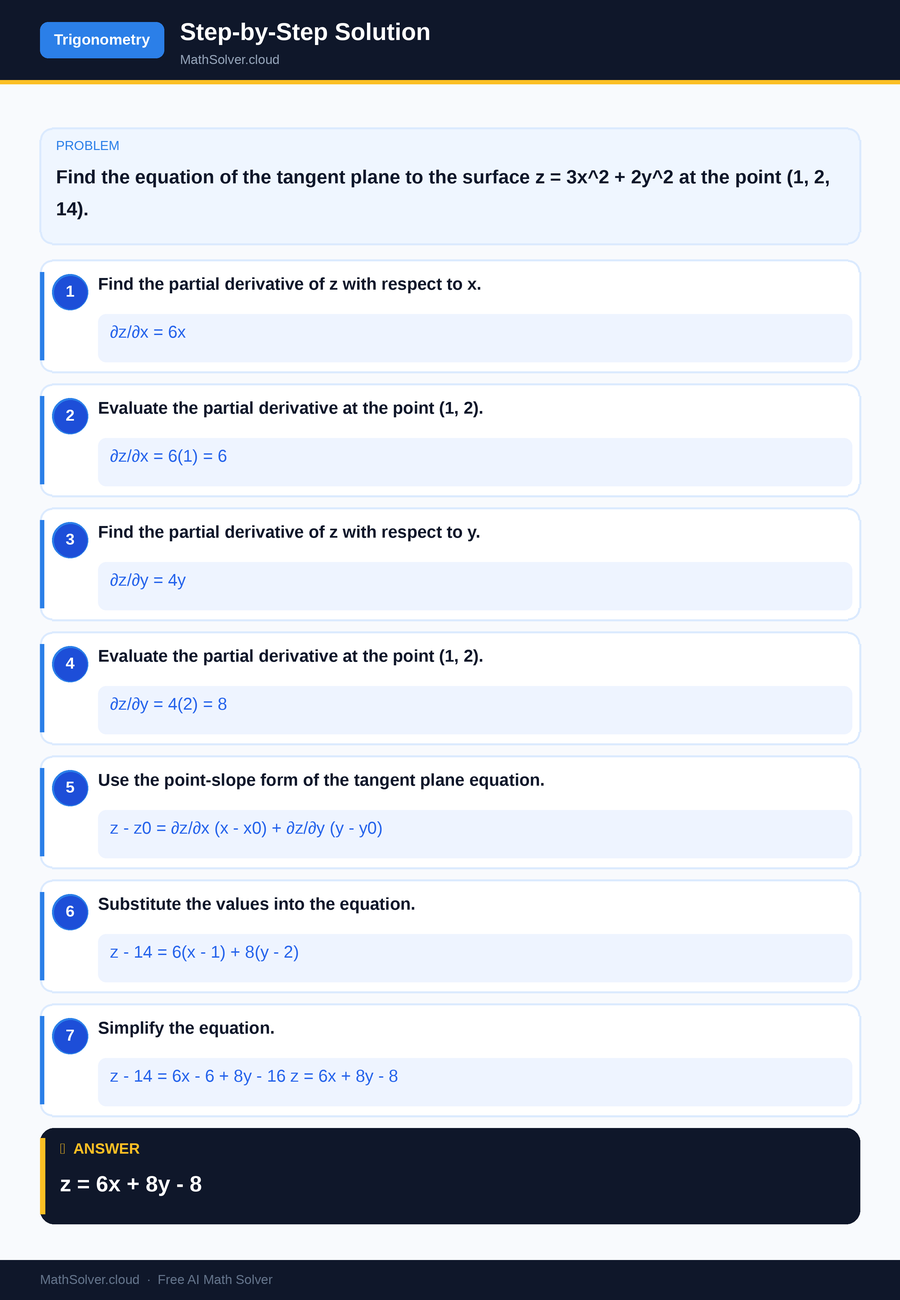
MathSolver Chrome extension solving this problem step-by-step
Example 2
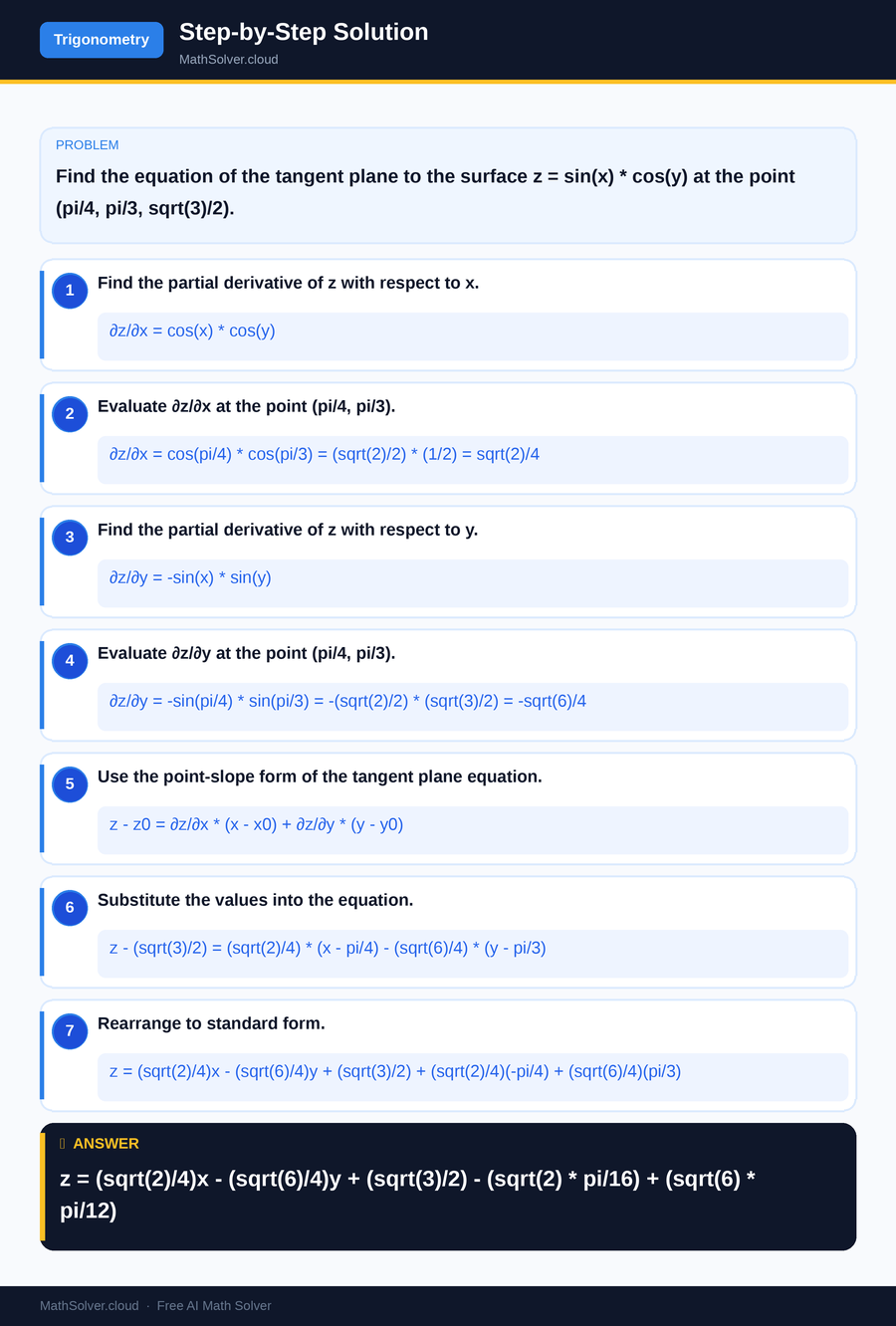
MathSolver Chrome extension solving this problem step-by-step
Common Mistakes to Avoid
When working with the equation tangent plane, one common mistake is neglecting to verify that the given point actually lies on the surface. Always substitute the point into the original surface equation to ensure validity. Another frequent error is incorrectly calculating partial derivatives, which can lead to an incorrect tangent plane equation. Double-checking your differentiation and arithmetic can help avoid these pitfalls.
Additionally, students often make algebraic errors when substituting values into the tangent plane equation. Carefully working through each step and simplifying the equation systematically can prevent these mistakes. Remember that practice and attention to detail are key to mastering the process.
Real-World Applications
The equation tangent plane is not just a theoretical construct; it has practical applications in various fields. For instance, in computer graphics, tangent planes are used to approximate curved surfaces with flat polygons, enabling efficient rendering of 3D models. This is crucial for creating realistic animations and video games.
Another application is in engineering, where tangent planes help in stress analysis of curved surfaces. By approximating a curved surface with a tangent plane, engineers can calculate forces and stresses more easily, facilitating the design of structures and components. These examples illustrate the importance of understanding the equation tangent plane in practical scenarios.
Frequently Asked Questions
❓ What is the equation tangent plane used for?
❓ How do you find the equation tangent plane for implicit surfaces?
❓ How can AI help with equation tangent plane problems?
❓ What is the difference between a tangent line and a tangent plane?
❓ How are tangent planes related to the photosynthesis equation?
🚀 Solve any math problem instantly
2,000+ students use MathSolver every day — join them for free
📥 Add to Chrome — It's Free