Mastering the Equation of the Tangent Line
📋 In this guide
The equation of the tangent line is a fundamental concept in calculus that describes the line that just "touches" a curve at a specific point without crossing it. Many students find this topic challenging because it combines several mathematical concepts, including differentiation, slope, and algebraic manipulation. Understanding how to find the equation of the tangent line is crucial for solving problems in calculus and beyond. By the end of this article, you'll have a thorough understanding of how to derive the equation of the tangent line, step by step.
Students often struggle with the equation of the tangent line because it requires a good grasp of derivatives and their geometric interpretation. The tangent line represents the instantaneous rate of change of a function at a given point, which is the same as the derivative of the function at that point. This concept can be abstract and difficult to visualize, especially for those new to calculus. However, with a structured approach and practice, finding the equation of the tangent line becomes more intuitive.
In this guide, we will break down the process of finding the equation of the tangent line into manageable steps. We'll provide clear explanations and worked examples to help you master this concept. By learning these techniques, you'll be able to tackle a wide range of mathematical problems involving curves and their tangents. Whether you're a student preparing for exams or simply looking to strengthen your calculus skills, this article will serve as a valuable resource.
Step-by-Step: How to Solve Equation Of The Tangent Line
Step 1: Find the Derivative of the Function
The first step in finding the equation of the tangent line is to determine the derivative of the function. The derivative represents the slope of the tangent line at any point along the curve. For a function y = f(x), the derivative is denoted by f'(x). Calculating the derivative involves applying differentiation rules, such as the power rule, product rule, quotient rule, or chain rule, depending on the form of the function. Understanding these rules is essential for finding the slope of the tangent line accurately.
Step 2: Evaluate the Derivative at the Given Point
Once you have determined the derivative of the function, the next step is to evaluate this derivative at the specific point where you want to find the tangent line. This point is usually given as an x-coordinate, say x1. By substituting x1 into the derivative f'(x), you obtain the slope m of the tangent line at the point (x1, y1). This slope is crucial as it defines the direction and steepness of the tangent line relative to the curve.
Step 3: Determine the Coordinates of the Point
The coordinates of the point where the tangent line touches the curve are essential for writing the equation of the tangent line. If you are given the x-coordinate x1, you can find the corresponding y-coordinate y1 by substituting x1 into the original function y = f(x). This will give you the point (x1, y1) on the curve. Knowing the exact coordinates ensures that your tangent line is accurate and passes through the correct point on the curve.
Step 4: Write the Equation of the Tangent Line
With the slope m and the point (x1, y1) determined, you can now write the equation of the tangent line using the point-slope form: y - y1 = m(x - x1). This equation represents the line that touches the curve at the designated point and has the slope calculated in the previous steps. Simplify the equation if necessary to make it easier to interpret or graph. This final step completes the process of finding the equation of the tangent line.
🤖 Stuck on a math problem?
Take a screenshot and let our AI solve it step-by-step in seconds
⚡ Try MathSolver Free →Worked Examples
Example 1
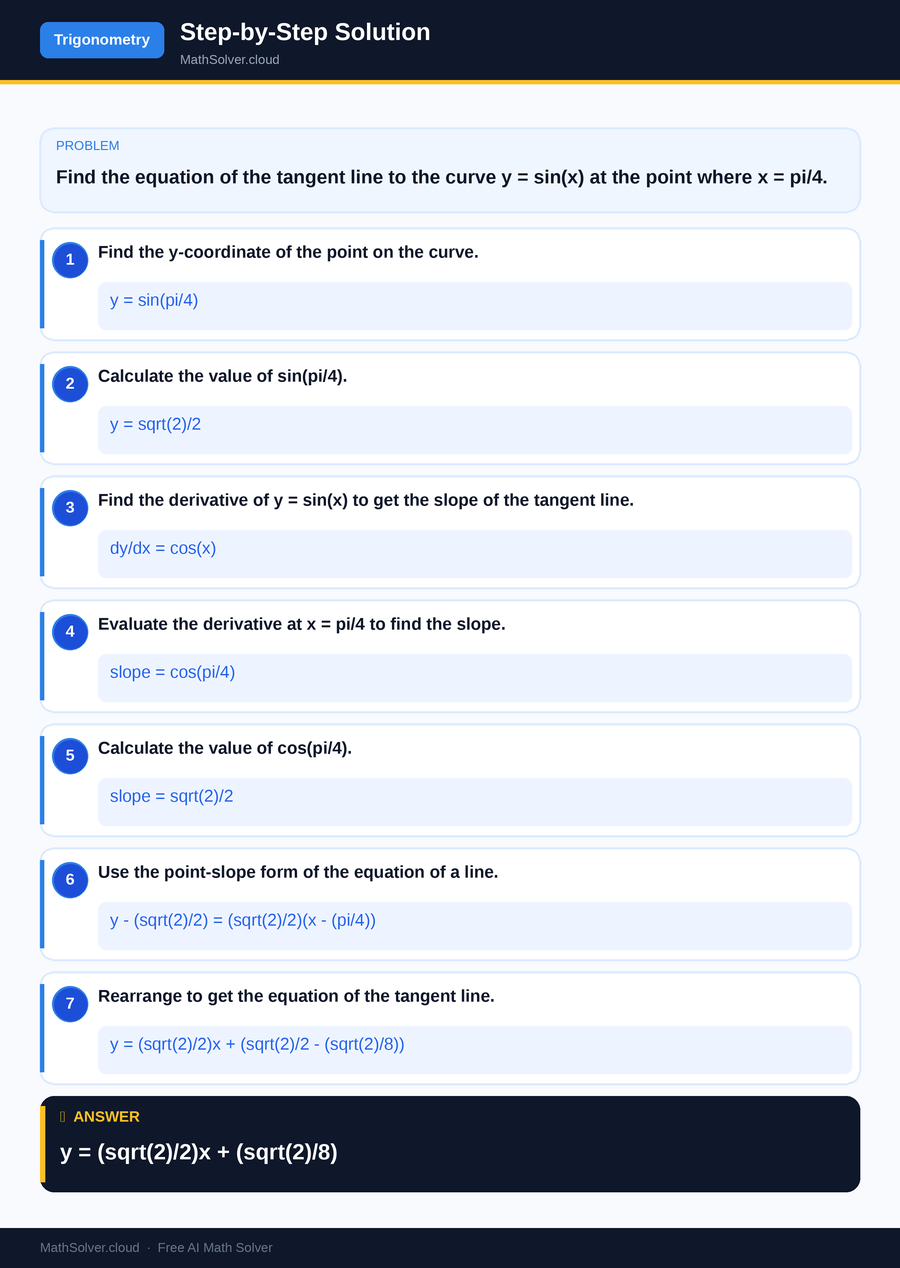
MathSolver Chrome extension solving this problem step-by-step
Example 2
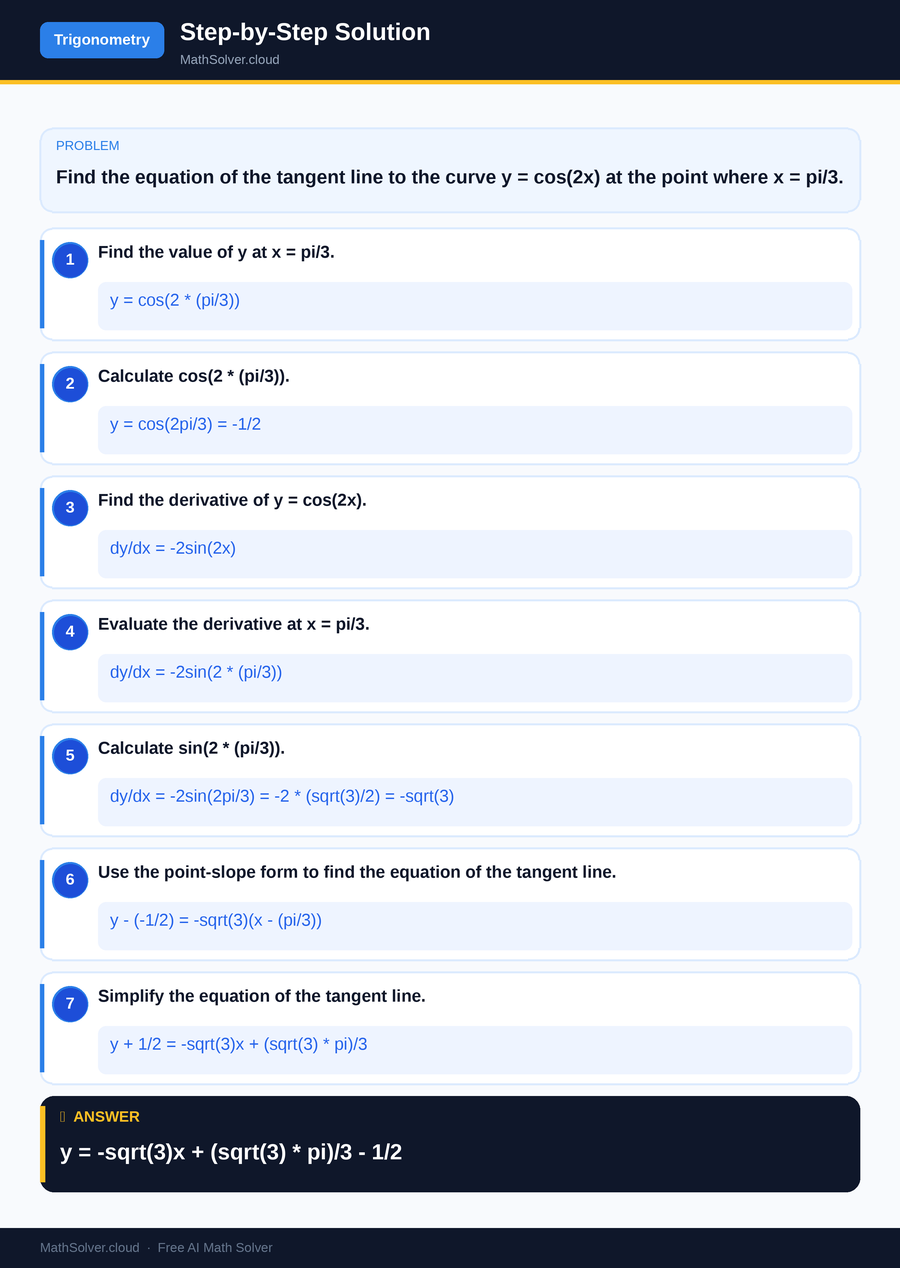
MathSolver Chrome extension solving this problem step-by-step
Common Mistakes to Avoid
One common mistake students make is confusing the derivative of the function with the function itself. Remember, the derivative gives the slope of the tangent line, not the coordinates of the point on the curve. Always ensure that you differentiate the function correctly and evaluate it at the given x-coordinate to find the slope.
Another frequent error is misapplying the point-slope form. Students sometimes mix up the x and y values or incorrectly simplify the equation. Always double-check your calculations and ensure that the equation is in the correct form. Practice and attention to detail can help prevent these mistakes.
Real-World Applications
The equation of the tangent line is used in various real-world applications, such as calculating the instantaneous rate of change in physics and engineering problems. For example, when determining the velocity of an object at a specific time, the tangent line to the position-time graph provides this information.
In economics, tangent lines help in understanding marginal costs and revenues, which are crucial for making informed business decisions. By analyzing the tangent to a cost or revenue curve, companies can optimize their pricing and production strategies. Understanding these applications makes the concept of the tangent line more relevant and practical.
Frequently Asked Questions
❓ What is the equation of the tangent line for a curve?
❓ Why do I need to find the equation of the tangent line?
❓ How can AI help with finding the equation of the tangent line?
❓ What is the difference between the tangent line and the tangent plane?
❓ How do I find the equation of a tangent line using technology?
🚀 Solve any math problem instantly
2,000+ students use MathSolver every day — join them for free
📥 Add to Chrome — It's Free