Mastering the Equation of Sine Curve
📋 In this guide
The equation of sine curve is a fundamental concept in trigonometry, representing periodic oscillations such as sound waves, light waves, and tides. Students often find this topic challenging because it involves understanding several parameters like amplitude, period, phase shift, and vertical shift. These elements affect the shape and position of the sine wave, making it crucial to grasp each aspect to master the equation of sine curve.
In this article, we will explore the equation of sine curve in detail, breaking down its components and guiding you through the process of constructing the equation. Our aim is to demystify this topic, giving you the confidence to tackle related problems with ease. By the end of this article, you will have a solid understanding of how to derive and manipulate the equation of sine curve, along with insights into real-world applications and common pitfalls to avoid.
Whether you're struggling with algebra equations or looking to understand more complex topics like the quadratic equation in trigonometry, this guide will be your go-to resource. We'll also touch on related topics such as the equation for diagonal to the right sine curve, the equation of tangent plane, and tangent equation. Dive in and let's unravel the mysteries of the sine curve together!
Step-by-Step: How to Solve Equation Of Sine Curve
Step 1: Understanding Amplitude
The amplitude of a sine curve, denoted by the variable A, represents the peak value of the wave from its central axis. It indicates how "tall" or "short" the wave appears. For instance, if A is 3, the wave will extend 3 units above and below the central axis. A positive amplitude results in a standard sine wave, while a negative amplitude flips the wave upside down. Grasping the concept of amplitude is crucial, as it directly affects the height of the sine curve.
Step 2: Calculating the Period
The period of a sine curve determines how long it takes for the wave to complete one full cycle. It is influenced by the coefficient B in the equation. The period is calculated using the formula: Period = 2pi/B. A larger value of B results in a shorter period, causing the wave to cycle more frequently over a given interval. Conversely, a smaller B value stretches the wave, increasing the period. Understanding how the period changes with B is essential for sketching accurate sine curves.
Step 3: Determining the Phase Shift
Phase shift, represented by the variable C, describes the horizontal movement of the sine curve along the x-axis. It indicates how far the wave has been shifted from its original position. A positive C value shifts the curve to the left, while a negative C value shifts it to the right. The phase shift is calculated as C/B. Mastering phase shifts allows you to accurately position the sine curve on the graph, aligning it with desired features or data points.
Step 4: Applying Vertical Shift
The vertical shift, denoted by D, moves the entire sine curve up or down along the y-axis. This shift alters the baseline of the wave without affecting its shape. A positive D value shifts the curve upwards, while a negative value moves it downwards. Vertical shift is crucial for situating the sine curve at the correct height relative to other graph elements or real-world data. By combining amplitude, period, phase shift, and vertical shift, you can construct a precise equation of sine curve.
🤖 Stuck on a math problem?
Take a screenshot and let our AI solve it step-by-step in seconds
⚡ Try MathSolver Free →Worked Examples
Example 1
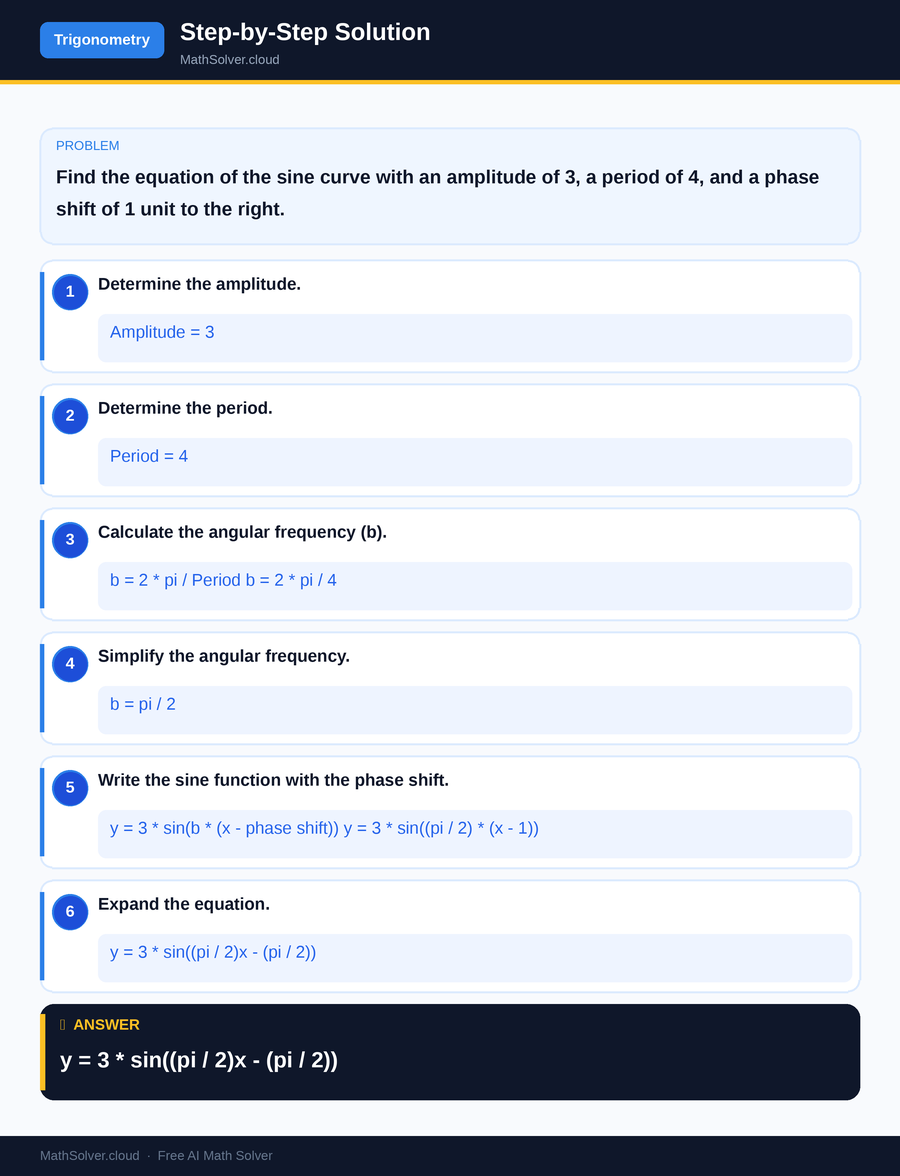
MathSolver Chrome extension solving this problem step-by-step
Example 2
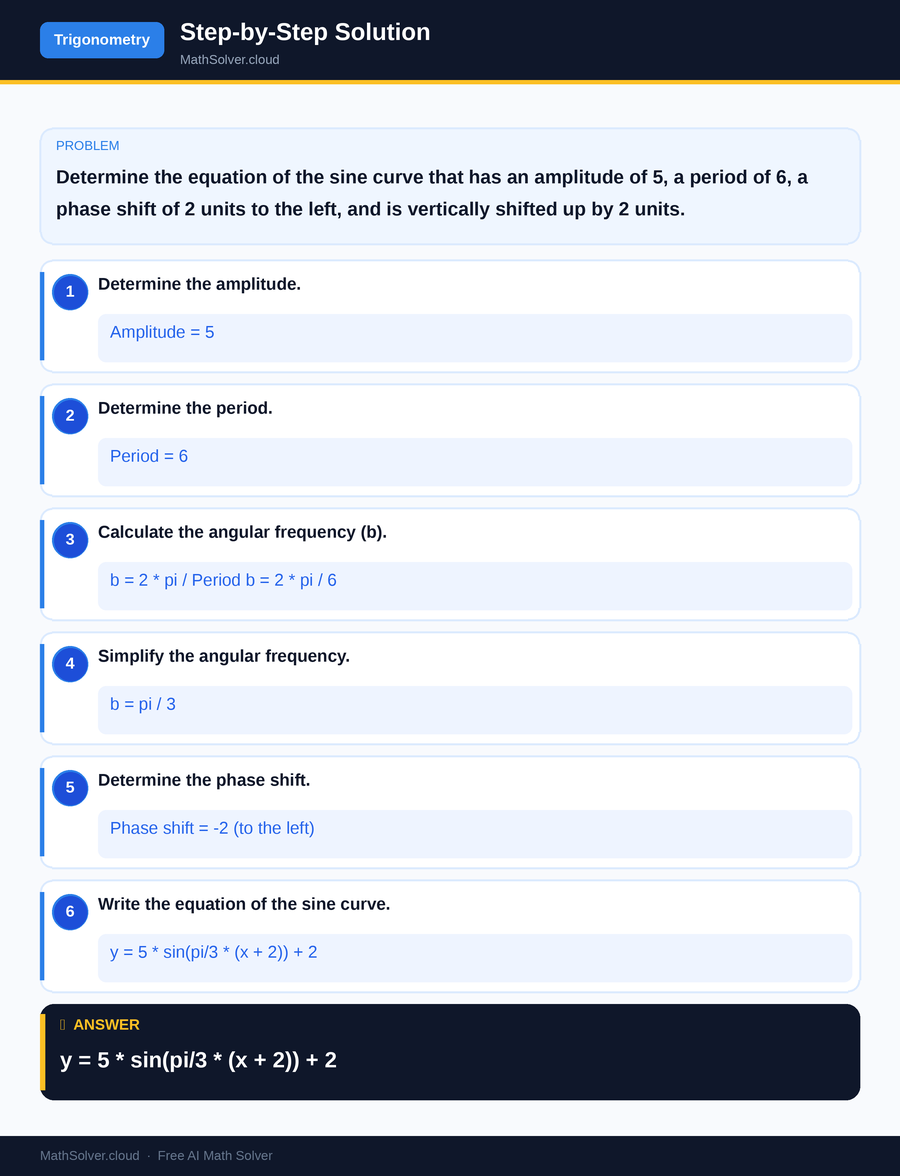
MathSolver Chrome extension solving this problem step-by-step
Common Mistakes to Avoid
One common mistake students make is confusing the direction of the phase shift. Remember, a positive phase shift moves the curve to the left, while a negative one moves it to the right. Another frequent error is miscalculating the period by forgetting to invert the B coefficient in the formula. Ensure you calculate the period as Period = 2pi/B to avoid errors.
It's also easy to overlook the impact of the vertical shift, especially when focusing on amplitude and period. Always double-check your equation to ensure the vertical shift is correctly applied. These common pitfalls can lead to incorrect graph interpretations, so take your time to verify each component of the equation of sine curve.
Real-World Applications
The equation of sine curve is widely used in real-world applications. For instance, sound engineers use it to model sound waves, helping in the design of acoustically optimized spaces. The predictable nature of sine waves makes them ideal for representing oscillations in audio signals.
In physics, sine curves describe the motion of pendulums and springs, making them essential in designing clocks and measuring devices. Additionally, sine curves are used in electrical engineering to model alternating current (AC) waveforms. Understanding the practical applications of the equation of sine curve helps relate mathematical concepts to tangible phenomena.
Frequently Asked Questions
❓ What is the equation of sine curve?
❓ Why do I struggle with the equation of sine curve?
❓ How can AI help with the equation of sine curve?
❓ How do phase shifts impact the equation of sine curve?
❓ What’s the difference between the equation of sine curve and the tangent equation?
🚀 Solve any math problem instantly
2,000+ students use MathSolver every day — join them for free
📥 Add to Chrome — It's Free