Mastering the Equation of a Tangent Line
📋 In this guide
The equation of a tangent line is a fundamental concept in calculus that often stumps students. At its core, the equation of a tangent line represents the line that just "touches" a curve at a specific point, matching the curve's slope at that point. This topic is pivotal in calculus because it bridges the gap between algebraic functions and their geometric interpretations. Despite its importance, many students struggle with understanding how to find the equation of a tangent line due to the abstract nature of derivatives and slopes.
Students often find themselves asking, "How do I find the equation of a tangent line?" This question stems from the challenge of applying the abstract concepts of derivatives and slopes to tangible problems. The process involves not just understanding the mathematics, but also visualizing how a line can just skim the surface of a curve at a single point. Fortunately, with systematic guidance and practice, mastering how to find the equation of a tangent line becomes an attainable goal.
In this article, you'll learn the essentials of determining the equation of a tangent line, broken down into manageable steps. By the end, you'll have a clear understanding of the process, complete with worked examples and common pitfalls to avoid. We'll also explore real-world applications and provide answers to frequently asked questions, making this a comprehensive guide to mastering the topic.
Step-by-Step: How to Solve Equation Of A Tangent Line
Step 1: Determine the Point of Tangency
To begin finding the equation of a tangent line, identify the point on the curve where the tangent line will touch. This point is typically given as a specific x-value, say x = a. Substitute this x-value into the function, f(x), to find the corresponding y-coordinate. The result will be the point of tangency, (a, f(a)), which is crucial for using the point-slope form of a line.
Step 2: Calculate the Derivative
The next step in how to find the equation of a tangent line involves calculating the derivative of the function, f'(x). The derivative represents the rate of change or the slope of the function at any point. Differentiation can be performed using standard rules, such as the power rule, product rule, or chain rule, depending on the complexity of the function.
Step 3: Evaluate the Derivative at the Point
Once you have the derivative, the next step is to evaluate it at the point of tangency, x = a. Substitute x = a into the derivative f'(x) to find the slope of the tangent line at that particular point. This value, f'(a), is crucial as it dictates the angle at which the tangent line intersects the curve.
Step 4: Use the Point-Slope Formula
With both the point of tangency (a, f(a)) and the slope f'(a) in hand, you can now use the point-slope form to find the equation of the tangent line. The formula y - f(a) = f'(a)(x - a) allows you to plug in the known values and derive the equation for the tangent line. Simplify this equation to get the final expression for the tangent line.
🤖 Stuck on a math problem?
Take a screenshot and let our AI solve it step-by-step in seconds
⚡ Try MathSolver Free →Worked Examples
Example 1
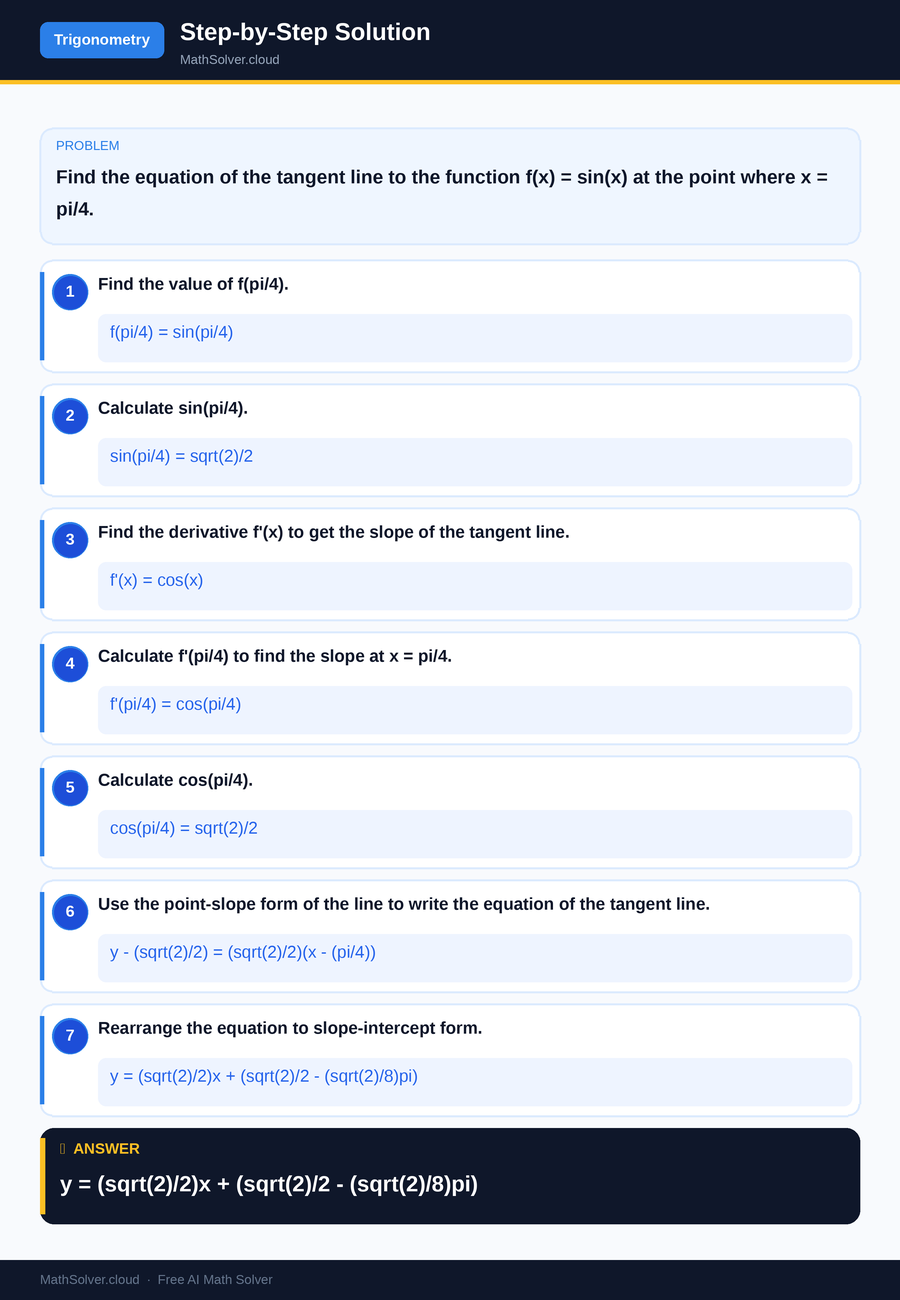
MathSolver Chrome extension solving this problem step-by-step
Example 2
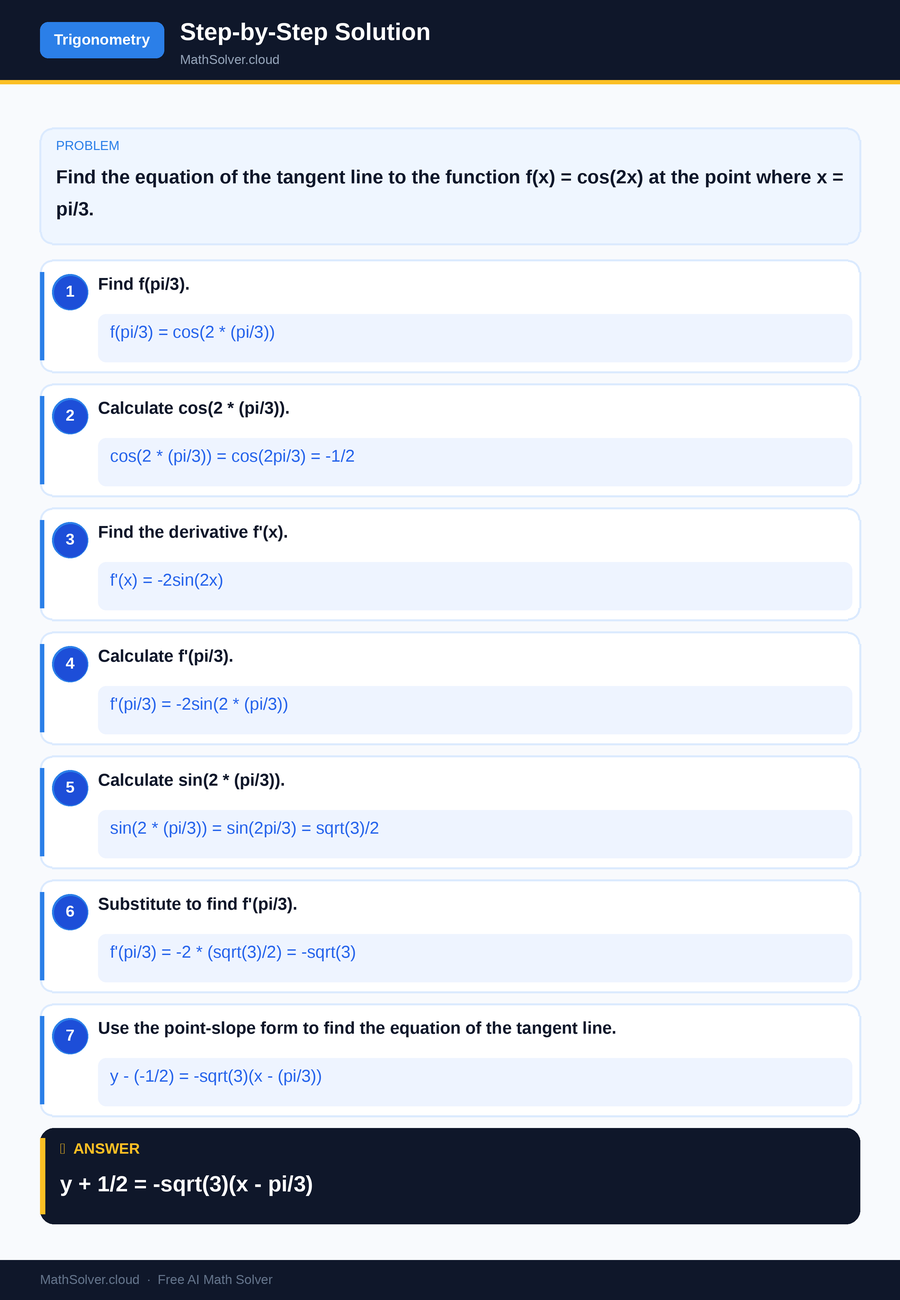
MathSolver Chrome extension solving this problem step-by-step
Common Mistakes to Avoid
One common mistake students make when finding the equation of a tangent line is miscalculating the derivative. This often happens when students apply the differentiation rules incorrectly or overlook the chain rule in composite functions. To avoid this, ensure that you understand the differentiation techniques thoroughly and double-check your calculations.
Another frequent error is substituting the wrong values into the point-slope formula. Students might confuse the point of tangency with another point, leading to an incorrect line equation. To prevent this, always verify that you have the correct coordinates for the point of tangency and the correct slope before proceeding with the formula.
Real-World Applications
The equation of a tangent line is not just a theoretical construct; it has numerous real-world applications. In physics, tangent lines help approximate the instantaneous velocity of an object when given a position-time curve. By finding the slope of the tangent line at a specific point, scientists can determine how fast an object is moving at that exact moment.
In economics, tangent lines are used to find marginal cost or revenue at a particular level of production. The slope of the tangent to the cost or revenue curve at any production level indicates the additional cost or revenue from producing one more unit, aiding in decision-making processes.
Frequently Asked Questions
❓ What is the equation of a tangent line used for?
❓ How do you find the equation of a tangent line?
❓ How can AI help with the equation of a tangent line?
❓ Can the tangent line be used for curves other than sine or cosine?
❓ How is the tangent line different from the tangent plane?
🚀 Solve any math problem instantly
2,000+ students use MathSolver every day — join them for free
📥 Add to Chrome — It's Free