Understanding the Creatinine Clearance Equation Calculator
📋 In this guide
A creatinine clearance equation calculator is a tool used to estimate the efficiency of the kidneys in filtering creatinine from the blood. This calculation is crucial for assessing kidney function, especially in patients with chronic kidney disease or those undergoing certain medical treatments. Students and healthcare professionals often find this topic challenging because it involves complex algebra equations and requires an understanding of both mathematical concepts and physiological processes. In this article, we will explore the creatinine clearance equation calculator, break down its components, and guide you through solving related problems. By the end of this article, you'll be equipped with the skills to tackle these calculations confidently.
Understanding the creatinine clearance equation involves more than just plugging numbers into a formula. It requires a comprehension of each variable and its significance in the context of kidney function. Many students struggle because they overlook the importance of these variables or make arithmetic errors when they attempt to solve the equation. Our aim is to simplify these concepts and provide a clear, step-by-step method to use the creatinine clearance equation calculator effectively.
In addition to a detailed walkthrough of the equation, we'll provide worked examples to illustrate the process. These examples will help reinforce your understanding and demonstrate how to avoid common pitfalls. Furthermore, we'll discuss real-world applications of the creatinine clearance equation calculator and answer frequently asked questions to ensure you have a comprehensive grasp of the topic. Let's dive in and demystify this important calculation.
Step-by-Step: How to Solve Creatinine Clearance Equation Calculator
Step 1: Gather Necessary Information
Before using a creatinine clearance equation calculator, ensure you have all the required information. You'll need the patient's age, weight, and serum creatinine level. These values are crucial inputs for the Cockcroft-Gault equation. Additionally, if the patient is female, remember to use the correction factor of 0.85. Having accurate data is essential for obtaining a reliable estimate of creatinine clearance.
Step 2: Understand the Variables
Each variable in the Cockcroft-Gault equation has a specific role. The age factor (140 - age) accounts for the natural decline in kidney function with age. The weight in kilograms represents the patient's muscle mass, which correlates with creatinine production. Serum creatinine, measured in mg/dL, indicates the concentration of creatinine in the blood. Understanding these variables will help you avoid common mistakes and ensure you interpret the results correctly.
Step 3: Perform the Calculation
With all necessary information at hand, input the values into the creatinine clearance equation. For example, if you have a 60-year-old male patient weighing 70 kg with a serum creatinine level of 1.2 mg/dL, the calculation would be: (140 - 60) * 70 / (72 * 1.2). Solving this gives an estimate of the creatinine clearance rate. For female patients, remember to multiply the result by the correction factor of 0.85.
Step 4: Analyze the Results
Once you have calculated the creatinine clearance, interpret the results in the context of kidney function. A lower creatinine clearance rate may indicate impaired kidney function, necessitating further medical evaluation. Conversely, a rate within the normal range suggests healthy kidney performance. Understanding the implications of the results is as important as performing the calculation itself.
🤖 Stuck on a math problem?
Take a screenshot and let our AI solve it step-by-step in seconds
⚡ Try MathSolver Free →Worked Examples
Example 1
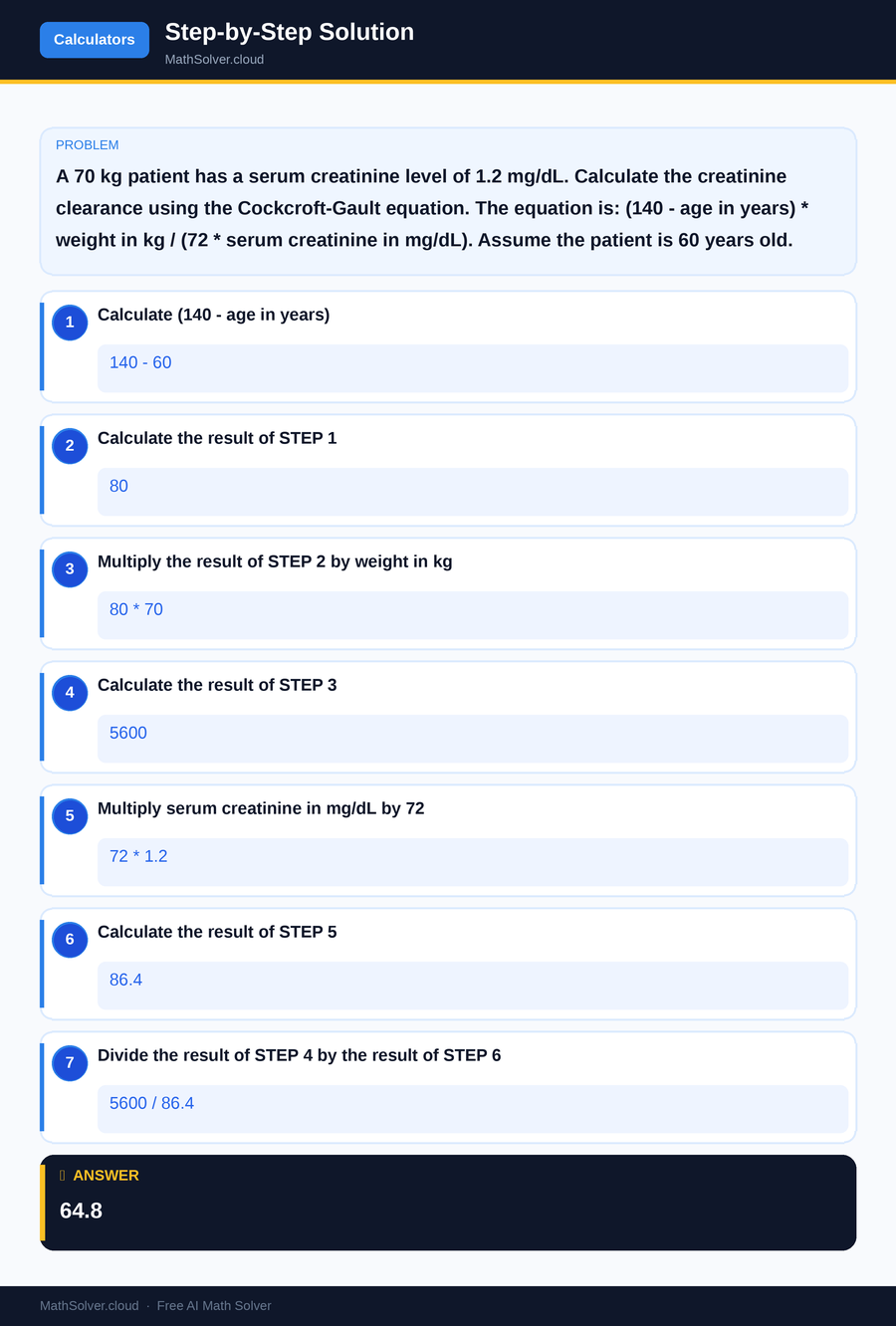
MathSolver Chrome extension solving this problem step-by-step
Example 2
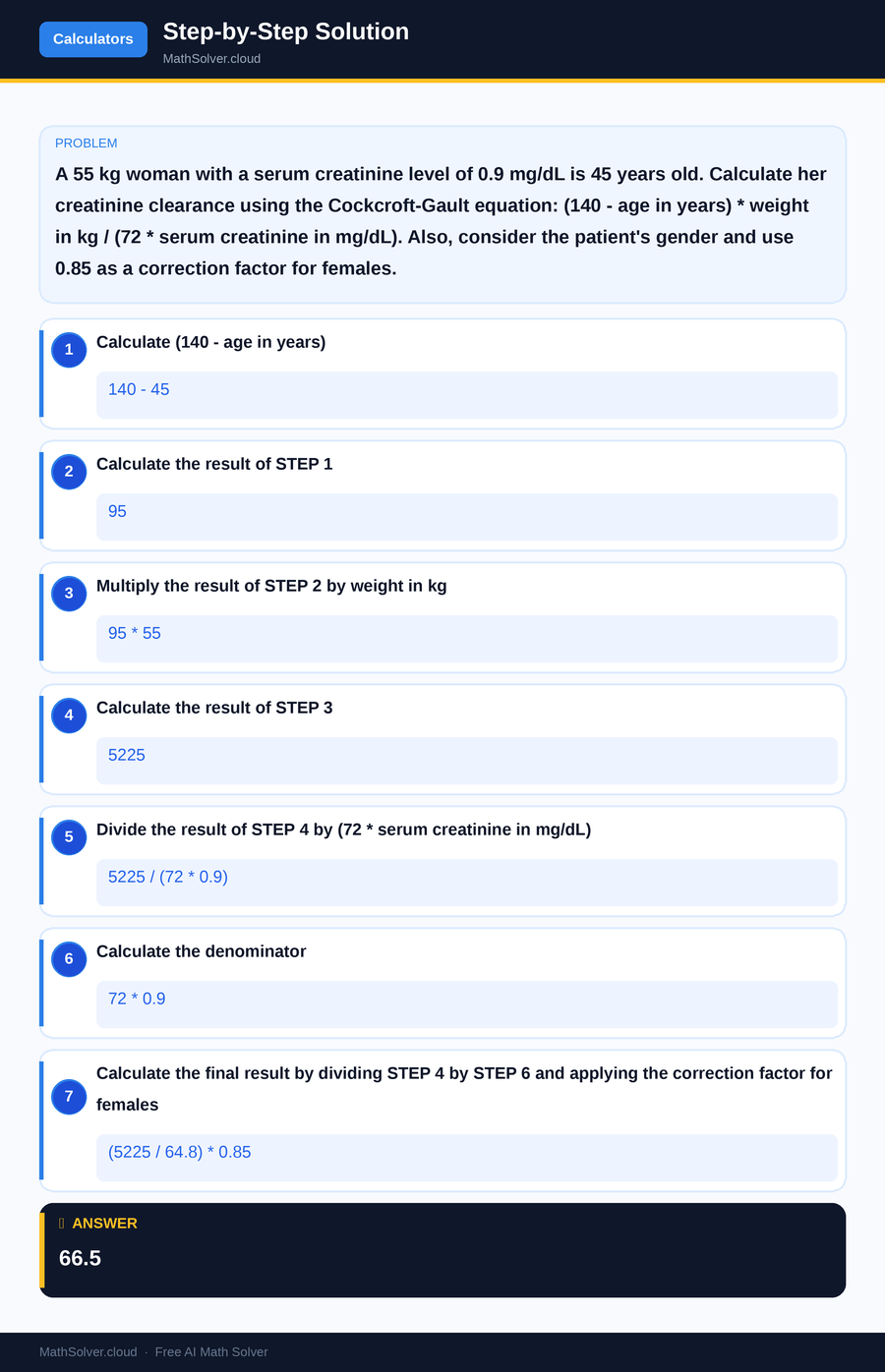
MathSolver Chrome extension solving this problem step-by-step
Common Mistakes to Avoid
One common mistake is misplacing decimal points during the calculation, particularly with serum creatinine levels. Ensure that you double-check your arithmetic to avoid errors. Another frequent error is neglecting the correction factor for female patients, which can lead to an overestimation of kidney function. Always remember to apply the 0.85 factor when calculating for women.
Additionally, using incorrect units or failing to convert them properly can result in inaccurate calculations. Make sure that weight is in kilograms and serum creatinine is in mg/dL. These details are crucial for obtaining a precise measure of creatinine clearance.
Real-World Applications
The creatinine clearance equation calculator is widely used in clinical settings to assess kidney function. It helps healthcare providers determine the appropriate dosage of medications that are cleared by the kidneys, ensuring patient safety and efficacy of treatment. For instance, patients undergoing chemotherapy may require adjusted doses based on their creatinine clearance to avoid toxic accumulation of drugs.
Furthermore, creatinine clearance calculations are essential in diagnosing and monitoring chronic kidney disease. By regularly assessing kidney function, doctors can detect early signs of decline and implement interventions to slow disease progression. This tool is invaluable for making informed decisions about patient care.
Frequently Asked Questions
❓ What is a creatinine clearance equation calculator used for?
❓ Why do students find the creatinine clearance equation challenging?
❓ How can AI help with creatinine clearance equation calculator?
❓ How does creatinine clearance relate to overall health?
❓ Can I use a math calculator to solve creatinine clearance problems?
🚀 Solve any math problem instantly
2,000+ students use MathSolver every day — join them for free
📥 Add to Chrome — It's Free