Mastering the Cosine Equation
📋 In this guide
A cosine equation is a mathematical expression involving the cosine function, a fundamental concept in trigonometry. Students often encounter difficulties with cosine equations due to the abstract nature of trigonometric functions and the need for precise angle measurements. Understanding these equations is crucial for solving a variety of mathematical problems, including those that involve waves, oscillations, and circular motion. In this article, you'll learn how to tackle cosine equations with confidence, from understanding the basic formula to solving complex problems and applying these concepts to real-world scenarios.
Cosine equations are an essential part of trigonometry, and they often appear in both high school and college-level mathematics. Despite their importance, these equations can be challenging for students because they require a deep understanding of trigonometric identities and properties. By breaking down the process into manageable steps and providing clear examples, this guide aims to demystify the process of solving cosine equations, helping students build a solid foundation in trigonometry.
Whether you're preparing for an exam or simply looking to enhance your math skills, mastering cosine equations can open the door to a wide range of mathematical applications. From understanding the intricacies of sine and cosine equations to exploring the law of cosine equations, you'll gain valuable insights into how these powerful tools can be used to solve complex problems. Let's dive into the world of cosine equations and explore their fascinating applications.
Step-by-Step: How to Solve Cosine Equation
Step 1: Identify the Type of Cosine Equation
The first step in solving a cosine equation is to identify the type of equation you're dealing with. There are simple cosine equations, like cos(x) = a, and more complex ones that involve additional terms, such as trigonometric identities or algebraic expressions. Knowing the type of equation will help you determine the best method for solving it. For example, if you encounter an equation like 2cos^2(x) - 3cos(x) + 1 = 0, you'll need to use algebraic techniques in addition to trigonometric knowledge.
Step 2: Isolate the Cosine Function
Once you've identified the equation, the next step is to isolate the cosine function. For simple equations like cos(x) = a, the cosine function is already isolated. However, in more complex equations, you may need to rearrange terms or use trigonometric identities to simplify the expression. The goal is to have the equation in a form where you can easily solve for x, the angle. This may involve factoring, using the quadratic formula, or applying trigonometric identities.
Step 3: Solve for the Angle x
After isolating the cosine function, you can solve for the angle x. For equations like cos(x) = a, you'll use the inverse cosine function, also known as arccos, to find the angle. It's important to consider the range of the cosine function and any given interval, such as [0, 2pi], to ensure you're finding the correct angle(s). In cases where the equation is more complex, you may need to solve a quadratic or apply additional trigonometric identities to find the solution.
Step 4: Verify and Interpret the Solution
The final step is to verify and interpret your solution. Make sure that the angles you found are within the specified interval and that they satisfy the original equation. Check your work by substituting the angles back into the equation to ensure they produce the correct cosine value. Additionally, interpret the solution in the context of the problem, whether it's a real-world application or a theoretical exercise. This step ensures that you have a complete understanding of the solution and its implications.
🤖 Stuck on a math problem?
Take a screenshot and let our AI solve it step-by-step in seconds
⚡ Try MathSolver Free →Worked Examples
Example 1

MathSolver Chrome extension solving this problem step-by-step
Example 2
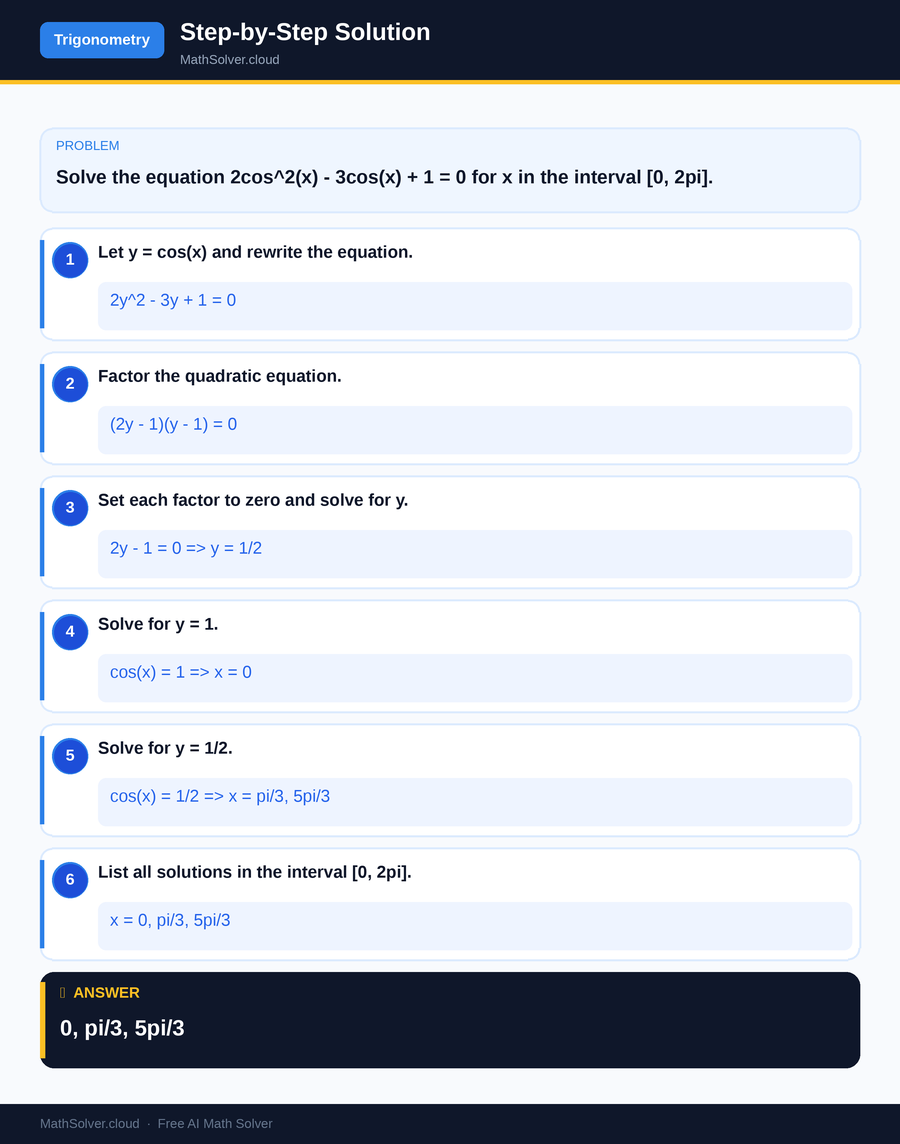
MathSolver Chrome extension solving this problem step-by-step
Common Mistakes to Avoid
One common mistake students make when solving cosine equations is neglecting to consider all possible angles within the given interval. The cosine function is periodic, meaning it repeats its values at regular intervals, so it's crucial to account for all angles that satisfy the equation. To avoid this mistake, always check for additional solutions in other quadrants.
Another frequent error is failing to verify the solutions by substituting them back into the original equation. This step is essential to ensure that the solutions are correct and that no errors were made in the calculations. Always double-check your work to confirm that the angles found do indeed satisfy the initial cosine equation.
Real-World Applications
Cosine equations are widely used in various real-world applications, particularly in fields that involve periodic phenomena. For example, in physics, cosine equations are used to model wave behavior, such as sound waves or electromagnetic waves. The cosine function's periodic nature makes it ideal for representing oscillations and vibrations.
In engineering, cosine equations are essential for analyzing alternating current (AC) circuits. The voltage and current in AC circuits are often described by sine and cosine equations, which help engineers design and optimize electrical systems. Additionally, cosine equations play a role in computer graphics, where they are used to simulate lighting and shading effects on three-dimensional surfaces.
Frequently Asked Questions
❓ How do you graph a cosine equation?
❓ What is the cosine equation of the function shown?
❓ How can AI help with cosine equations?
❓ What is the law of cosine equation?
❓ How do you solve sine and cosine equations simultaneously?
🚀 Solve any math problem instantly
2,000+ students use MathSolver every day — join them for free
📥 Add to Chrome — It's Free