Mastering College Algebra
📋 In this guide
College algebra is a foundational mathematics course that many students encounter during their higher education journey. It serves as a bridge between basic algebraic concepts learned in high school and more advanced mathematical theories. Students often find college algebra challenging due to its abstract nature and the need for analytical thinking. Understanding equations, functions, and graphs can be daunting, especially when they are applied in complex scenarios.
In college algebra, you'll delve into topics such as linear equations, quadratic equations, polynomials, and rational expressions. These concepts are crucial as they lay the groundwork for more advanced courses in mathematics, science, and engineering. Mastering college algebra not only helps in academic pursuits but also enhances problem-solving skills valuable in everyday life and various careers.
Students frequently struggle with college algebra problems because they require a shift from rote memorization to a deeper understanding of mathematical principles. Many students ask, "Is college algebra hard?" The answer depends on one's approach and practice. Consistent effort, utilizing resources like Khan Academy college algebra, and engaging in college algebra practice can significantly ease the learning curve.
Step-by-Step: How to Solve College Algebra
Step 1: Understanding the Problem
The first step in tackling college algebra problems is to thoroughly understand the problem at hand. Carefully read the equation or expression and identify the type of problem you're dealing with. Is it a linear equation, a quadratic equation, or involves polynomials? Recognizing the problem type will guide you in selecting the appropriate method to solve it. Take note of any given values and what the problem asks you to find or simplify.
Step 2: Choose the Right Method
Once you've identified the problem type, the next step is to choose the right method to solve it. For linear equations, you might use simple algebraic manipulation, whereas for quadratic equations, the quadratic formula or factoring might be more appropriate. Understanding different solution methods is crucial, as some problems might require a combination of techniques. Familiarize yourself with substitution, elimination, and graphing as well.
Step 3: Execute the Solution
After selecting the method, it's time to execute the solution. Carefully perform each step of the calculation, ensuring that you adhere to mathematical rules and operations. Pay attention to signs, especially when dealing with negative numbers or subtraction. For example, in solving quadratic equations, ensure that you accurately calculate the discriminant (b^2 - 4ac) and apply the quadratic formula correctly.
Step 4: Verify Your Answer
The final step in solving college algebra problems is to verify your answer. Double-check your calculations to ensure there are no errors. Substitute your solution back into the original equation to see if it satisfies the equation. This verification process is crucial as it confirms the accuracy of your solution and helps you catch any mistakes you may have made along the way.
🤖 Stuck on a math problem?
Take a screenshot and let our AI solve it step-by-step in seconds
⚡ Try MathSolver Free →Worked Examples
Example 1
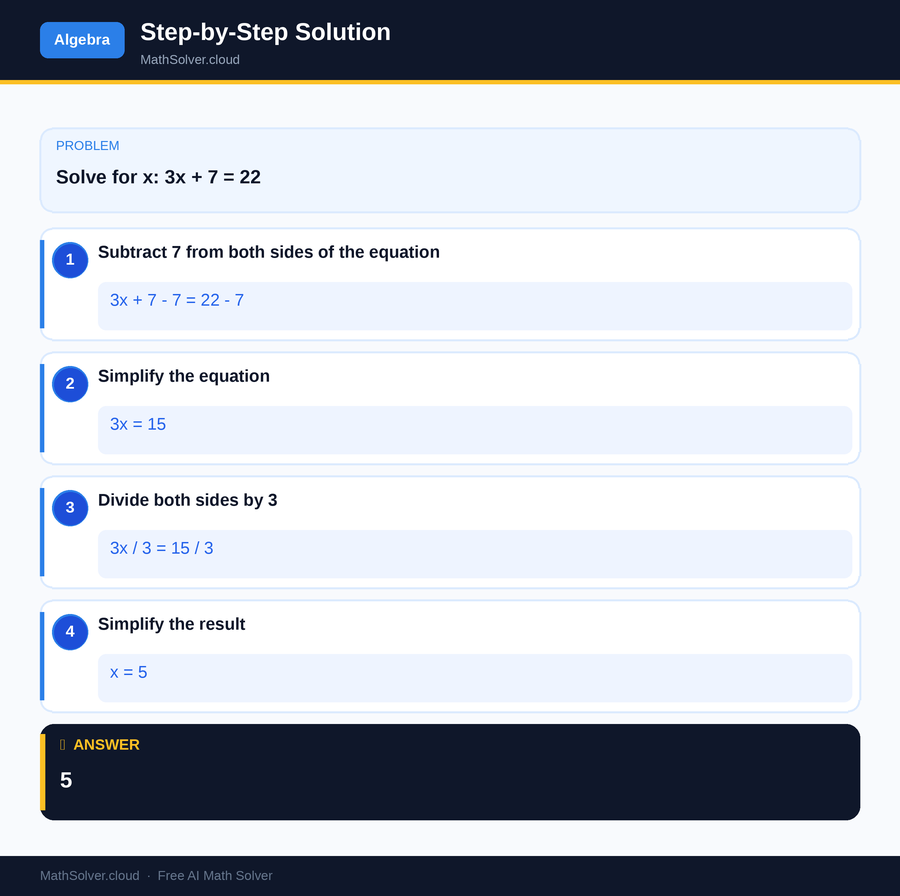
MathSolver Chrome extension solving this problem step-by-step
Example 2
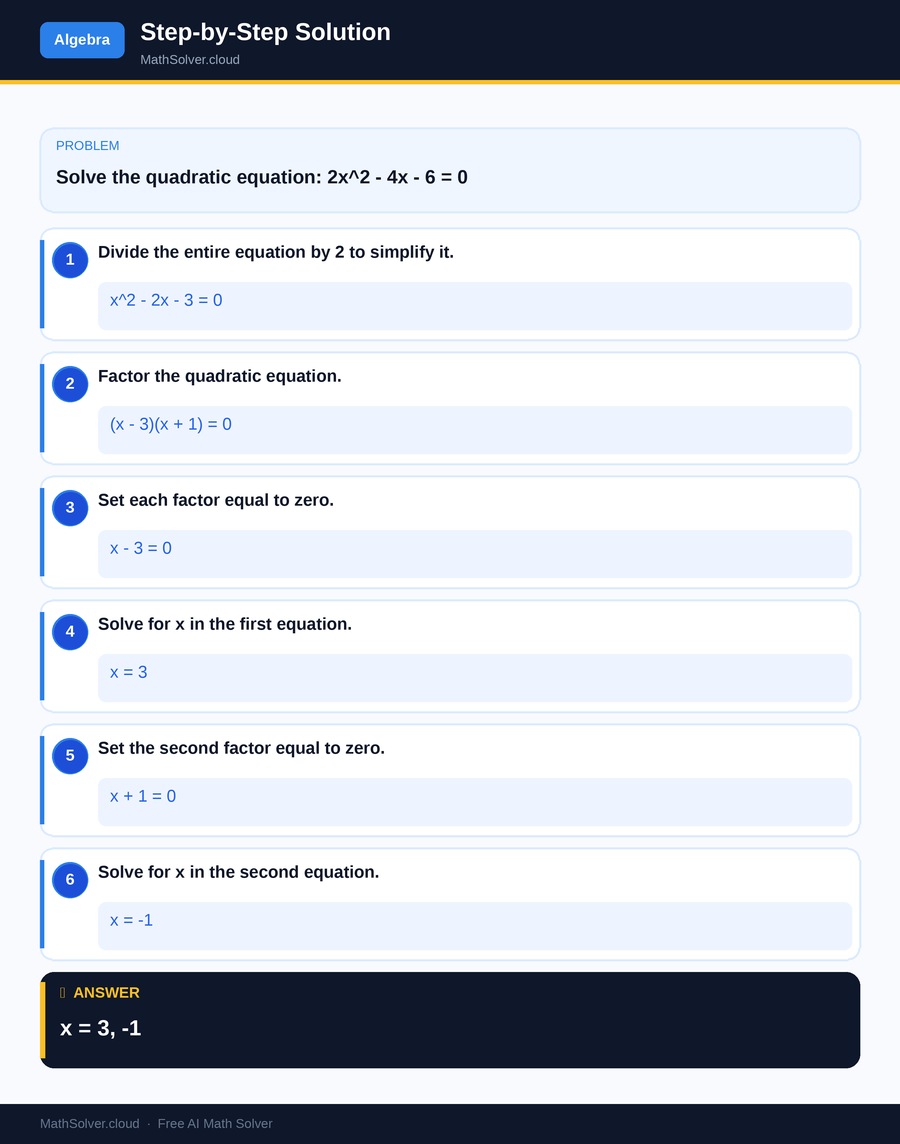
MathSolver Chrome extension solving this problem step-by-step
Common Mistakes to Avoid
One common mistake in college algebra is improperly handling negative signs, especially in subtraction and when using formulas like the quadratic formula. Students often forget to apply the negative sign across terms, leading to incorrect results. To avoid this, carefully track your signs throughout each step.
Another frequent error is skipping verification of your solution. Many students stop once they find an answer without checking if it satisfies the original equation. Verifying your answer by substituting it back into the equation helps ensure accuracy and builds confidence in your problem-solving skills.
Real-World Applications
College algebra is not just an academic hurdle; it's a tool used in various real-world applications. For instance, engineers use algebra to calculate forces and stresses in structures. Understanding algebraic equations allows them to design safe and efficient buildings and bridges.
In business, college algebra helps in financial analysis and modeling. Calculating interest rates, predicting market trends, and optimizing production processes often involve solving algebraic equations. Thus, mastering college algebra can be a valuable asset in many professional fields.
Frequently Asked Questions
❓ What is college algebra?
❓ Is college algebra hard?
❓ How can AI help with college algebra?
❓ What are the common topics in college algebra?
❓ How can I improve my college algebra practice?
🚀 Solve any math problem instantly
2,000+ students use MathSolver every day — join them for free
📥 Add to Chrome — It's Free