Mastering Boolean Algebra: A Comprehensive Guide
📋 In this guide
Boolean algebra is a branch of mathematics that deals with variables that have two possible values: true or false, often represented as 1 and 0 respectively. It's a fundamental component in computer science and digital circuit design, yet many students find it challenging due to its abstract nature and the logical reasoning it requires. In this article, we'll break down the essentials of boolean algebra, from its basic principles to its practical applications, making it easier to understand and apply.
Students often struggle with boolean algebra because it differs significantly from the algebra they are accustomed to, such as solving quadratic equations. Unlike traditional algebra, which involves numbers, boolean algebra involves logical operations and relationships. This can be confusing for those who are more familiar with the numerical solving techniques found in algebra 1 regents or algebra 2.0. However, by the end of this article, you'll have a clearer understanding of boolean algebra simplification and be able to tackle problems with confidence.
You'll learn about the key laws of boolean algebra, how to simplify expressions using a boolean algebra simplifier, and how to evaluate boolean expressions. We'll also explore real-world applications and how tools like a boolean algebra calculator can assist in solving complex problems. Whether you're preparing for an edmentum mastery test in algebra 1 or simply want to enhance your logical reasoning skills, this guide will provide the knowledge you need.
Step-by-Step: How to Solve Boolean Algebra
Step 1: Understanding the Basic Operations
To tackle boolean algebra problems, you first need to understand the basic operations: AND, OR, and NOT. The AND operation (A AND B) results in true only if both A and B are true. The OR operation (A OR B) results in true if either A or B, or both, are true. The NOT operation (NOT A) simply inverts A’s value, making true become false and vice versa. Familiarizing yourself with these operations is essential for boolean algebra simplifying.
Step 2: Applying Boolean Algebra Laws
Once you understand the basic operations, the next step is to apply boolean algebra laws. These laws help simplify expressions and solve complex problems more efficiently. The Commutative Law states that the order of operands does not affect the result (A AND B = B AND A). The Associative Law allows you to regroup operands (A AND (B AND C) = (A AND B) AND C). These laws, along with others like the Distributive Law, are vital tools in boolean algebra simplification.
Step 3: Simplifying Boolean Expressions
Boolean algebra simplification involves reducing expressions to their simplest form. This is where a boolean algebra simplifier can be incredibly helpful. For example, according to the Identity Law, A AND 1 = A and A OR 0 = A. Recognizing these patterns allows you to simplify expressions systematically. Practice using these laws to break down complex expressions into simpler ones, making them easier to solve.
Step 4: Evaluating Boolean Expressions
Finally, evaluating boolean expressions requires substituting the values of variables and performing logical operations. Start by identifying the operations within parentheses, applying NOT operations first, then AND, and finally OR. This step-by-step approach ensures accuracy. Utilize a boolean algebra calculator to verify your results and gain confidence in your solutions.
🤖 Stuck on a math problem?
Take a screenshot and let our AI solve it step-by-step in seconds
⚡ Try MathSolver Free →Worked Examples
Example 1
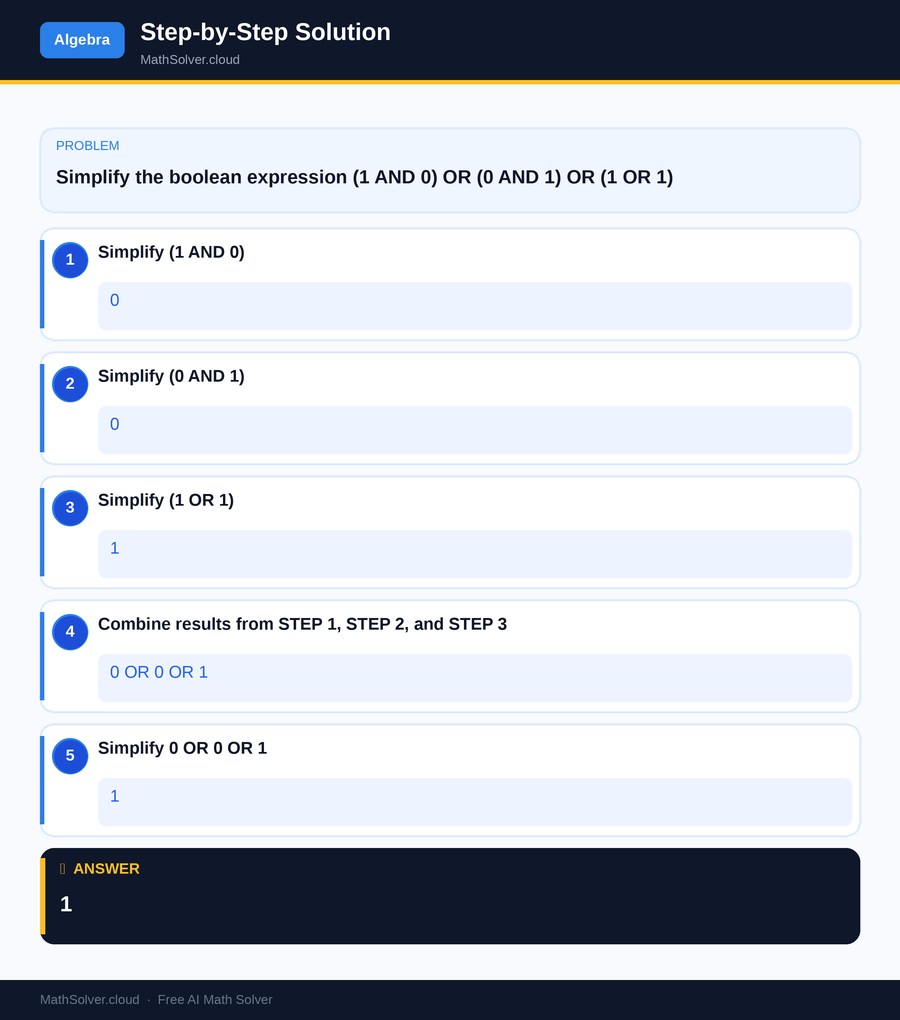
MathSolver Chrome extension solving this problem step-by-step
Example 2
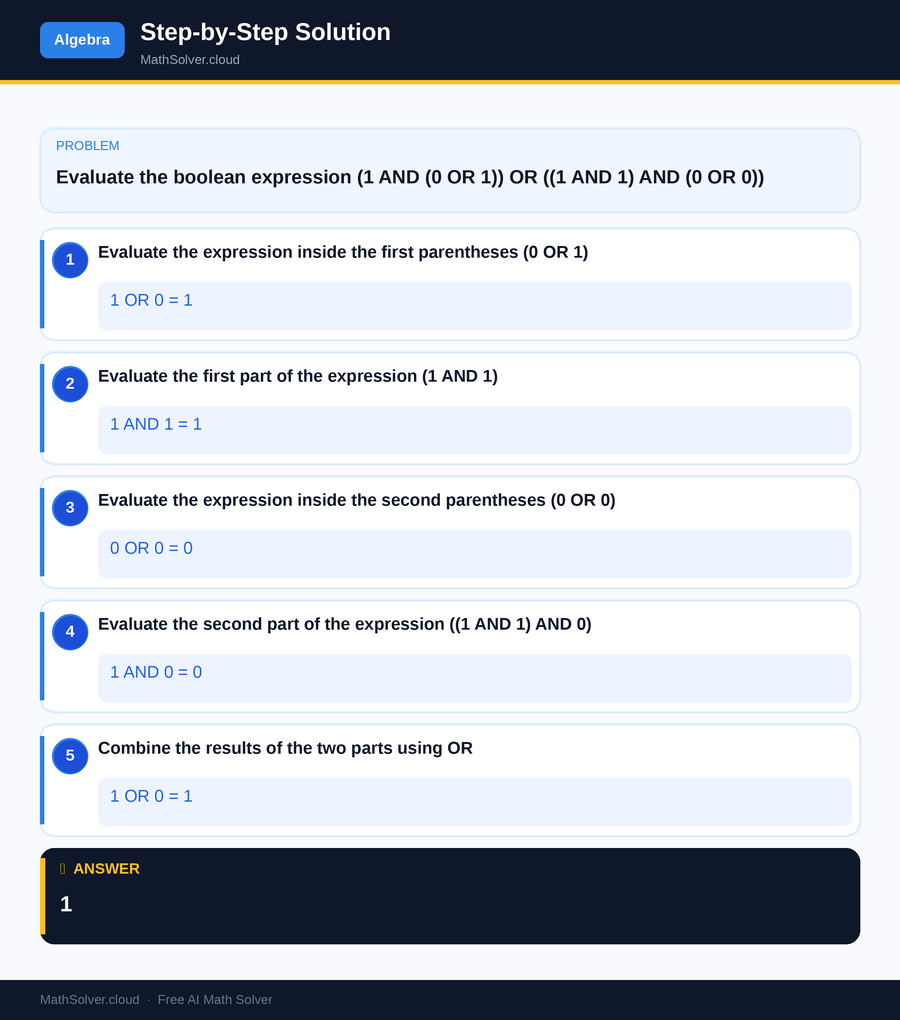
MathSolver Chrome extension solving this problem step-by-step
Common Mistakes to Avoid
One common mistake in boolean algebra is neglecting the precedence of operations, especially when dealing with NOT, AND, and OR. Always apply NOT operations first, followed by AND, and finally OR. Ignoring this order can lead to incorrect results. Additionally, students often overlook the importance of boolean algebra laws, leading to missed simplification opportunities.
Another frequent error is failing to verify solutions using a boolean algebra calculator. While manual calculations are essential for understanding, using a calculator can confirm your results and highlight any mistakes. By being aware of these pitfalls, you can improve your problem-solving accuracy and efficiency.
Real-World Applications
Boolean algebra is not just an academic exercise; it has real-world applications that are vital in various fields. In computer science, boolean algebra is used in the design and optimization of digital circuits, which are fundamental to computer hardware. Logical gates, which are built using boolean algebra principles, form the basis of these circuits.
Boolean algebra is also crucial in search engine algorithms. When you perform a search using keywords, boolean logic determines how the search engine interprets and returns results. Understanding these applications underscores the importance of mastering boolean algebra, as it impacts technology and everyday tasks.
Frequently Asked Questions
❓ What is boolean algebra and why is it important?
❓ How does boolean algebra differ from regular algebra?
❓ How can AI help with boolean algebra?
❓ What are some common boolean algebra laws?
❓ How is boolean algebra used in digital electronics?
🚀 Solve any math problem instantly
2,000+ students use MathSolver every day — join them for free
📥 Add to Chrome — It's Free