Understanding the Balanced Equation Calculator
📋 In this guide
A balanced equation calculator is an essential tool for students trying to understand and solve mathematical equations, particularly in algebra and chemistry. Whether you're balancing a chemical equation or solving algebraic expressions, these calculators provide a way to verify your work and ensure accuracy. Many students find the concept of balancing equations challenging because it requires a firm grasp of both mathematical principles and logical reasoning. In this article, we'll explore how a balanced equation calculator can help demystify these concepts, making them more accessible and manageable for learners.
Understanding how to use a balanced equation calculator effectively can dramatically improve your problem-solving skills. The ability to balance equations is crucial, not just in academic settings but also in various real-world applications. From solving algebra equations to balancing chemical reactions, learning to use this tool can enhance your mathematical fluency and confidence. Students often struggle with the initial setup of the equation and determining the correct coefficients to make both sides equal, which is where these calculators can be highly beneficial.
In this guide, we will explore the functionalities of a balanced equation calculator, walk you through a step-by-step guide on how to use it, and provide worked examples to reinforce your understanding. You'll also learn about common pitfalls to avoid, real-world applications, and answers to frequently asked questions. By the end, you'll be equipped with the knowledge to tackle equations with ease and precision.
Step-by-Step: How to Solve Balanced Equation Calculator
Step 1: Identifying the Equation Type
The first step in using a balanced equation calculator is to identify what type of equation you are working with. Are you dealing with a simple algebraic equation, a quadratic equation, or a chemical equation? Understanding the nature of the equation helps in selecting the appropriate approach for balancing. For instance, algebra equations might involve finding the value of x, while chemical equations require balancing the number of atoms on each side.
Step 2: Entering the Equation
Once you've identified the type of equation, the next step is to enter it into the balanced equation calculator. Ensure that you input the equation correctly, paying attention to details such as coefficients, variables, and constants. Most calculators have a user-friendly interface that guides you through this process, making it easier to avoid input errors.
Step 3: Solving the Equation
After entering the equation, the calculator will process the information and provide a solution. This step often involves the calculator performing various operations such as addition, subtraction, multiplication, or division to simplify the equation. If you are using a balanced equation calculator with steps, it will display the intermediary steps taken to arrive at the solution, enhancing your understanding of the process.
Step 4: Analyzing and Verifying the Solution
The final step is to analyze the solution provided by the calculator. Verify that the equation is balanced by checking that both sides have equivalent values or that the atoms are balanced in the case of chemical equations. If your calculator provides a step-by-step guide, review each step to understand how the solution was derived. This analysis not only helps in verifying the solution but also reinforces the learning process.
🤖 Stuck on a math problem?
Take a screenshot and let our AI solve it step-by-step in seconds
⚡ Try MathSolver Free →Worked Examples
Example 1
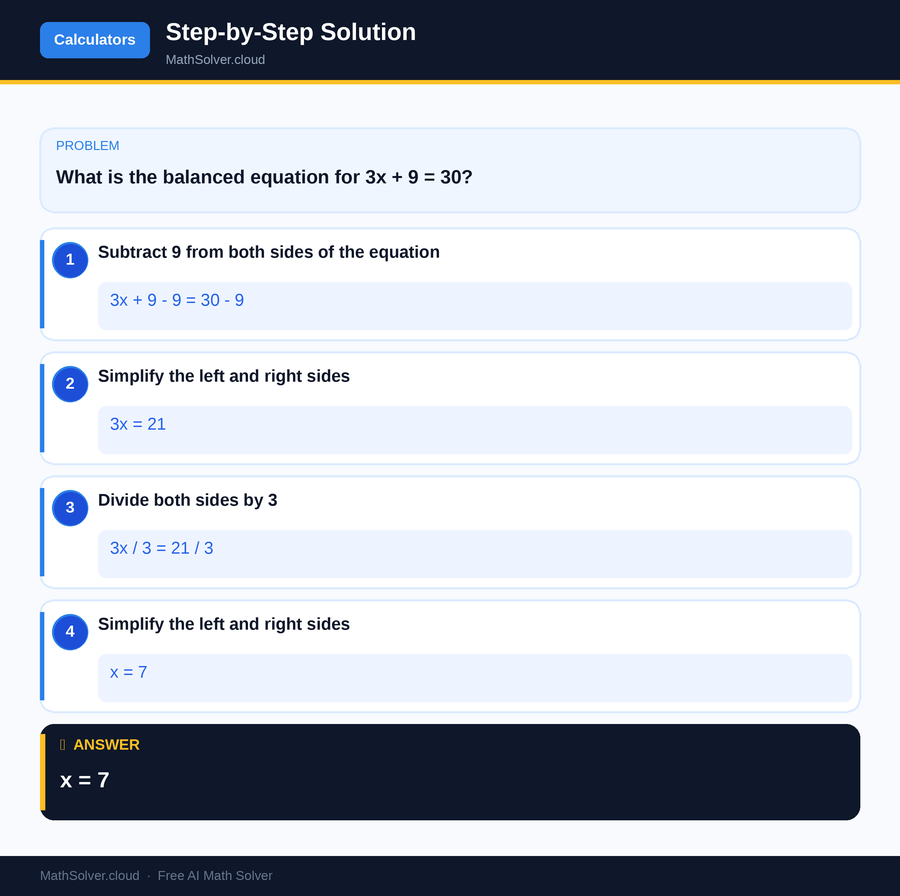
MathSolver Chrome extension solving this problem step-by-step
Example 2
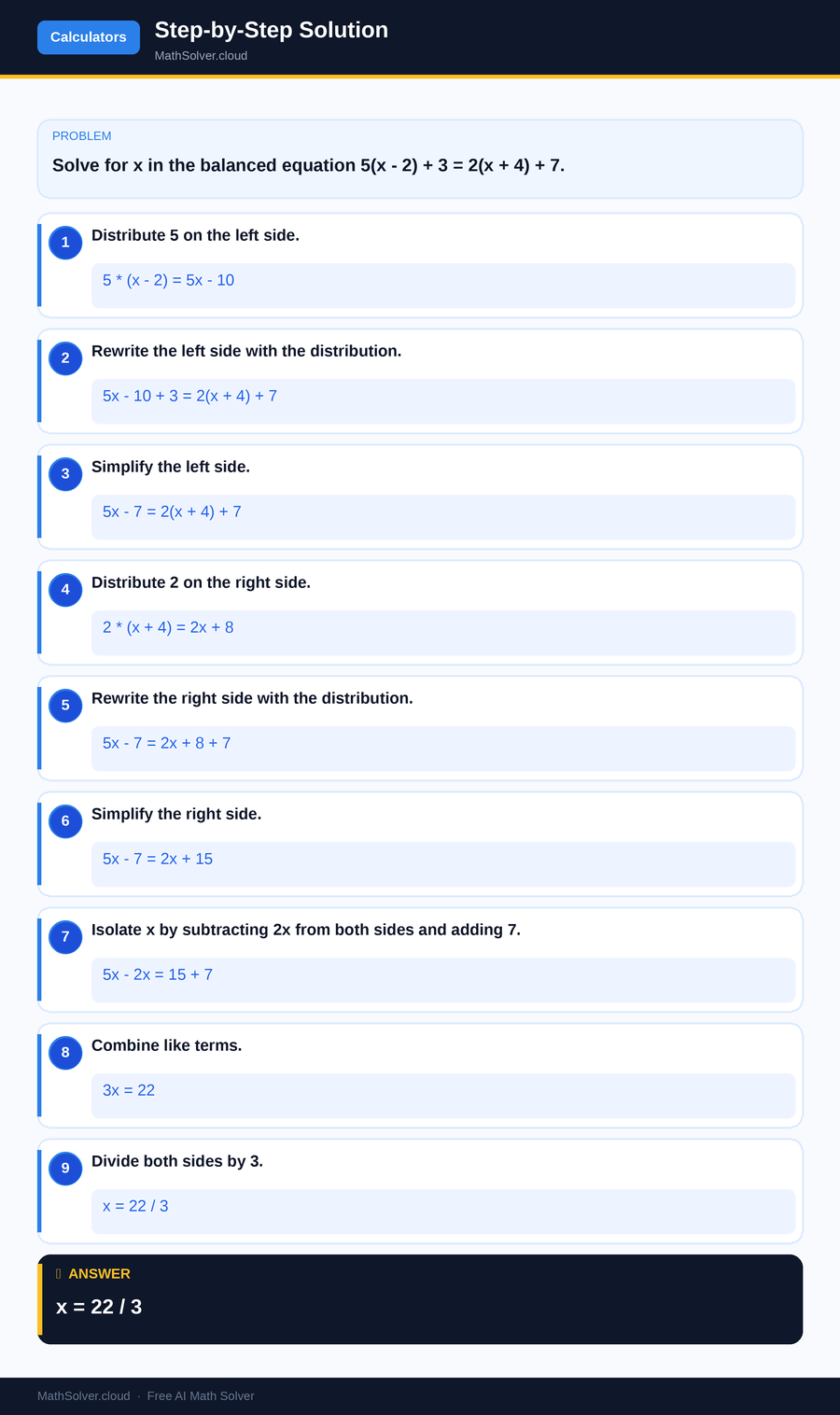
MathSolver Chrome extension solving this problem step-by-step
Common Mistakes to Avoid
One common mistake when using a balanced equation calculator is entering the equation incorrectly. Always double-check your inputs to ensure that you have not made any typographical errors, as this can lead to incorrect solutions. Another frequent error is misinterpreting the results, especially if the calculator provides a step-by-step solution. Make sure to follow each step and understand the logic behind the operations performed.
Another pitfall is relying too heavily on the calculator without understanding the underlying principles. While calculators are excellent tools for verifying solutions, it's crucial to practice solving equations manually to build a solid understanding of the concepts. This will enhance your problem-solving skills and reduce dependency on technology.
Real-World Applications
Balanced equation calculators are not just confined to classrooms; they have practical applications in various fields. For instance, in chemistry, these calculators are used to balance chemical reactions, which is fundamental in laboratory experiments and industrial processes. Understanding how to balance chemical equations is crucial for predicting the products of a reaction and ensuring safety in the handling of substances.
In engineering, balanced equations are used in the analysis and design of systems. For example, electrical engineers use them to solve circuit equations, ensuring that current and voltage are appropriately balanced. This is vital for the efficient functioning of electronic devices and systems.
Frequently Asked Questions
❓ How does a balanced equation calculator work?
❓ Why do students struggle with balancing equations?
❓ How can AI help with balanced equation calculators?
❓ What is the difference between a balanced equation calculator and a delta math calculator?
❓ Can I use a Texas Instruments 30xiis scientific/math calculator for balancing equations?
🚀 Solve any math problem instantly
2,000+ students use MathSolver every day — join them for free
📥 Add to Chrome — It's Free