Exploring Algebraic Equations
📋 In this guide
Algebraic equations are fundamental components of mathematics that allow us to represent relationships between numbers using variables and constants. These equations form the backbone of many mathematical concepts and are crucial in developing problem-solving skills. However, students often struggle with algebraic equations due to the abstract nature of variables and the variety of operations involved. In this article, we will explore algebraic equations in detail, covering essential definitions, step-by-step solutions, and real-world applications. By the end, you'll have a better understanding of how to solve algebraic equations effectively.
Understanding algebraic equations is essential for students as they progress in their mathematical education. These equations are not just limited to math classes but are also applicable in various fields such as engineering, economics, and the sciences. Students often find themselves puzzled by the complexity of algebraic equations, but with the right approach and practice, solving them can become intuitive.
Throughout this article, we'll explore how to solve algebraic equations step by step and provide examples to illustrate the process. We'll also discuss common mistakes students make and how to avoid them, ensuring a smoother learning journey. Whether you're preparing for an algebra 1 regents exam or need help with edmentum mastery test answers algebra 1, mastering algebraic equations is a valuable skill that will benefit you across various aspects of math and beyond.
Step-by-Step: How to Solve Algebraic Equations
Step 1: Understand the Equation
The first step in solving algebraic equations is to understand the structure of the equation itself. Look at the equation and identify the variable, constants, and operations involved. This initial analysis will help you plan your approach to finding the solution. For instance, in a linear equation like 3x + 5 = 20, recognize that '3x' represents three times the variable x, and '5' is a constant added to it.
Step 2: Simplify the Equation
Once you understand the components of the equation, the next step is to simplify it by performing basic arithmetic operations. This might involve combining like terms or using the distributive property to remove parentheses. Simplifying the equation makes it easier to isolate the variable and solve it. For example, if you have an equation like 2(y - 4) + 3(y + 2), distribute the constants to eliminate the parentheses.
Step 3: Isolate the Variable
The main goal in solving algebraic equations is to isolate the variable on one side of the equation. To do this, use inverse operations to cancel out other terms. For example, if you're dealing with an equation like 3x + 5 = 20, subtract 5 from both sides to leave 3x = 15. Then, divide both sides by 3 to find x = 5. Remember, whatever operation you perform on one side, you must do the same to the other side to maintain equality.
Step 4: Verify the Solution
After finding a solution, it's crucial to verify its accuracy by substituting the value back into the original equation. This step ensures that no mistakes were made during the solving process. If substituting the value satisfies the equation, then you have found the correct solution. For instance, substituting x = 5 back into 3x + 5 = 20 confirms the equation holds true, validating your solution.
🤖 Stuck on a math problem?
Take a screenshot and let our AI solve it step-by-step in seconds
⚡ Try MathSolver Free →Worked Examples
Example 1
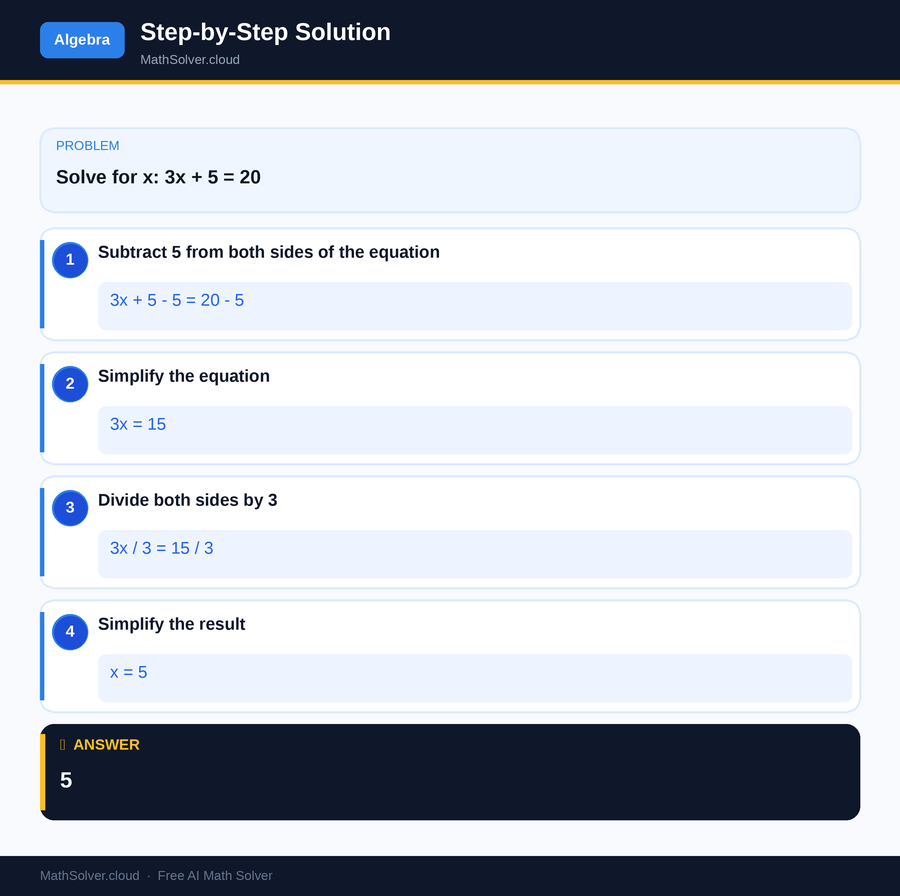
MathSolver Chrome extension solving this problem step-by-step
Example 2
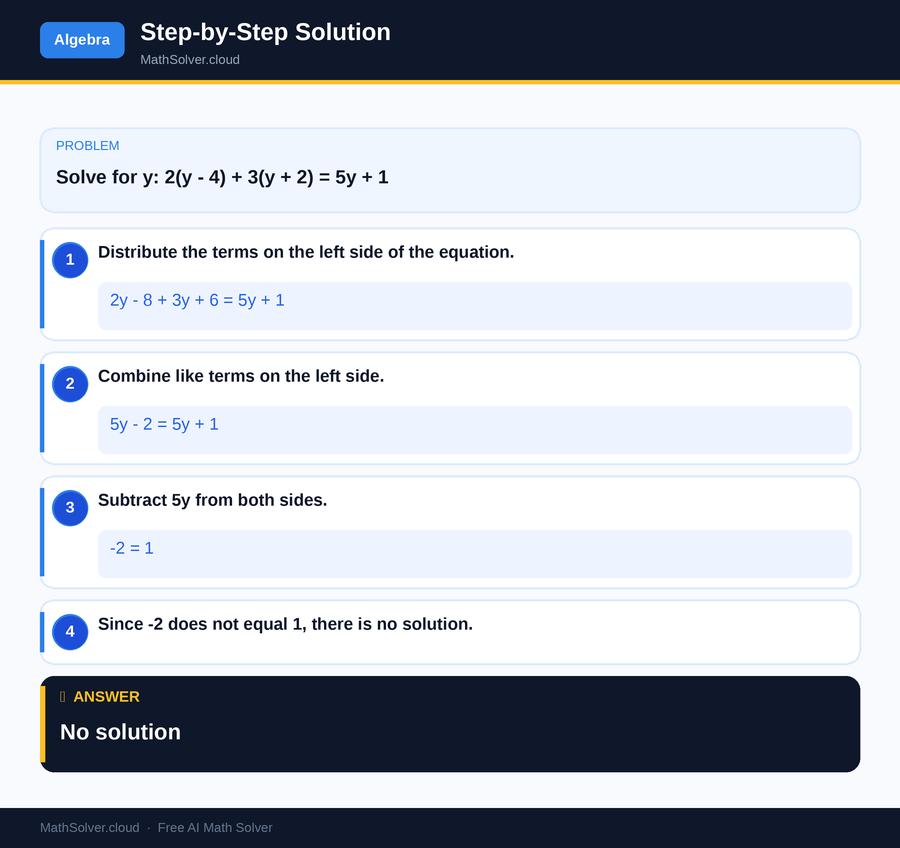
MathSolver Chrome extension solving this problem step-by-step
Common Mistakes to Avoid
One common mistake in solving algebraic equations is failing to perform the same operation on both sides of the equation. This oversight can lead to incorrect solutions and misunderstanding of the problem. Always remember that maintaining balance in an equation is crucial, so whatever you do to one side, do the same to the other.
Another frequent error is incorrectly simplifying expressions, especially when dealing with negative signs or distributing terms. Misapplying the distributive property or combining like terms inaccurately can lead to incorrect results. Take your time to simplify expressions carefully, double-check your work, and ensure that all arithmetic operations are performed correctly.
Real-World Applications
Algebraic equations are used extensively in real-world scenarios. For instance, in finance, they help calculate interest rates, loan payments, and investment growth. By setting up equations that represent financial relationships, individuals and businesses can make informed decisions about their finances.
In engineering, algebraic equations are crucial for designing systems and structures. Engineers use these equations to model physical phenomena, analyze forces, and optimize designs for safety and efficiency. Algebraic equations also play a significant role in computer science, where they are used to develop algorithms and solve complex problems.
Frequently Asked Questions
❓ What are algebraic equations used for?
❓ Why do students struggle with algebraic equations?
❓ How can AI help with algebraic equations?
❓ What is the difference between linear and quadratic equations?
❓ How do algebraic equations apply to everyday life?
🚀 Solve any math problem instantly
2,000+ students use MathSolver every day — join them for free
📥 Add to Chrome — It's Free