Mastering Algebra: A Comprehensive Guide
📋 In this guide
Algebra is a branch of mathematics that deals with symbols and the rules for manipulating those symbols. It is a unifying thread of almost all mathematics and is a critical stepping stone to more advanced subjects like calculus and linear algebra. Many students find algebra challenging because it introduces abstract thinking for the first time. Instead of dealing solely with numbers, students must learn to handle variables that represent numbers. This shift can be daunting, but understanding algebra is essential for solving a wide range of problems.
Students often struggle with algebra because it requires a strong foundation in earlier math skills, such as arithmetic and basic geometry. Without these, the jump to understanding algebra equations can seem insurmountable. However, with practice and the right approach, students can conquer these difficulties. In this article, you will learn about key algebraic concepts, how to solve algebraic equations, and how to avoid common mistakes.
By the end of this article, you will have a clearer understanding of algebra and its applications in both academic settings and real-world situations. You'll gain insights into solving equations, utilizing tools like an algebra calculator, and exploring advanced topics like algebra 1 and algebra 2. Whether you're preparing for an algebra 1 regents exam or looking to better understand algebra 2.0, this guide will provide valuable assistance.
Step-by-Step: How to Solve Algebra
Step 1: Understanding Variables and Constants
The first step in mastering algebra is understanding the distinction between variables and constants. Variables, often represented by letters like x or y, are symbols that stand in for unknown values. Constants are fixed values that do not change. In the equation 3x + 5 = 20, the number 3 and the number 5 are constants, while x is the variable. Recognizing these components is crucial because it allows you to manipulate and solve the equation appropriately.
Step 2: Simplifying Algebraic Expressions
Once you understand variables and constants, the next step is simplifying algebraic expressions. This involves combining like terms and using arithmetic operations to make the equation easier to solve. For instance, in the expression 2(y - 4) + 3(y + 2), you would first distribute the numbers outside the parentheses, resulting in 2y - 8 + 3y + 6. Then, combine like terms to simplify it to 5y - 2. Simplification is key to making equations more manageable.
Step 3: Solving Linear Equations
After simplifying expressions, the next step is solving linear equations. This involves isolating the variable on one side of the equation to find its value. Using the equation 3x + 5 = 20 as an example, you would first subtract 5 from both sides to get 3x = 15. Then, divide both sides by 3 to solve for x, resulting in x = 5. Understanding this process is fundamental to solving more complex algebra problems.
Step 4: Checking Your Solution
The final step is to check your solution by plugging it back into the original equation. This ensures that the solution is correct and that no errors were made during the simplification or solving process. For instance, substituting x = 5 back into 3x + 5 = 20 yields 3(5) + 5 = 20, which simplifies to 15 + 5 = 20, confirming the solution is correct. Checking your work is a good habit that helps prevent mistakes.
🤖 Stuck on a math problem?
Take a screenshot and let our AI solve it step-by-step in seconds
⚡ Try MathSolver Free →Worked Examples
Example 1
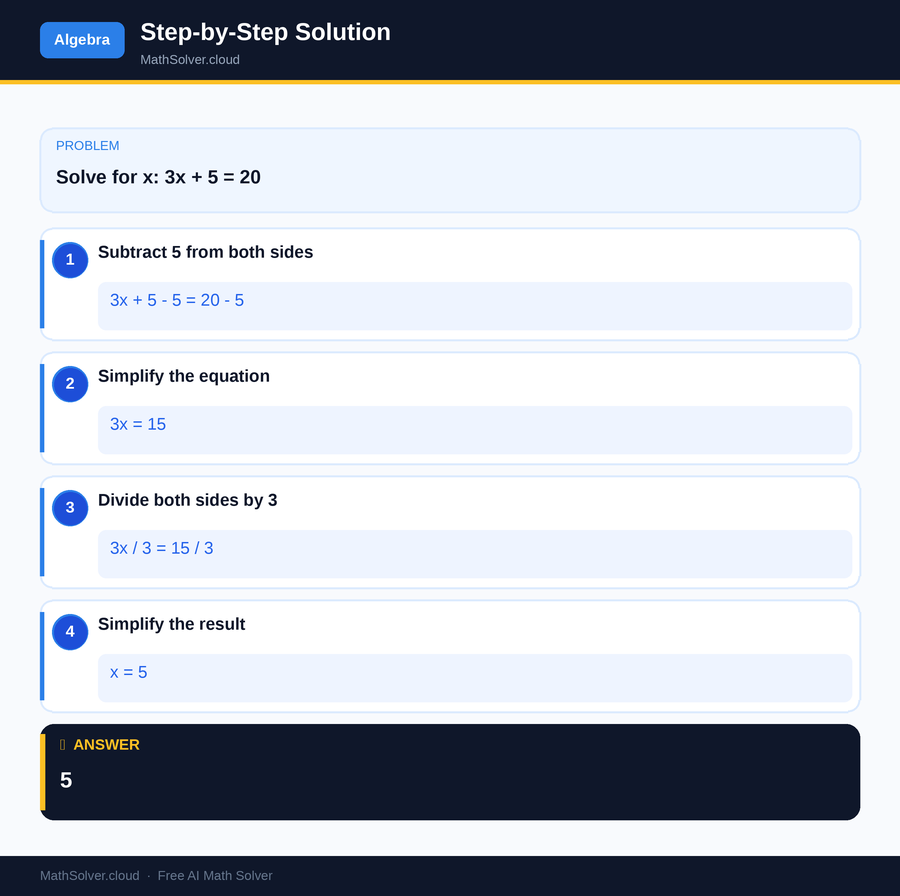
MathSolver Chrome extension solving this problem step-by-step
Example 2
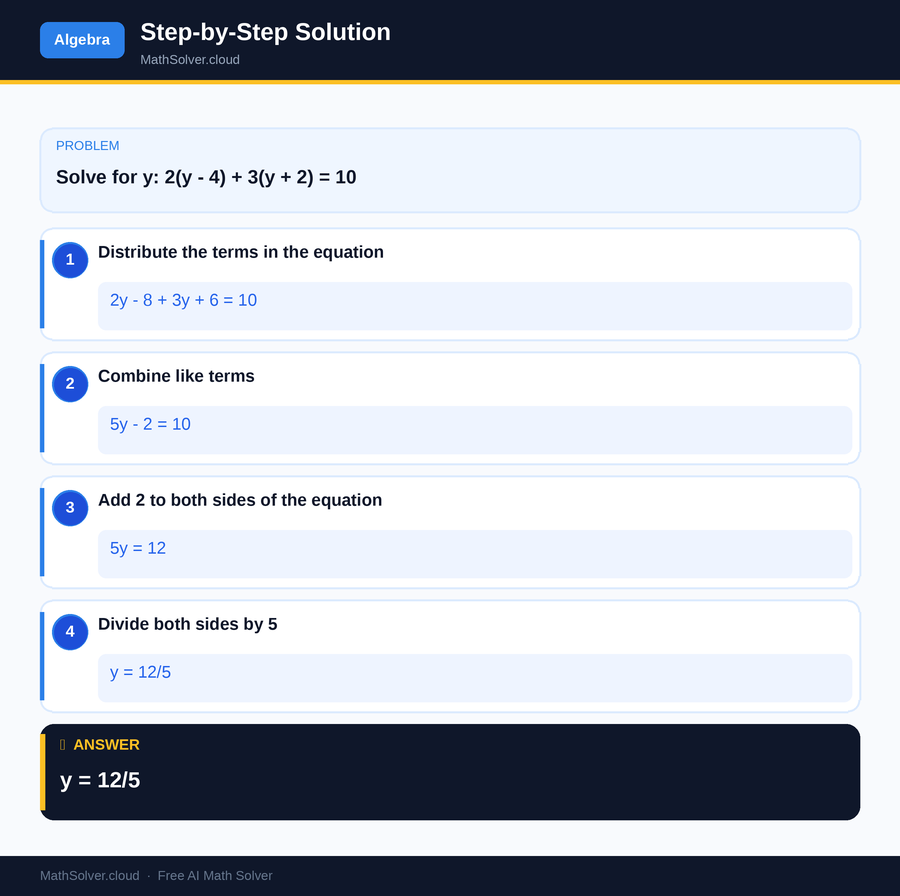
MathSolver Chrome extension solving this problem step-by-step
Common Mistakes to Avoid
One common mistake in algebra is failing to apply the distributive property correctly, especially when working with expressions in parentheses. For example, students often forget to distribute a negative sign or multiply every term inside the parentheses. Always double-check that each term is correctly distributed to avoid errors.
Another frequent error is not combining like terms properly, which can lead to incorrect solutions. Like terms are terms that have the same variables raised to the same power. Failing to combine them accurately can make equations more complicated and harder to solve. Carefully identify and combine these terms to simplify equations effectively.
Real-World Applications
Algebra is not just an academic subject; it has countless applications in the real world. For instance, in finance, algebra is used to calculate interest rates, loan payments, and investment growth. Understanding algebraic principles helps individuals make informed financial decisions and manage their personal finances effectively.
In technology, algebra is used in algorithms and programming to solve complex problems and optimize systems. Engineers use algebraic equations to design structures, analyze forces, and improve efficiency. These applications demonstrate that algebra is a valuable tool in various fields, proving its importance beyond the classroom.
Frequently Asked Questions
❓ What is algebra?
❓ Why do students struggle with algebra?
❓ How can AI help with algebra?
❓ What are the differences between algebra 1 and algebra 2?
❓ How is linear algebra different from basic algebra?
🚀 Solve any math problem instantly
2,000+ students use MathSolver every day — join them for free
📥 Add to Chrome — It's Free