Demystifying Algebra Equations
📋 In this guide
Algebra equations are a fundamental component of mathematics, representing relationships between variables and constants through mathematical expressions. For many students, these equations can seem daunting due to their abstract nature and the need for logical reasoning to solve them. However, understanding algebra equations is crucial as they serve as the foundation for more advanced mathematical concepts. In this article, we will demystify algebra equations, explore key formulas, and provide step-by-step instructions to solve them efficiently.
Students often struggle with algebra equations because they require a shift from arithmetic to abstract thinking. Unlike basic arithmetic, which deals with specific numbers, algebra introduces variables that stand for unknowns. This abstraction can be challenging, but with practice and the right approach, anyone can master it. Our goal is to equip you with the knowledge and skills necessary to tackle unsolved algebra equations with confidence.
By the end of this article, you'll not only understand how to solve basic algebra equations but also appreciate their real-world applications. Whether you're preparing for an exam, like the algebra 1 regents, or simply looking to improve your math skills, this guide will offer valuable insights and practical strategies. Along the way, we'll also provide resources, such as our complete Algebra guide, to further support your learning journey.
Step-by-Step: How to Solve Algebra Equations
Step 1: Understanding the Equation
The first step in solving algebra equations is to thoroughly understand the problem. Identify the variables, constants, and the operations involved. For example, in the equation 3x + 5 = 20, the variable is x, and you have an addition operation and a constant 5. The goal is to isolate the variable on one side of the equation to find its value. Understanding what each part of the equation represents is crucial for solving it correctly.
Step 2: Simplify Both Sides
Before isolating the variable, it might be necessary to simplify both sides of the equation. This could involve combining like terms or simplifying fractions. For example, if you have an equation like 2(x + 3) = x + 10, you would first distribute the 2 to get 2x + 6 = x + 10. Simplifying makes it easier to manage the equation and helps prevent errors in later steps.
Step 3: Isolate the Variable
The next step is to get the variable by itself on one side of the equation. This is usually done by performing inverse operations. For addition and subtraction, you do the opposite operation to both sides. For multiplication and division, you divide or multiply both sides by the same number. In the equation 3x + 5 = 20, you would subtract 5 from both sides to get 3x = 15, then divide both sides by 3 to solve for x.
Step 4: Verify the Solution
After finding the value of the variable, it's essential to verify your solution. Substitute the value back into the original equation to ensure both sides are equal. This step helps catch any mistakes made during the solving process. For example, if x = 5 in the equation 3x + 5 = 20, substituting 5 back into the equation gives 3(5) + 5 = 20, which simplifies to 15 + 5 = 20, confirming the solution is correct.
🤖 Stuck on a math problem?
Take a screenshot and let our AI solve it step-by-step in seconds
⚡ Try MathSolver Free →Worked Examples
Example 1
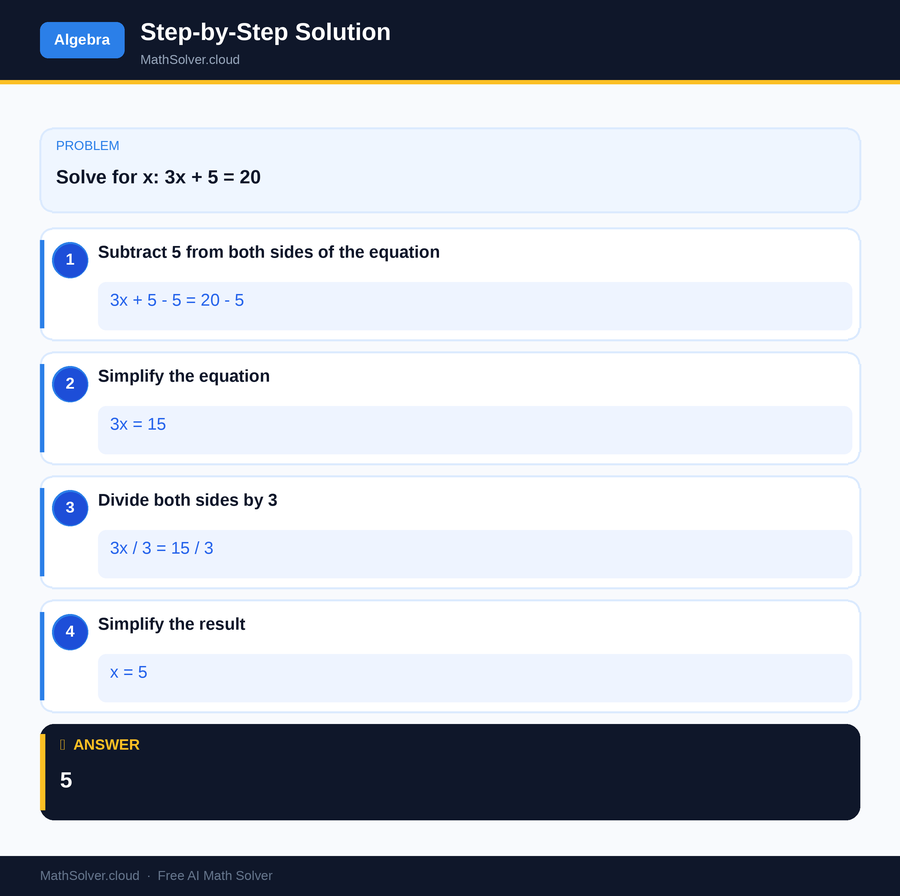
MathSolver Chrome extension solving this problem step-by-step
Example 2
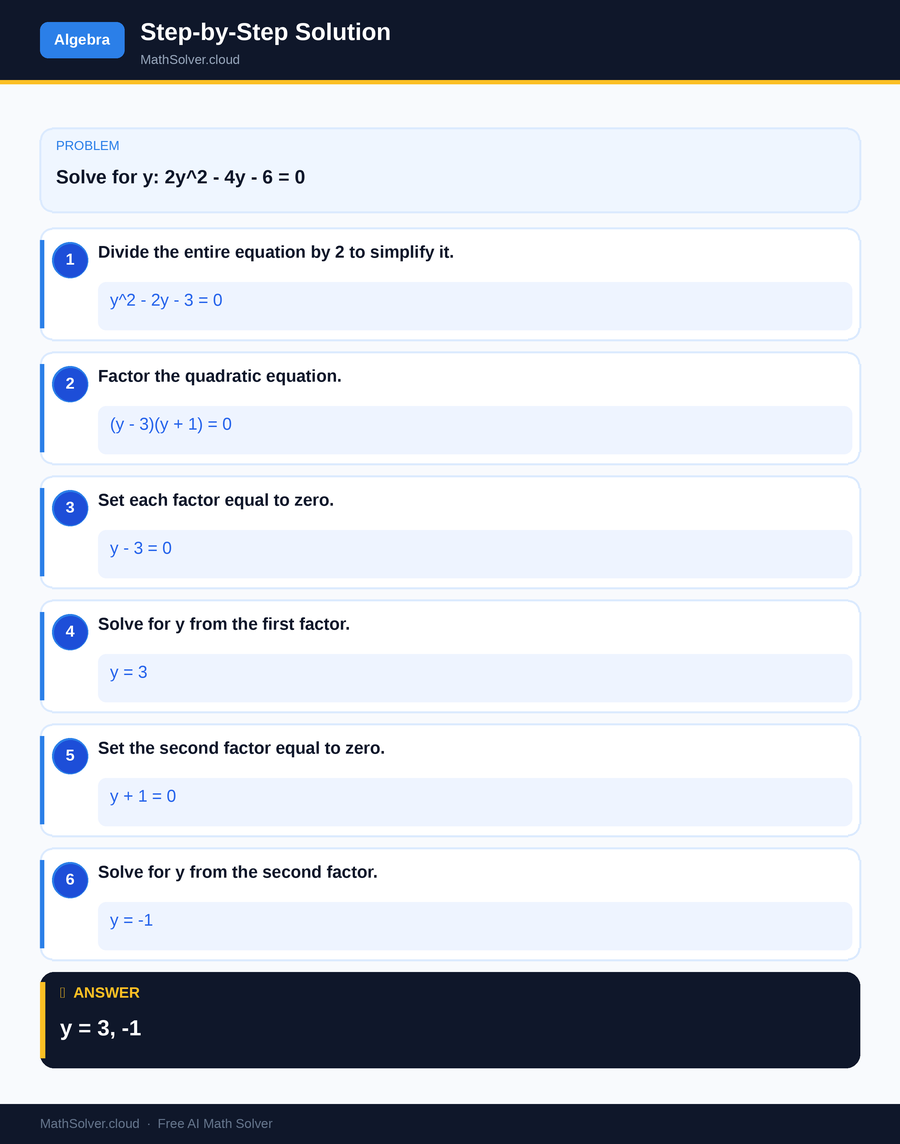
MathSolver Chrome extension solving this problem step-by-step
Common Mistakes to Avoid
One common mistake students make with algebra equations is neglecting to perform operations on both sides of the equation. This error can lead to incorrect solutions. Always remember that whatever you do to one side must be done to the other to maintain balance. Another frequent error is miscalculating while simplifying, especially with negative numbers or fractions. Double-check your work at each step to avoid these pitfalls.
Additionally, students often forget to verify their solutions. Skipping this step can result in overlooking mistakes made during the solving process. Verification is crucial as it ensures the solution satisfies the original equation. By being mindful of these common errors, you can improve your accuracy and confidence when solving algebra equations.
Real-World Applications
Algebra equations are not just confined to textbooks; they have numerous real-world applications. For instance, they are used in engineering to calculate forces and stresses in structures. Algebra is also vital in computer science for algorithm development and problem-solving. Understanding how to manipulate and solve equations is key to success in these fields.
In business, algebra equations help in financial modeling and analysis. They enable professionals to forecast revenue, calculate interest, and optimize resource allocation. By learning how to solve algebra equations effectively, you equip yourself with tools that are valuable in various professional contexts, from science and engineering to finance and economics.
Frequently Asked Questions
❓ What are algebra equations, and why are they important?
❓ Why do students find algebra equations challenging?
❓ How can AI help with algebra equations?
❓ What are some effective ways to practice solving algebra equations?
❓ How are algebra equations used in everyday life?
🚀 Solve any math problem instantly
2,000+ students use MathSolver every day — join them for free
📥 Add to Chrome — It's Free