Mastering the Algebra 2 Regents Exam
📋 In this guide
Algebra 2 Regents is a critical exam for high school students in New York, designed to test their understanding and proficiency in algebra. This exam can be particularly challenging for students because it covers a wide range of topics, including advanced algebraic concepts, functions, and complex numbers. Many students struggle with Algebra 2 Regents due to the depth of content and the analytical skills required to solve problems efficiently. However, with the right preparation and practice, students can master these skills and approach the exam with confidence.
Algebra 2 Regents covers a comprehensive curriculum that includes polynomial expressions, exponential and logarithmic functions, sequences and series, and probability. Students are expected to understand and apply various mathematical concepts and techniques to solve equations, model real-world situations, and analyze data. This exam aims to ensure that students have a solid foundation in algebra, which is essential for more advanced studies in mathematics and related fields.
To succeed in Algebra 2 Regents, students should familiarize themselves with the types of questions they will encounter and practice solving complex problems efficiently. Utilizing resources such as the algebra 2 regents reference sheet can be incredibly helpful. Additionally, understanding the grading system and the algebra 2 regents curve 2025 can provide insights into how students' performances are assessed. As students prepare for the June 2024 Algebra 2 Regents exam, consistent practice and review of key concepts will be paramount.
Step-by-Step: How to Solve Algebra 2 Regents
Step 1: Understanding the Problem
The first step in tackling any algebra problem is to thoroughly understand what is being asked. Read the problem statement carefully and identify the variables and constants involved. Determine what the problem is asking you to find or solve. For example, if the problem is to solve an equation, identify the type of equation (linear, quadratic, etc.) and the relevant formulas or methods you might need.
Step 2: Organize Your Information
Once you understand the problem, organize the given information logically. Write down any known values, equations, or relationships that might help you solve the problem. This could include rewriting the equation in a simpler form or isolating the variable you are trying to find. Organizing your information helps clarify the problem and makes it easier to identify the steps needed to solve it.
Step 3: Apply Relevant Formulas or Methods
With a clear understanding of the problem and organized information, apply the relevant formulas or methods needed to find the solution. For example, if you are solving a quadratic equation, use the quadratic formula. Substitute the known values into the formula and simplify the equation step-by-step. Be careful with arithmetic and follow the order of operations to avoid mistakes.
Step 4: Check Your Solution
After solving the problem, always check your solution. Substitute your solution back into the original equation to verify its accuracy. Ensure that your solution makes sense in the context of the problem and that you have not overlooked any details. Checking your work helps catch any errors and ensures that your solution is correct.
🤖 Stuck on a math problem?
Take a screenshot and let our AI solve it step-by-step in seconds
⚡ Try MathSolver Free →Worked Examples
Example 1
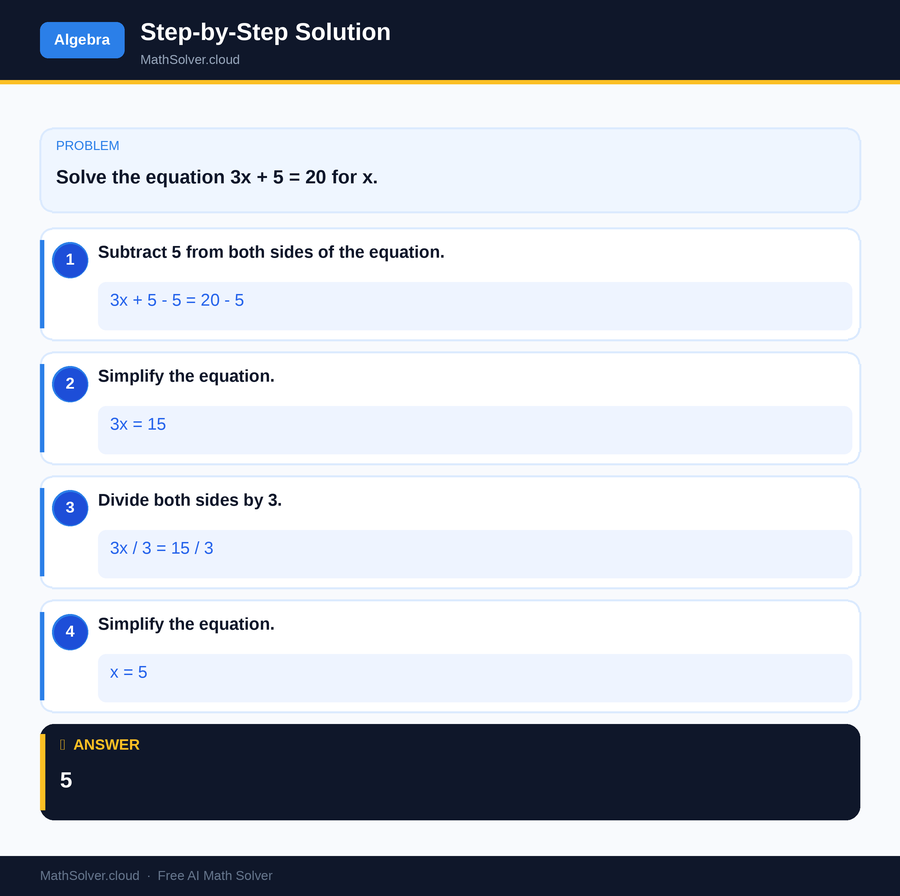
MathSolver Chrome extension solving this problem step-by-step
Example 2
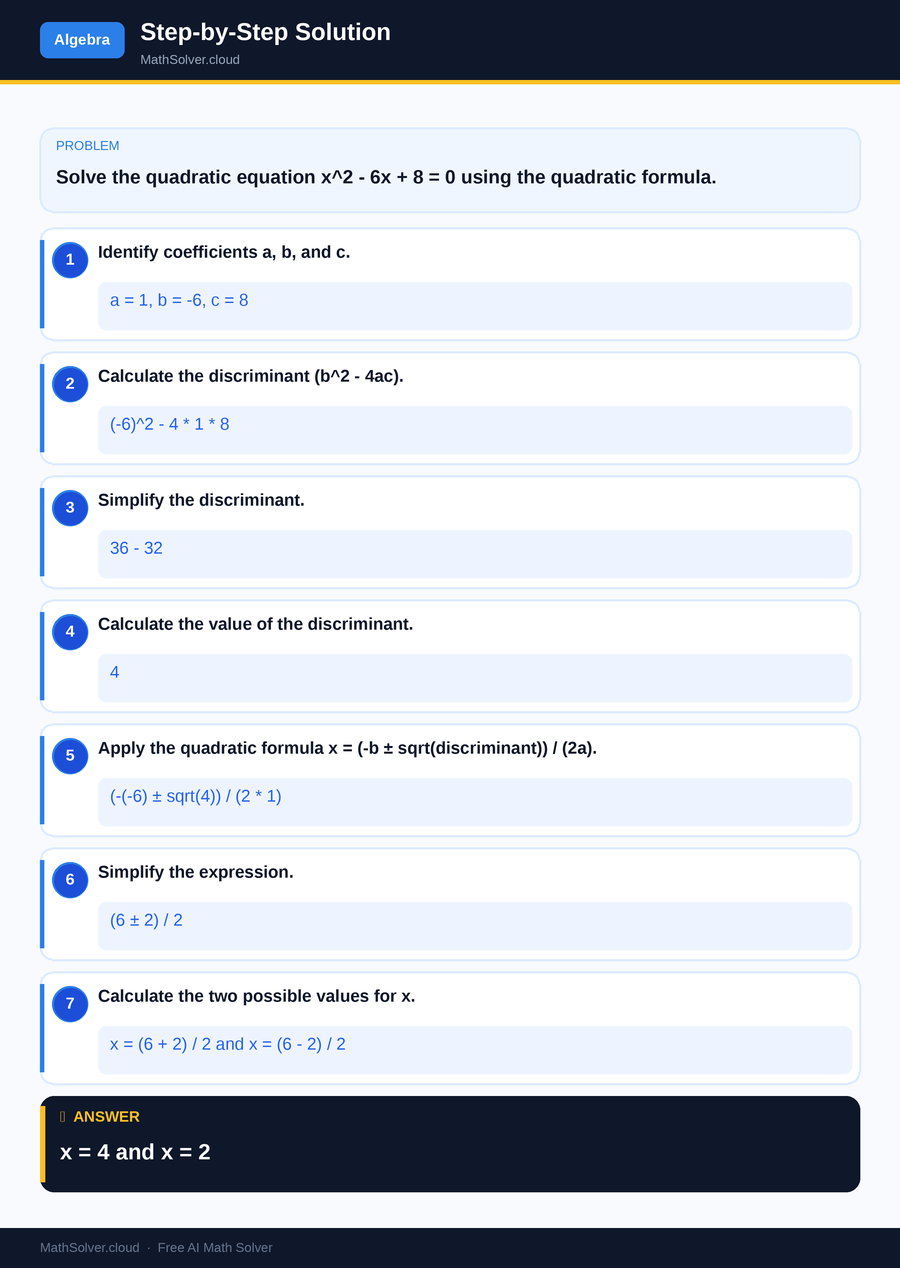
MathSolver Chrome extension solving this problem step-by-step
Common Mistakes to Avoid
One common mistake students make on the Algebra 2 Regents exam is misapplying formulas. For instance, incorrectly using the quadratic formula by not considering the signs of b or the coefficients properly can lead to wrong answers. To avoid this, always double-check the values substituted into the formula and ensure all arithmetic is performed correctly.
Another frequent error is not simplifying expressions or equations completely, which can lead to incorrect solutions. Students should practice simplifying fractions, factoring expressions, and combining like terms to ensure their final answers are in the simplest form. Careful attention to detail and thorough checking of work can help mitigate these mistakes.
Real-World Applications
The skills and concepts learned in Algebra 2 Regents have numerous real-world applications. For example, understanding exponential functions can be beneficial in fields such as finance, where they are used to calculate compound interest and model economic growth. This knowledge is crucial for careers in banking, investment, and economics.
Another practical application is in the field of engineering, where solving systems of equations is a common task. Engineers use these techniques to design structures, optimize systems, and solve complex problems. The analytical skills developed through mastering Algebra 2 are invaluable in these and many other professions.
Frequently Asked Questions
❓ What is the Algebra 2 Regents exam?
❓ Why do students find Algebra 2 Regents challenging?
❓ How can AI help with Algebra 2 Regents preparation?
❓ What topics are essential for the Algebra 2 Regents exam?
❓ How can students effectively prepare for the Algebra 2 Regents exam?
🚀 Solve any math problem instantly
2,000+ students use MathSolver every day — join them for free
📥 Add to Chrome — It's Free