Mastering Algebra 2: A Comprehensive Guide
📋 In this guide
Algebra 2 is a vital component of high school mathematics that builds upon the fundamentals learned in Algebra 1. Students often find algebra 2 challenging because it introduces more complex concepts, such as quadratic equations, polynomials, and logarithms. In this course, learners are expected to develop a deep understanding of these concepts through rigorous practice and application. Algebra 2 not only prepares students for higher-level math courses but also equips them with problem-solving skills that are applicable in various real-world scenarios.
Many students struggle with algebra 2 due to its abstract nature and the necessity to grasp multiple new mathematical ideas simultaneously. The transition from concrete arithmetic to abstract reasoning can be daunting. However, mastering algebra 2 is crucial as it serves as a foundation for advanced studies in mathematics, science, and engineering. Understanding these concepts can open doors to many career opportunities and enhance critical thinking skills.
Throughout an algebra 2 course, students will encounter a variety of topics, such as solving exponential equations using logarithms, understanding and manipulating functions, and exploring complex numbers. Textbooks like the "big ideas math algebra 2" and resources such as the "algebra 2 regents" exam can provide invaluable practice. Students are encouraged to use different study materials, including an algebra 2 textbook, to navigate through the course successfully. For additional guidance, our complete Algebra guide on MathSolver.cloud can be a helpful resource.
Step-by-Step: How to Solve Algebra 2
Step 1: Understanding the Problem
The first step in tackling any algebra 2 problem is to fully understand what is being asked. Carefully read the problem and identify the type of equation or concept involved. For example, if you encounter a problem involving exponential equations, recognize that you may need to use logarithms to solve it. Familiarize yourself with the necessary formulas and methods related to the problem, and determine what information is given and what needs to be found.
Step 2: Organizing Information
Once you understand the problem, organize the given information in a clear and structured manner. Write down the known variables, constants, and equations. This step is crucial in algebra 2, especially when dealing with complex problems involving multiple steps or operations. By organizing the data, you can visualize the problem better and determine the most efficient approach to solving it.
Step 3: Applying the Right Method
After organizing the information, choose the appropriate method or formula to solve the problem. For instance, if dealing with quadratic equations, decide whether to use factoring, completing the square, or the quadratic formula. Similarly, when solving exponential equations using logarithms, ensure you apply the correct logarithmic properties. Practice is key in algebra 2, so familiarizing yourself with different methods will improve your problem-solving skills.
Step 4: Solving and Checking Your Work
Finally, solve the problem step by step, ensuring each calculation is accurate. It's important to show all your work, as this helps in identifying any errors that may occur. Once you reach a solution, check your work by substituting the solution back into the original equation to verify its correctness. In algebra 2, double-checking your answers is a good practice to avoid common mistakes and reinforce your understanding.
🤖 Stuck on a math problem?
Take a screenshot and let our AI solve it step-by-step in seconds
⚡ Try MathSolver Free →Worked Examples
Example 1
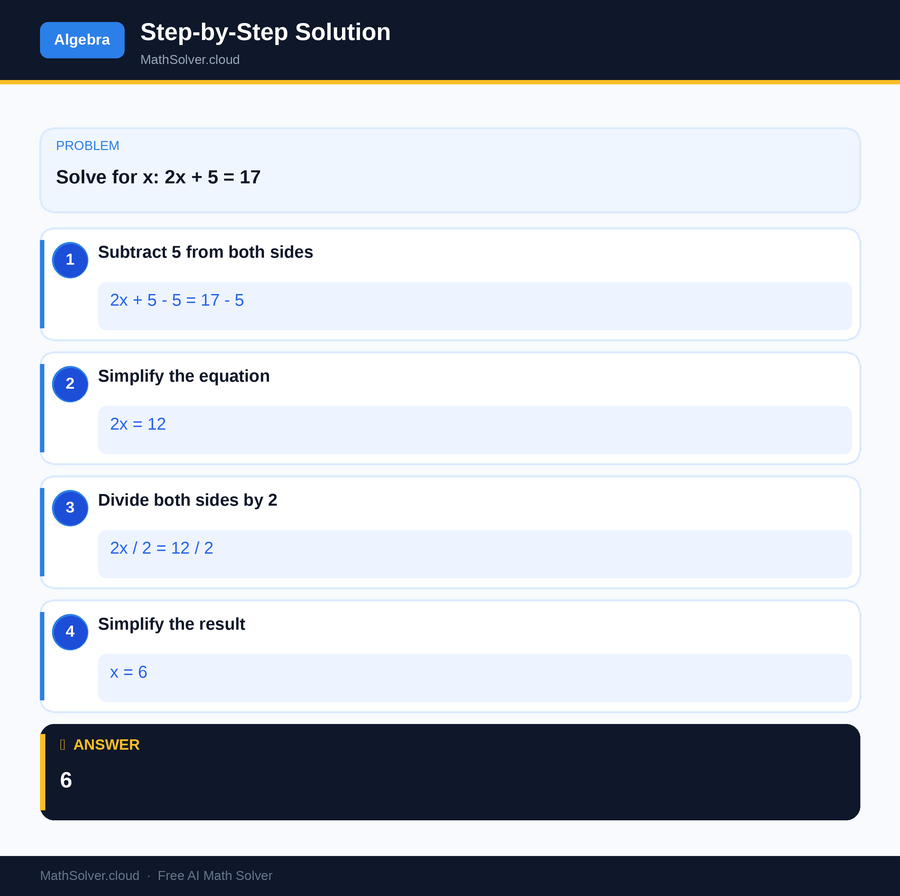
MathSolver Chrome extension solving this problem step-by-step
Example 2
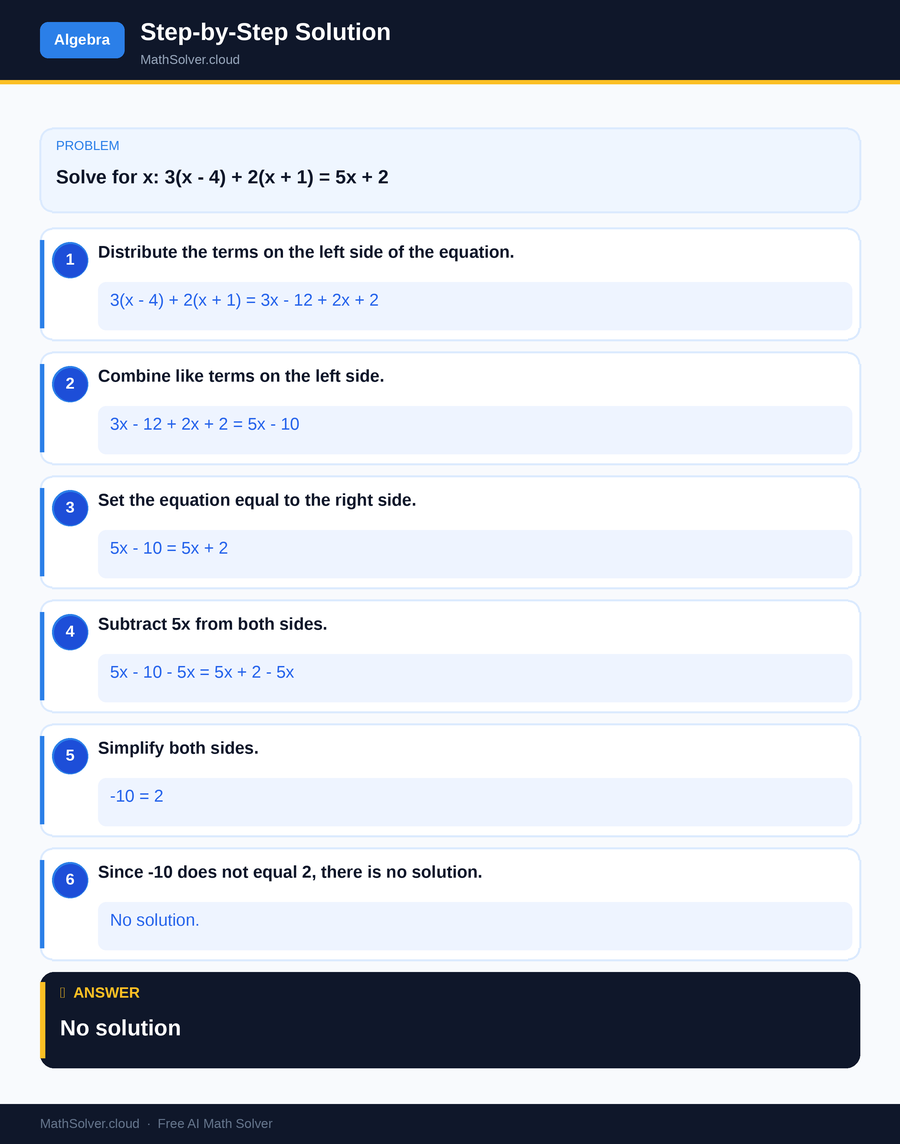
MathSolver Chrome extension solving this problem step-by-step
Common Mistakes to Avoid
One common mistake in algebra 2 is misapplying the order of operations, often remembered by the acronym PEMDAS (Parentheses, Exponents, Multiplication and Division, Addition and Subtraction). For instance, neglecting to perform operations within parentheses first can lead to incorrect solutions. Always ensure that you follow the proper order to avoid errors.
Another frequent error is not checking your work. Many students solve equations but forget to verify their solutions by substituting them back into the original equations. This step is crucial in identifying any mistakes made during calculations. By consistently checking your work, you can catch errors early and improve your accuracy in solving algebra 2 problems.
Real-World Applications
Algebra 2 has numerous real-world applications, making it an invaluable skill beyond the classroom. For example, in the field of finance, algebra 2 is used to calculate interest rates, model economic trends, and assess investment risks. Understanding how to manipulate equations and analyze data is crucial for making informed financial decisions.
In engineering and technology, algebra 2 is essential for designing systems and solving complex problems. Engineers use algebraic equations to model and analyze mechanical systems, electrical circuits, and structural components. The ability to apply algebra 2 concepts is vital for innovation and problem-solving in these fields.
Frequently Asked Questions
❓ Why is algebra 2 important?
❓ What are some tips for succeeding in algebra 2?
❓ How can AI help with algebra 2?
❓ What is the difference between algebra 1 and algebra 2?
❓ How is algebra 2 used in technology?
🚀 Solve any math problem instantly
2,000+ students use MathSolver every day — join them for free
📥 Add to Chrome — It's Free