Mastering Algebra 1: A Comprehensive Guide
📋 In this guide
Algebra 1 is often considered the gateway to higher-level mathematics, providing students with the foundational skills necessary for more advanced topics. This subject typically includes solving linear equations, working with inequalities, and understanding functions. Despite its importance, many students struggle with Algebra 1 due to its abstract nature and the leap in complexity from arithmetic to algebraic thinking. The transition from dealing with numbers to working with variables and unknowns can be daunting. However, mastering Algebra 1 is crucial as it lays the groundwork for future success in mathematics, science, and engineering fields.
In Algebra 1, students will learn to manipulate and solve equations and inequalities, explore functions, and analyze graphs. These skills are essential for solving real-world problems and are the foundation for courses like Algebra 2.0 and beyond. Understanding these concepts will not only help students excel in their current studies but also enable them to perform well in standardized tests like the algebra 1 regents, which assesses proficiency in this subject area.
As students navigate the challenges of Algebra 1, they often seek resources that provide clear explanations and step-by-step solutions. Tools like the MathSolver Chrome extension can be incredibly helpful, offering instant step-by-step solutions by simply taking a screenshot of a problem. This kind of technology aids students in grasping complex concepts, empowering them to tackle Algebra 1 with confidence.
Step-by-Step: How to Solve Algebra 1
Step 1: Understanding Variables and Constants
The first step in mastering Algebra 1 is to understand the difference between variables and constants. Variables are symbols, often represented by letters like x or y, that stand for unknown values. Constants are fixed values that do not change. In an equation such as 2x + 5 = 15, 2x is a term with a variable, and 5 is a constant. Recognizing these components is crucial for solving equations, as you will need to manipulate them to isolate the variable.
Step 2: Balancing Equations
Balancing equations is a fundamental skill in Algebra 1. The goal is to isolate the variable on one side of the equation to find its value. This is done by performing the same operation on both sides of the equation. For example, in the equation 2x + 5 = 15, you would first subtract 5 from both sides, resulting in 2x = 10. This step maintains the equality of the equation, ensuring that both sides remain balanced.
Step 3: Solving for the Variable
Once the equation is balanced, the next step is to solve for the variable. Continuing with the equation 2x = 10, you would divide both sides by 2 to isolate x, resulting in x = 5. This solves the equation, providing the value of the variable. Solving for the variable often involves inverse operations, such as addition and subtraction or multiplication and division, to undo the operations applied to the variable.
Step 4: Checking Your Solution
The final step is to check your solution by substituting the value of the variable back into the original equation. For the equation 2x + 5 = 15, if x = 5, substitute 5 for x to verify: 2(5) + 5 = 15. Simplifying the left side results in 10 + 5 = 15, confirming that the solution is correct. This step is crucial as it ensures the accuracy of your solution and builds confidence in your problem-solving skills.
🤖 Stuck on a math problem?
Take a screenshot and let our AI solve it step-by-step in seconds
⚡ Try MathSolver Free →Worked Examples
Example 1
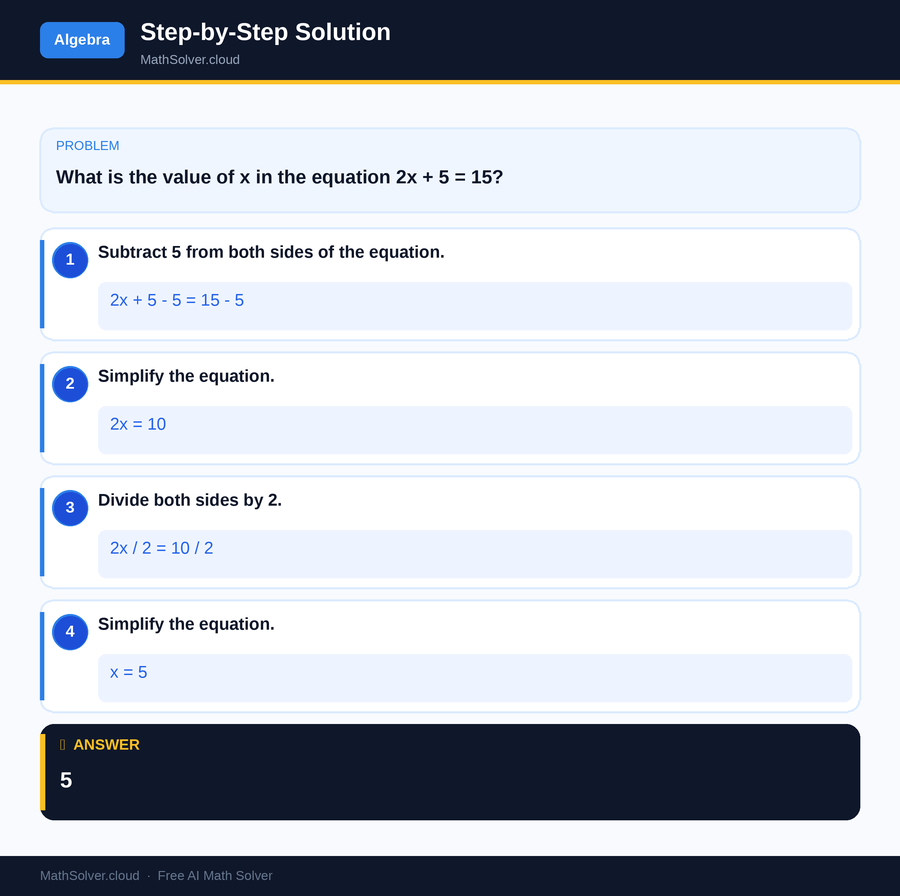
MathSolver Chrome extension solving this problem step-by-step
Example 2
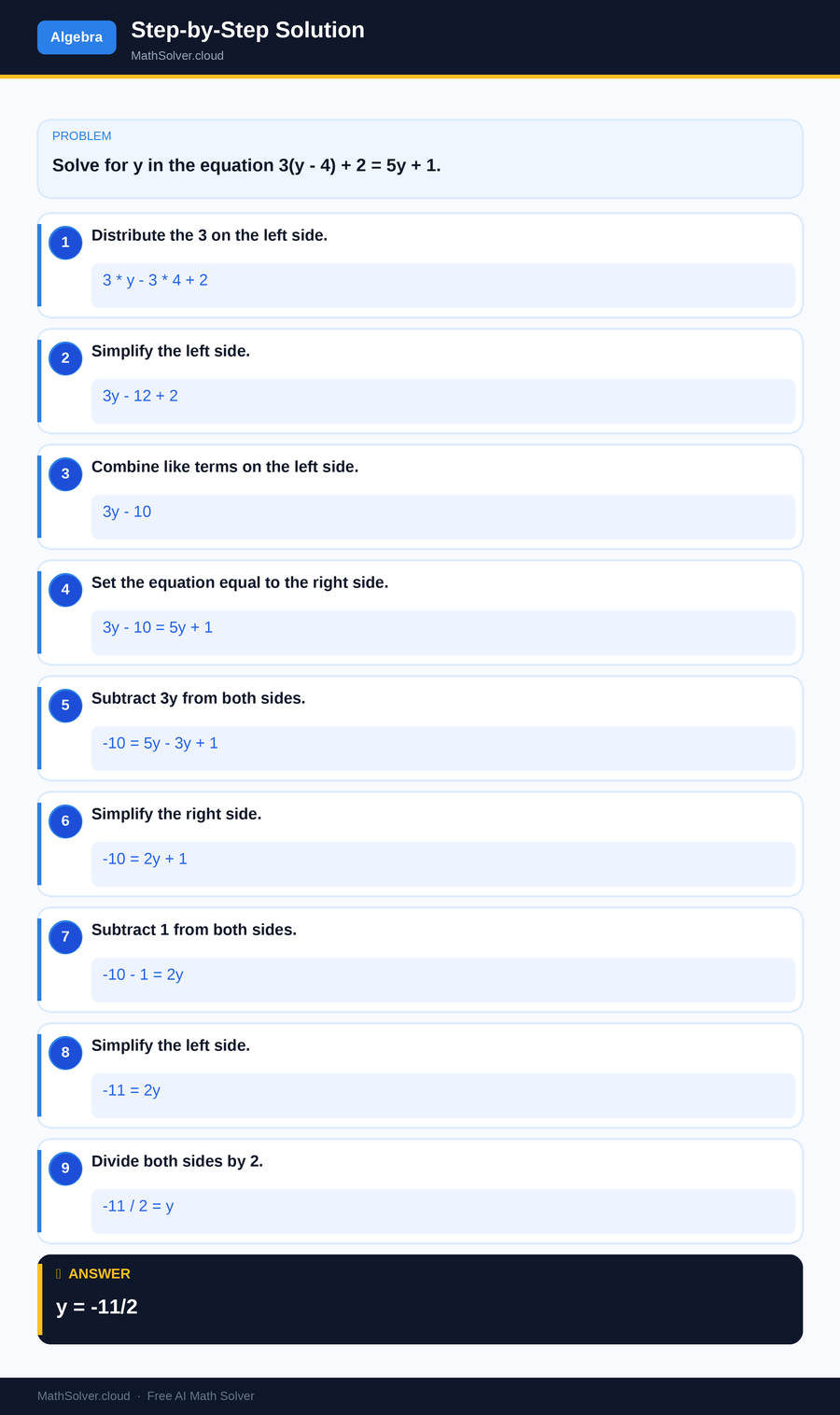
MathSolver Chrome extension solving this problem step-by-step
Common Mistakes to Avoid
One common mistake students make in Algebra 1 is failing to perform the same operation on both sides of an equation. This can lead to incorrect solutions because the equation becomes unbalanced. To avoid this, always ensure that whatever operation you apply to one side, you do the same to the other side. Another frequent error is combining terms incorrectly, particularly when dealing with negative signs. Pay close attention to the signs of numbers and variables when performing operations, as this can significantly impact your results.
Additionally, students often make mistakes when distributing terms or when working with fractions. Misplacing a negative sign or incorrectly simplifying a fraction can lead to errors. To prevent these mistakes, take your time to carefully perform each step and double-check your work. Understanding these common pitfalls and how to avoid them will improve your accuracy and confidence in solving Algebra 1 problems.
Real-World Applications
Algebra 1 is not just an academic requirement; it has numerous real-world applications. For example, understanding linear equations is essential for budgeting and financial planning. When creating a budget, you often use equations to determine how changes in income or expenses affect your overall financial situation. This practical application shows how algebra can help in making informed decisions about personal finances.
Another real-world application of Algebra 1 is in the field of engineering. Engineers use algebraic formulas to design and analyze systems, ensuring they function properly and efficiently. Whether calculating the load a bridge can support or determining the optimal fuel efficiency of a vehicle, algebra is a critical tool in solving complex engineering problems. These examples illustrate the versatility and importance of Algebra 1 in various professional fields.
Frequently Asked Questions
❓ What is Algebra 1?
❓ Why do students struggle with Algebra 1?
❓ How can AI help with Algebra 1?
❓ What are some common topics covered in Algebra 1 regents exams?
❓ How do you sketch the graph of each function in Algebra 1?
🚀 Solve any math problem instantly
2,000+ students use MathSolver every day — join them for free
📥 Add to Chrome — It's Free