Understanding AI Problem Solvers
📋 In this guide
An ai problem solver is a cutting-edge tool that employs artificial intelligence to help solve complex mathematical and scientific problems. These solvers are incredibly beneficial for students who often struggle with understanding and applying mathematical concepts. Whether it's algebra, calculus, or physics, many students find it challenging to navigate these subjects without assistance. This article will guide you through understanding how ai problem solvers work, what key formulas are involved, and how to effectively use these tools to enhance your learning experience.
Students often face difficulties in mathematics and physics due to the abstract nature of the subjects, which require a high level of conceptual understanding and problem-solving skills. An ai problem solver can bridge this gap by providing step-by-step solutions, explanations, and even visual aids, such as graphs or diagrams, to facilitate comprehension. By the end of this article, you'll learn how to utilize ai problem solvers to tackle various mathematical challenges more efficiently and confidently.
Moreover, we'll explore the specific features of different ai problem solvers and how they cater to diverse needs. Whether you're searching for a math ai problem solver, a physics ai problem solver, a free ai problem solver, or an ai problem solver that can interpret pictures, this guide will help you understand the myriad of options available and how to make the most of them in your studies.
Step-by-Step: How to Solve Ai Problem Solver
Step 1: Input the Problem
The first step in using an ai problem solver is to accurately input the problem you wish to solve. This could involve typing out an equation, uploading a picture of the problem, or even using voice commands if the solver supports it. For instance, if you're dealing with a quadratic equation like ax^2 + bx + c = 0, ensure that all coefficients are entered correctly. This step is crucial because any errors in input can lead to incorrect solutions.
Step 2: Choose the Appropriate Solver
Once the problem is inputted, the next step is to select the appropriate solver or algorithm. Some ai problem solvers are specialized, such as a physics ai problem solver for physics-related problems, or a math ai problem solver for mathematical equations. If you're using a solver that offers multiple functions, choose the one that aligns with your problem type. For example, if you're solving a cubic equation, use a cubic equation calculator to get the most accurate results.
Step 3: Review the Solution Process
After selecting the appropriate solver, the ai problem solver will process the input and provide a step-by-step solution. This is where the tool's educational value shines, as it not only gives you the answer but also shows how it was derived. Pay attention to each step, as this will help you understand the methodology and apply it to similar problems in the future. Some solvers even offer visual aids or diagrams to enhance understanding.
Step 4: Verify and Apply the Solution
The final step is to verify the solution provided by the ai problem solver. Cross-check the answer with manual calculations or use another tool like the texas instruments 30xiis scientific/math calculator - orange to ensure accuracy. Once verified, apply the solution to your specific context, whether it’s for homework, an exam, or real-world application. This practice not only solidifies your understanding but also builds confidence in solving similar problems independently.
🤖 Stuck on a math problem?
Take a screenshot and let our AI solve it step-by-step in seconds
⚡ Try MathSolver Free →Worked Examples
Example 1
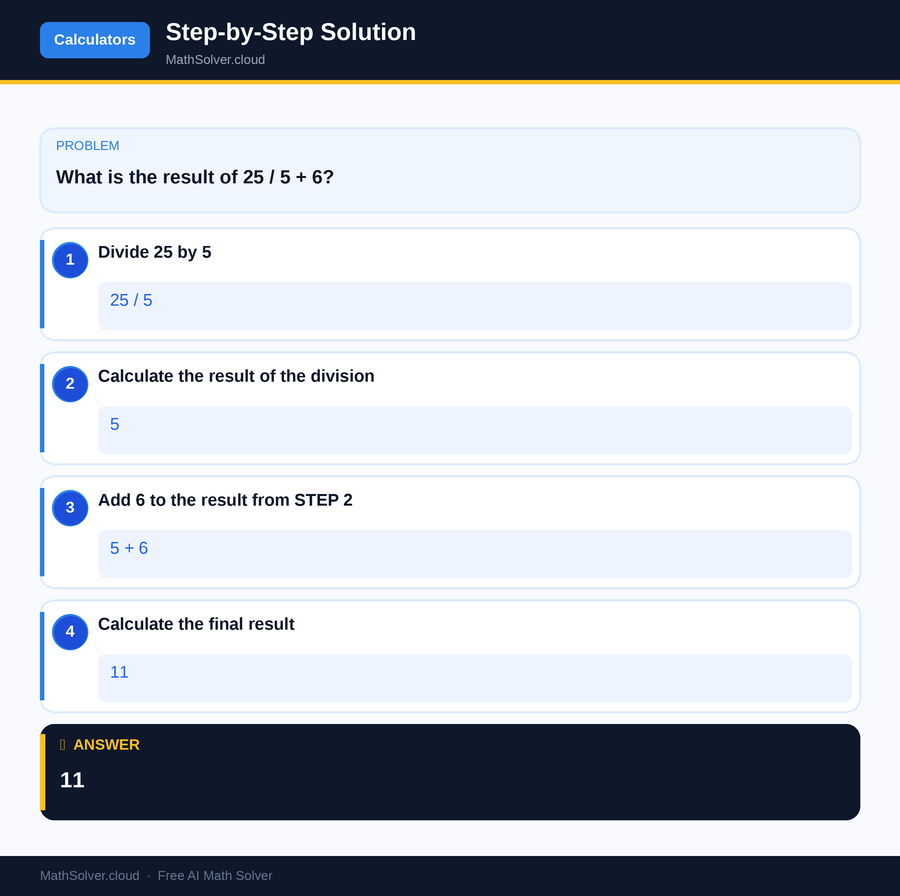
MathSolver Chrome extension solving this problem step-by-step
Example 2
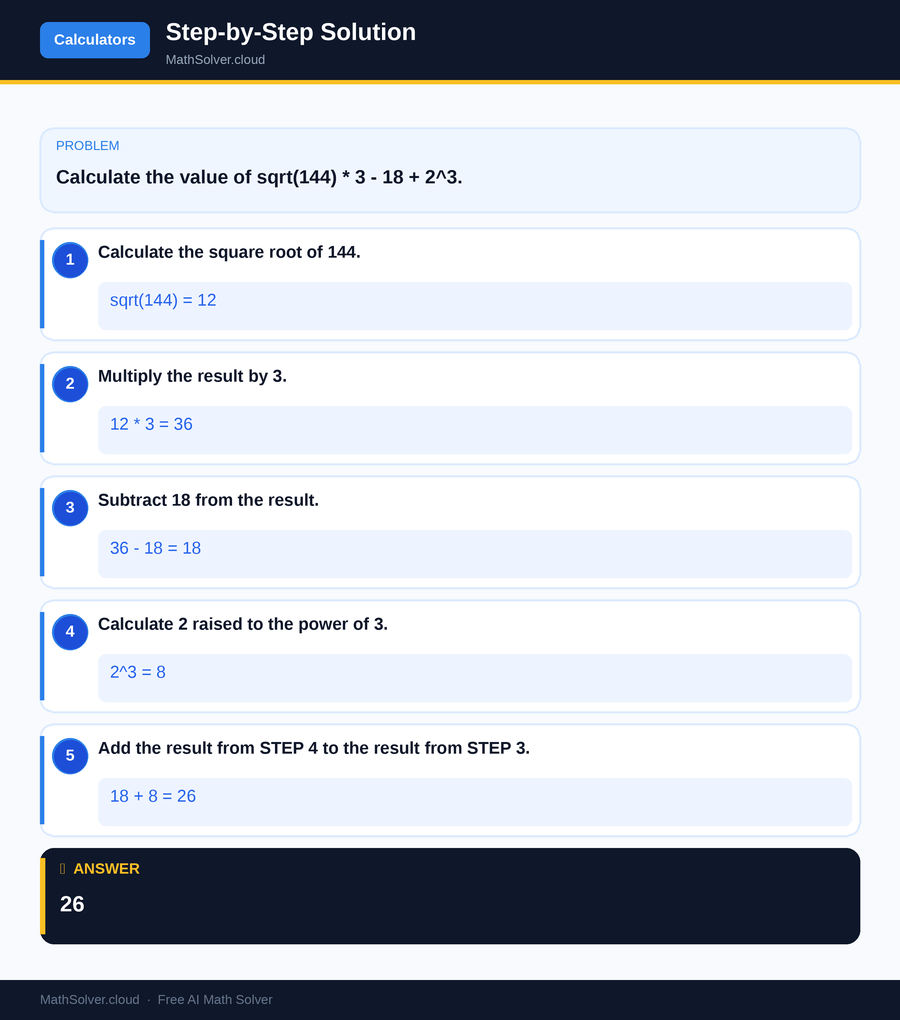
MathSolver Chrome extension solving this problem step-by-step
Common Mistakes to Avoid
One common mistake students make when using an ai problem solver is relying solely on the final answer without understanding the solution process. To avoid this, always review each step of the solution provided by the solver. This will not only help you grasp the concepts better but also prepare you to tackle similar problems independently.
Another frequent error is incorrect input of problem data, which can lead to inaccurate solutions. Double-check your input for any typos or miscalculations before running it through the ai problem solver. This is especially important when dealing with complex equations where every detail matters.
Real-World Applications
Ai problem solvers are widely used in various real-world scenarios, such as in education, engineering, and finance. In education, teachers and students use these solvers to facilitate learning and provide instant feedback on homework and tests. They are especially beneficial in remote learning environments where immediate assistance might not be readily available.
In engineering, ai problem solvers assist in designing and testing models by providing quick calculations and simulations. They are also used in financial sectors for analyzing data and predicting trends, thereby aiding in decision-making processes. Their ability to handle large datasets and provide accurate solutions makes them invaluable tools in these fields.
Frequently Asked Questions
❓ What is an ai problem solver, and how does it work?
❓ Why do students struggle with using ai problem solvers?
❓ How can AI help with ai problem solver?
❓ Can ai problem solvers interpret handwritten problems?
❓ Are there any free ai problem solvers available?
🚀 Solve any math problem instantly
2,000+ students use MathSolver every day — join them for free
📥 Add to Chrome — It's Free