What is the Hardest Math Problem?
📋 In this guide
When discussing what is the hardest math problem, it's important to remember that math problems can range in complexity and difficulty depending on a student's experience and the context of the problem. Students often find themselves struggling with certain math problems due to their intricate nature, abstract concepts, or the level of logic required to solve them. In this article, we will explore what constitutes the hardest math problem, the reasons why these problems are challenging, and offer strategies for tackling them effectively.
Understanding what is the hardest math problem is crucial for students who wish to improve their problem-solving skills. Math problems that are considered difficult often require a deep understanding of multiple mathematical concepts and the ability to apply them in novel ways. These problems can be daunting, but learning how to approach them methodically will not only enhance your math skills but also boost your confidence in tackling other academic challenges.
By examining what is the hardest math problem and learning how to approach it systematically, students can gain valuable insights into the nature of mathematical problem-solving. This article will provide a step-by-step guide, work through detailed examples, and explore real-world applications to help you master even the most challenging math problems. We'll also discuss common mistakes to avoid and answer frequently asked questions, ensuring a comprehensive understanding of this topic.
Step-by-Step: How to Solve What Is The Hardest Math Problem
Step 1: Analyzing the Problem
The first step in solving what is the hardest math problem is to carefully analyze the problem statement. This involves identifying the key elements, such as given information, required outcomes, and any constraints. Understanding these components will help you devise a plan to tackle the problem. It's crucial to take your time in this step, as a thorough analysis can prevent errors and guide you toward the correct solution.
Step 2: Identifying Relevant Concepts
Once you have a clear understanding of the problem, the next step is to identify the relevant mathematical concepts that can be applied. Hard math problems often require the use of advanced techniques from fields such as calculus, algebra, or geometry. By pinpointing which concepts are applicable, you can streamline your approach and focus on the most pertinent techniques to solve the problem efficiently.
Step 3: Developing a Solution Strategy
After identifying the necessary concepts, develop a strategy to solve the problem. This might involve breaking the problem down into smaller, more manageable parts or using a specific formula. A well-thought-out strategy will provide a roadmap for solving the problem and help you stay organized throughout the process. It's important to remain flexible and adjust your strategy as needed if you encounter unexpected challenges.
Step 4: Executing and Verifying the Solution
The final step in solving what is the hardest math problem is to execute your solution strategy and verify the accuracy of your results. Carefully perform any calculations and ensure that each step logically follows from the previous one. Once you have arrived at a solution, double-check your work for any errors or inconsistencies. Verification is key to ensuring that your solution is correct and that you have truly mastered the problem.
🤖 Stuck on a math problem?
Take a screenshot and let our AI solve it step-by-step in seconds
⚡ Try MathSolver Free →Worked Examples
Example 1

MathSolver Chrome extension solving this problem step-by-step
Example 2
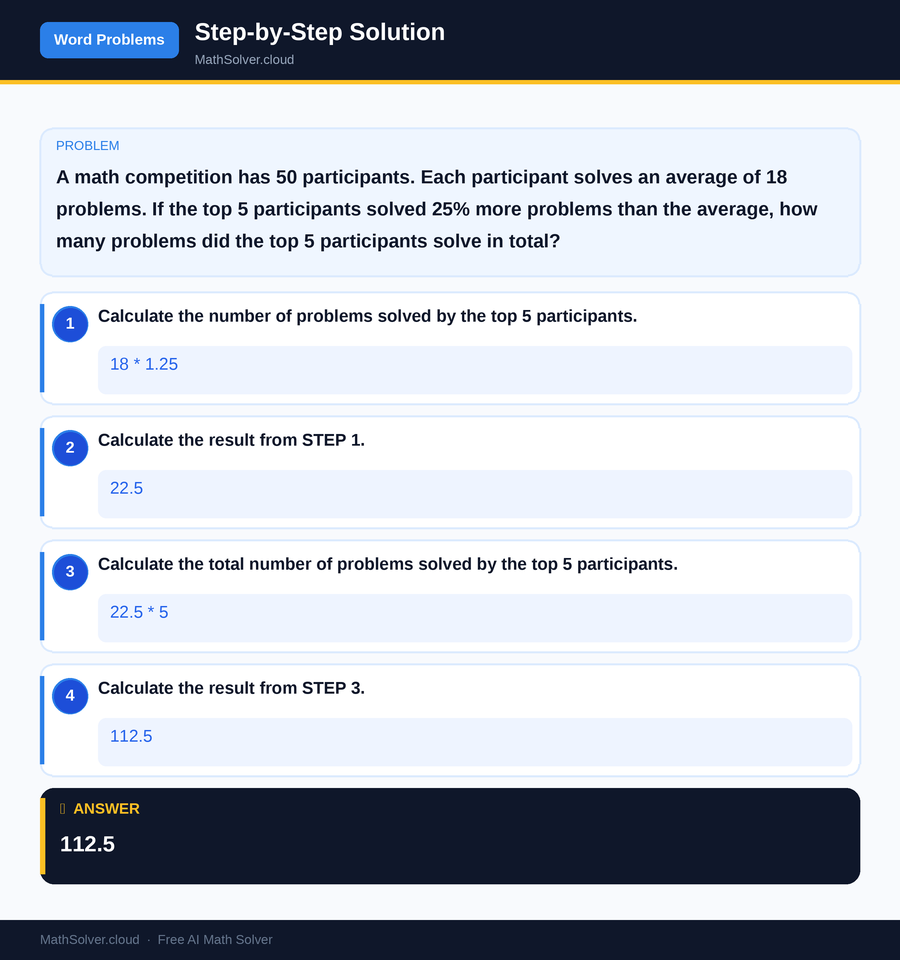
MathSolver Chrome extension solving this problem step-by-step
Common Mistakes to Avoid
One common mistake when tackling the hardest math problems is misinterpreting the problem statement. This can lead to incorrect assumptions and ultimately an incorrect solution. To avoid this, take the time to read and understand the problem thoroughly before beginning your calculations. Highlight or underline key information to ensure that you are focusing on the important details.
Another frequent error is failing to verify your solution. After working through a complex problem, it's tempting to accept the first answer you arrive at. However, verification is crucial to ensure accuracy. Double-check your calculations and logic, and consider whether your solution makes sense in the context of the problem. This step can prevent avoidable mistakes and reinforce your understanding of the problem-solving process.
Real-World Applications
Understanding what is the hardest math problem can have practical applications beyond the classroom. For example, in fields such as engineering, physics, and computer science, complex mathematical problems are often encountered and require sophisticated problem-solving skills. Engineers might use advanced math to design structures that can withstand various forces, while computer scientists may apply complex algorithms to optimize software performance.
In finance, complex math problems are solved to model economic scenarios and predict market trends. By mastering difficult math problems, individuals can enhance their analytical skills and apply them to real-world challenges, making significant contributions to their respective fields.
Frequently Asked Questions
❓ What is the hardest math problem?
❓ Why are some math problems considered harder than others?
❓ How can AI help with what is the hardest math problem?
❓ What strategies can help in solving hard math problems?
❓ Can learning to solve hard math problems benefit other areas of study?
🚀 Solve any math problem instantly
2,000+ students use MathSolver every day — join them for free
📥 Add to Chrome — It's Free