Solve Differential Equation Calculator: A Comprehensive Guide
📋 In this guide
A solve differential equation calculator is an indispensable tool for students tackling the complexities of calculus. Differential equations are mathematical equations that relate a function to its derivatives, and they appear frequently in fields such as physics, engineering, and economics. However, solving these equations by hand can be a daunting task for many students due to the intricate steps and algebraic manipulations involved. In this article, we will explore how a solve differential equation calculator can simplify this process, making it more accessible for learners at all levels.
Students often struggle with differential equations because they require a deep understanding of calculus concepts and techniques. The process of solving these equations typically involves integrating functions, applying initial conditions, and sometimes employing numerical methods. This complexity can be overwhelming, especially if students lack a strong foundation in calculus. By using a solve differential equation calculator, students can focus on understanding the solutions and their applications without getting bogged down in tedious computations.
In this guide, you will learn how to use a solve differential equation calculator effectively and gain insights into the step-by-step approach to solving differential equations. We'll also delve into common mistakes to avoid, real-world applications of these calculators, and answer frequently asked questions. By the end of this article, you'll be well-equipped to tackle differential equations with confidence and ease.
Step-by-Step: How to Solve Solve Differential Equation Calculator
Step 1: Understanding the Problem
Before using a solve differential equation calculator, it's crucial to understand the problem you're dealing with. Determine the order and type of the differential equation. Is it a first-order or higher-order equation? Is it linear or nonlinear? Identifying these aspects will help you choose the right method and tools to solve it. For instance, a first-order linear differential equation usually takes the form dy/dx + P(x)y = Q(x), where P(x) and Q(x) are functions of x.
Step 2: Setting Up the Calculator
Once you comprehend the equation, it's time to set up the solve differential equation calculator. Input the differential equation into the calculator, ensuring that you enter it accurately. Some calculators have fields for initial conditions, which are vital for obtaining a unique solution to the differential equation. For example, if the problem includes an initial condition such as y(0) = 5, make sure to input this information as well.
Step 3: Solving the Equation
After setting up the calculator, let it do its work. The calculator will apply appropriate methods to solve the differential equation, either analytically or numerically. Analytical solutions involve finding an explicit formula for the function y, while numerical solutions provide an approximate value of y at specific points. A solve differential equation calculator with steps will often show the process it uses, which can help you learn and understand the solution.
Step 4: Interpreting the Results
Finally, interpret the results provided by the solve differential equation calculator. Check if the solution satisfies the initial conditions and makes sense within the context of the problem. Understanding the interpretation of the solution is crucial, as it allows you to apply it in real-world scenarios. If the calculator provides graphical representations, use them to visualize the behavior of the solution and gain further insights.
🤖 Stuck on a math problem?
Take a screenshot and let our AI solve it step-by-step in seconds
⚡ Try MathSolver Free →Worked Examples
Example 1
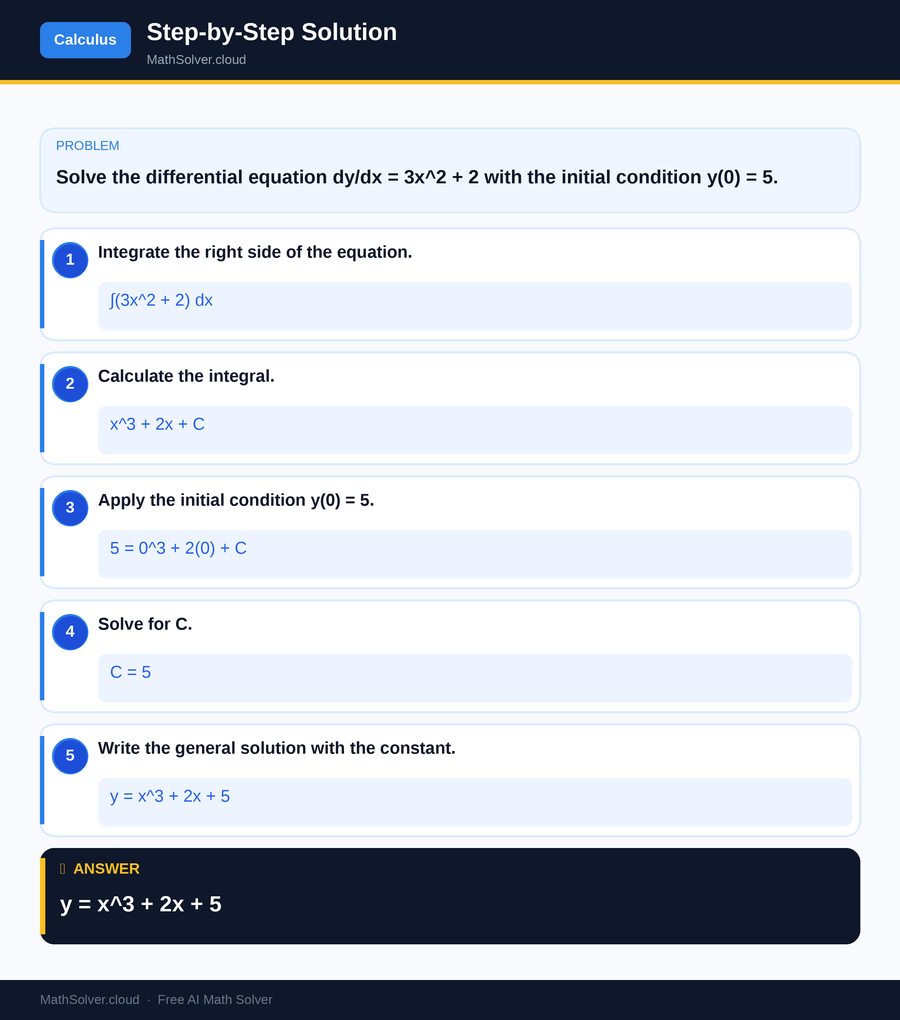
MathSolver Chrome extension solving this problem step-by-step
Example 2
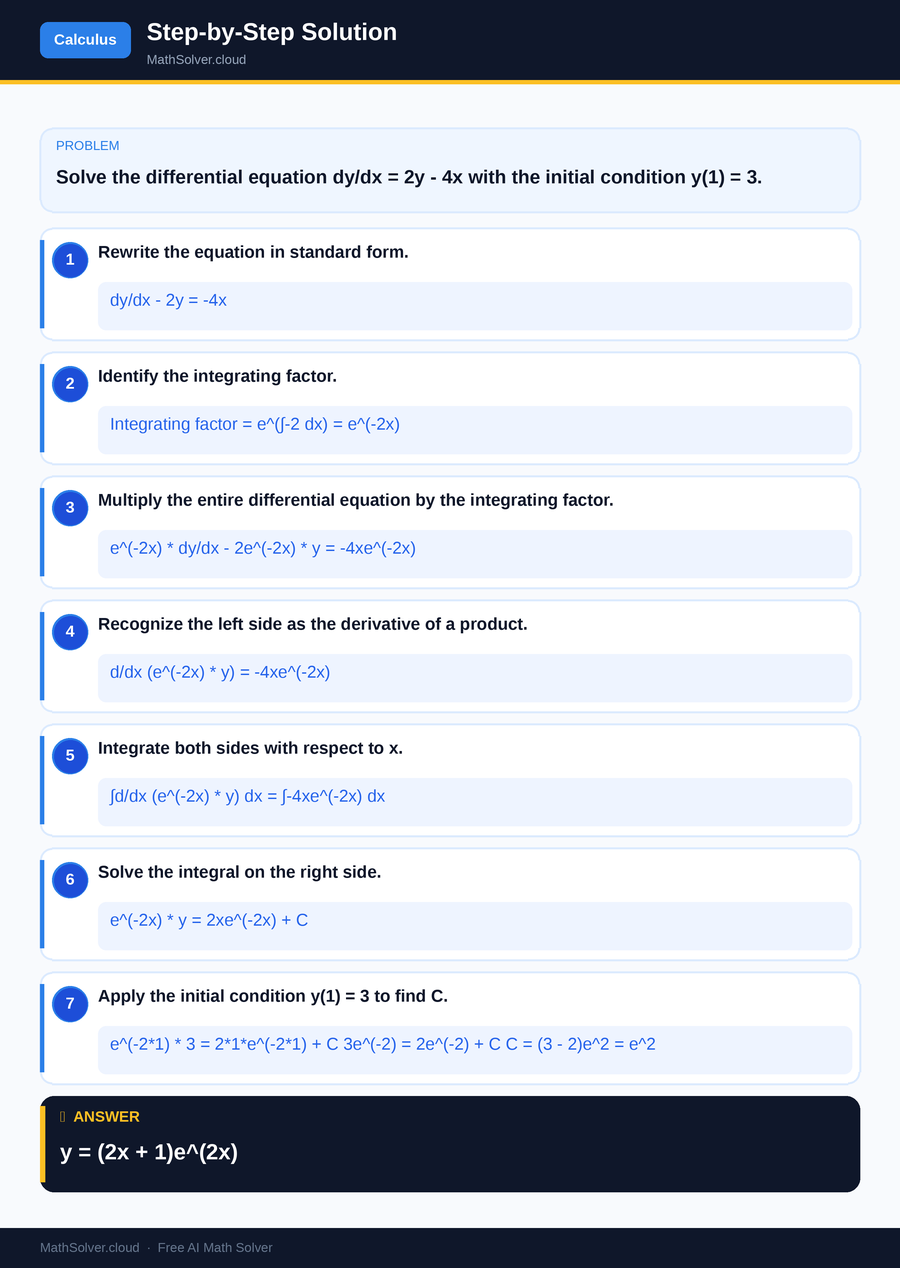
MathSolver Chrome extension solving this problem step-by-step
Common Mistakes to Avoid
One common mistake students make when using a solve differential equation calculator is entering the equation incorrectly. This can lead to erroneous solutions that don't satisfy the original problem. Always double-check your inputs before solving the differential equation.
Another frequent error is misunderstanding the initial conditions or neglecting to include them when required. Initial conditions are crucial for determining the specific solution to a differential equation. Without them, the solution may contain arbitrary constants, leading to ambiguity. When using a calculator, ensure you input all necessary initial conditions to obtain a precise solution.
Real-World Applications
Solve differential equation calculators are widely used in various real-world applications. In engineering, they help model and analyze systems such as electrical circuits, where the behavior of current and voltage can be described by differential equations. These calculators enable engineers to simulate and predict the performance of complex systems efficiently.
In the field of biology, differential equations are used to model population dynamics and the spread of diseases. A solve differential equation calculator can assist researchers in understanding how populations evolve over time or how an infectious disease might spread within a community. These insights are crucial for making informed decisions in public health and conservation efforts.
Frequently Asked Questions
❓ What is a solve differential equation calculator, and how does it work?
❓ Why do students struggle with differential equations, and how can they improve?
❓ How can AI help with solve differential equation calculator tasks?
❓ What types of differential equations can a solve differential equation calculator handle?
❓ How can students use a solve differential equation calculator to check their work?
🚀 Solve any math problem instantly
2,000+ students use MathSolver every day — join them for free
📥 Add to Chrome — It's Free