Understanding Flipped Math Calculus
📋 In this guide
Flipped math calculus is a teaching approach that reverses the traditional learning environment by delivering instructional content outside of the classroom. This method is particularly beneficial for calculus, a subject that many students find challenging due to its abstract concepts and complex problem-solving techniques. Calculus introduces a new way of thinking about change and motion, which can be difficult for students to grasp without proper guidance. In a flipped classroom, students engage with calculus content, such as videos or reading materials, at home and then apply what they have learned through problem-solving and discussions in the classroom.
Students often struggle with flipped math calculus because it requires a higher degree of self-discipline and responsibility for their learning. Unlike traditional classroom settings, students must take the initiative to study the content before attending class. This can be particularly daunting for those who are not used to active learning strategies. However, this approach allows students to learn at their own pace, review materials multiple times, and gain a deeper understanding of calculus concepts.
In this article, we will explore the essential aspects of flipped math calculus, including key formulas and definitions, step-by-step problem-solving techniques, and real-world applications. By the end of this guide, you will have a clearer understanding of how to approach calculus problems using a flipped classroom model, and you will be better equipped to tackle this complex subject with confidence.
Step-by-Step: How to Solve Flipped Math Calculus
Step 1: Understanding the Concept of Derivatives
Before diving into computations, it's crucial to understand what a derivative represents. In flipped math calculus, the derivative is the foundation of differential calculus. It measures the rate at which a function changes at any given point. Think of it as the slope of the tangent line to the curve of the function at a particular point. This understanding is pivotal as it allows you to visualize how functions behave and change, which is essential for solving calculus problems.
Step 2: Learning How to Compute Derivatives
Once you have a conceptual understanding, the next step is computation. Start with basic functions such as polynomials, where the power rule is commonly applied. For a function f(x) = ax^n, the derivative f'(x) is n*ax^(n-1). Practice computing derivatives of simple functions to build confidence. Use resources like videos and online exercises, which are often part of the flipped math calculus approach, to reinforce your learning.
Step 3: Applying Derivatives to Solve Problems
In the classroom, apply what you've learned to solve real problems. This is where the flipped classroom shines, as you can collaborate with peers and get immediate feedback from your instructor. Focus on problems that involve finding the slope of a function at a point, determining concavity, and solving real-life rate of change problems. This hands-on approach solidifies your understanding and prepares you for more complex applications.
Step 4: Exploring Integration and Its Connection to Derivatives
Integration is the reverse process of differentiation and is a critical aspect of calculus. In flipped math calculus, explore how integration relates to area under curves and accumulation functions. Begin with basic integrals and gradually work up to more complex ones. Understanding the fundamental theorem of calculus, which links differentiation and integration, is key. This theorem states that if a function is continuous over an interval, then its integral over that interval can be found using its antiderivative.
🤖 Stuck on a math problem?
Take a screenshot and let our AI solve it step-by-step in seconds
⚡ Try MathSolver Free →Worked Examples
Example 1
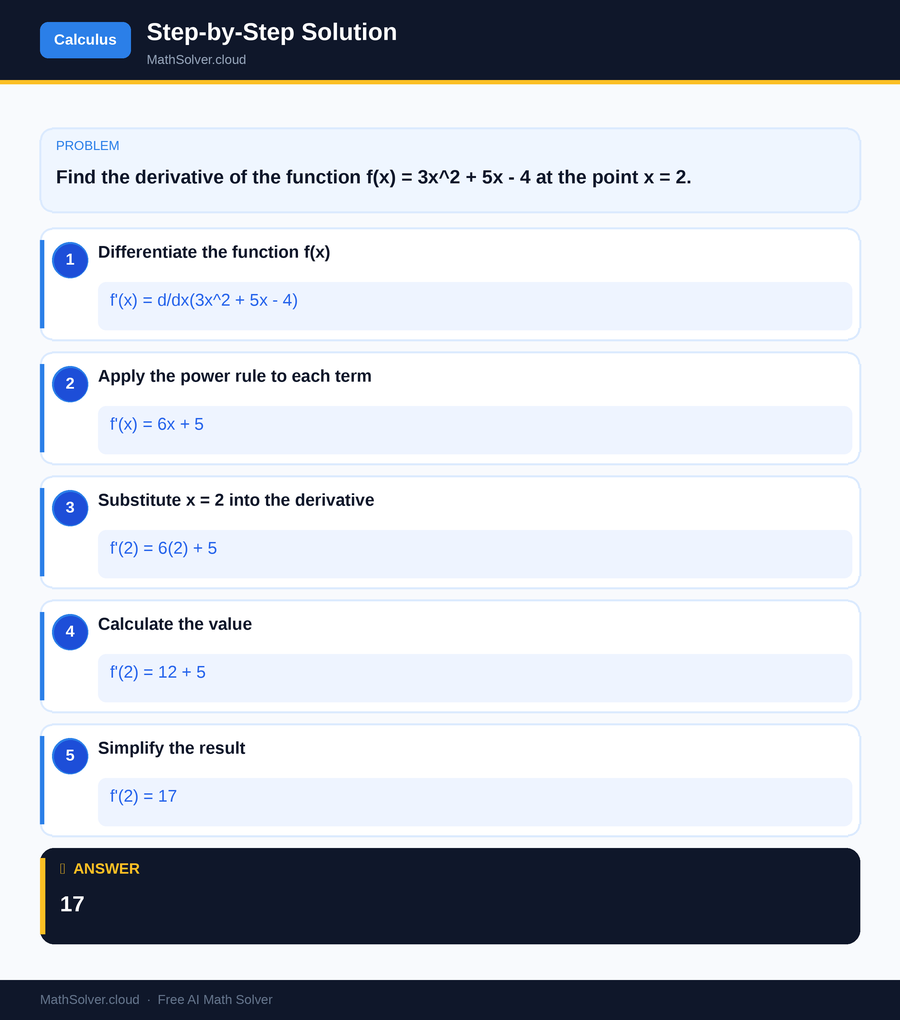
MathSolver Chrome extension solving this problem step-by-step
Example 2
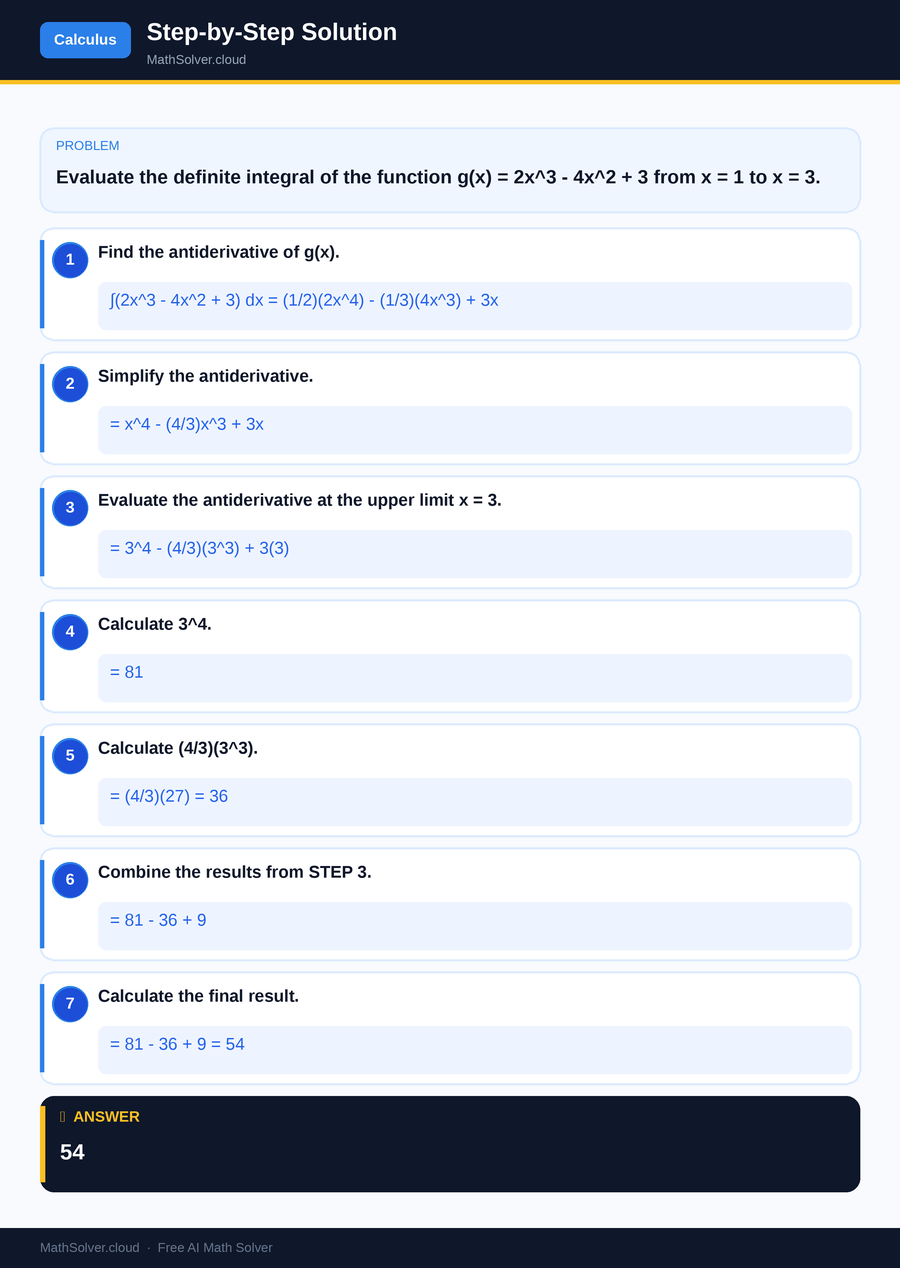
MathSolver Chrome extension solving this problem step-by-step
Common Mistakes to Avoid
One of the most common mistakes in flipped math calculus is neglecting to fully understand the underlying theory before jumping into problem-solving. Students often focus too much on memorizing formulas without grasping the "why" behind them. To avoid this, take the time to understand the concepts thoroughly. Use the resources provided in a flipped classroom, such as videos and interactive discussions, to build a strong conceptual foundation.
Another frequent error is misapplying formulas, especially when dealing with derivatives and integrals. For instance, students might incorrectly apply the power rule or make arithmetic mistakes during calculations. Always double-check your work and practice with a variety of problems to develop accuracy and confidence. Utilize tools such as a differential equation calculator for additional practice and verification.
Real-World Applications
Flipped math calculus is not just an academic exercise; it has numerous real-world applications. For example, in physics, calculus is used to model motion and change, such as calculating velocity and acceleration. Engineers use calculus to design and analyze systems and structures, ensuring safety and efficiency. By understanding the principles of calculus, you can solve practical problems and contribute to technological advancements.
In the field of economics, calculus is used to optimize functions for maximum profit or minimum cost. Businesses apply calculus to forecast trends, manage resources, and make informed decisions. The flipped classroom approach enables you to apply calculus concepts to these real-world scenarios, enhancing your problem-solving skills and preparing you for future careers.
Frequently Asked Questions
❓ What is flipped math calculus, and how does it differ from traditional learning?
❓ Why do students struggle with flipped math calculus?
❓ How can AI help with flipped math calculus?
❓ What resources are available for students learning flipped math calculus?
❓ How can I effectively study for a flipped math calculus course?
🚀 Solve any math problem instantly
2,000+ students use MathSolver every day — join them for free
📥 Add to Chrome — It's Free